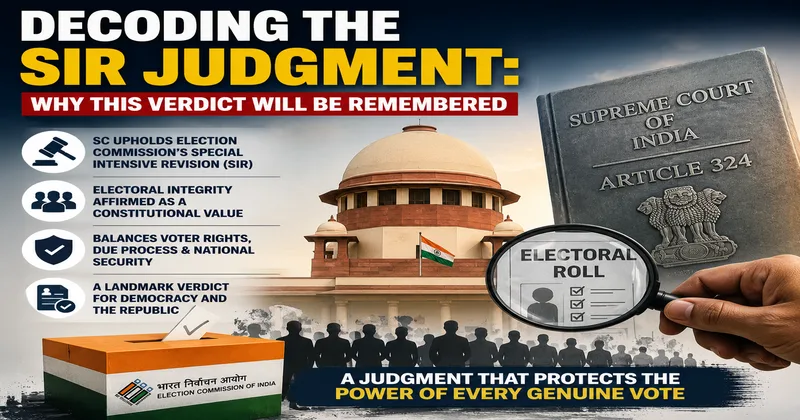
The Supreme Court of India does not often deliver a judgment that vindicates a constitutional institution and rescues a national project at the same time. On May 27, 2026, in Association for Democratic Reforms v. Election Commission of India, it did precisely that. Chief Justice Surya Kant, writing for the Bench that included Justice Joymalya Bagchi, upheld the Special Intensive Revision (SIR) of electoral rolls ordered by the Election Commission on 24 June 2025. The Court has handed the Republic something rare: a clear, principled, and necessary affirmation that the integrity of the electoral roll is not a partisan slogan but a constitutional value.
The figures themselves are the story. Before the SIR began, Bihar’s electoral roll carried 7.89 crore names. After house-to-house enumeration, scrutiny under the Commission’s Guidelines, and the supervision of the Court itself, the final roll published on 30 September 2025 contained 7.42 crore electors. Of the 65 lakh initially excluded from the draft roll, the Commission later added back 21.53 lakh eligible voters; only 3.66 lakh further deletions followed. The Court’s interventions during the proceedings — the inclusion of the Aadhaar Card as the twelfth document of identity, the publication of excluded names in print and electronic media, the deployment of legal services authorities and para-legal volunteers — ensured that no genuine elector was left to fend alone.
The petitioners, led by Kapil Sibal and Dr Abhishek Manu Singhvi, raised three principal objections. First, that Article 324 of the Constitution could not be invoked where Parliament had legislated through the Representation of the People Act, 1950. Second, that Section 21(3) of that Act, by referring to “any constituency or part of a constituency”, did not permit a statewide exercise. Third, that the Commission, in scrutinising eligibility, was carrying out a determination of citizenship reserved to the Ministry of Home Affairs.
The Court has answered each with care. On the first, it has done the legal community a great service by setting Mohinder Singh Gill (1978) and A.C. Jose (1984) back in their proper place. Justice Krishna Iyer never held that the Commission falls silent the moment Parliament legislates. He held that it must act in conformity with the statute, not against it. Where Parliament is silent, or, as in Section 21(3), has expressly conferred discretion, the Commission’s constitutional function survives. To read Article 324 as exhausted by every parliamentary enactment under Article 327 would reduce the Commission to a postman. That was never the design of the Constitution-makers, and the Court has said so with finality.
On the second objection, the Court has chosen common sense over textual hair-splitting. To require the Commission to issue a separate Section 21(3) notification for each of Bihar’s 243 Assembly constituencies, when the reasons (twenty-two years of accumulated error, migration, urbanisation, duplication of entries) are statewide, would elevate form over substance and protect no one. The word “any”, the Court holds, may embrace “many” or “all” where the circumstances warrant. That is a clean and workable reading, drawn from the ordinary meaning of the language Parliament used.
The proportionality analysis is where the judgment shows its real maturity. The four-step test of legitimate purpose, rational nexus, necessity, and balance has been applied with rigour, not as a recitation. The object of restoring accuracy after two decades of mere summary revisions is legitimate. The means (house-to-house enumeration, structured forms, documentary verification) are rationally connected to that object. Less restrictive alternatives, urged in the abstract but never specified, were not in fact available. And the procedural safeguards built into the SIR Guidelines — suo motu enquiry, show-cause notice, reasoned orders, two-tier appeal under Section 24, and the supervisory directions of the Court itself — keep the balance from tilting against the elector.
On the presumption of validity attaching to enrolled electors, the Court has placed Lal Babu Hussein (1995) firmly in its proper setting. That decision dealt with adjudicatory proceedings against individual electors. It cannot be read as a constitutional bar on systemic revision. The presumption under Section 114 of the Indian Evidence Act, 1872 (now Section 119 of the Bharatiya Sakshya Adhiniyam, 2023) is a rebuttable presumption, not a rule that freezes the roll for all time. A constitutional system in which an entry once made can never be revisited is not protecting the franchise; it is calcifying it.
On citizenship, the Court has drawn the finest line of the entire judgment. The Commission may, in preparing the roll, examine the question of citizenship, but only because Section 16 of the RP Act makes citizenship a precondition of enrolment, and only for the limited purpose of inclusion or exclusion. Such an enquiry is not a determination under the Citizenship Act, 1955, and cannot strip a person of that status. Where the Commission is unsatisfied, it must refer the case to the Competent Authority, which must decide before the next election in that constituency. The deletion is electoral; the substantive question of citizenship stays with the executive authority Parliament has designated. That is a balance struck with a careful hand.
What the judgment achieves on the ground is perhaps the most important part of the story. For decades, India has carried electoral rolls that no honest official would call accurate. Names of the dead remained on the lists. Migrants were counted twice. Worse, in States bordering Bangladesh, and most acutely in West Bengal, illegal immigrants settled over years and supplied with forged documents were enrolled as voters in numbers no Census could explain. The 2003 intensive revision in Bihar was the last serious effort to clean the rolls in that State. After twenty-two years of summary revisions, the rot was not incidental; it was structural.
The post-SIR record speaks for itself. As the exercise spread from Bihar to West Bengal, Border Security Force data confirmed what every honest observer in the border districts had long known. Thousands of illegal Bangladeshi nationals — many of whom had lived in India for over a decade, voted in elections, and drawn benefits from public welfare schemes — began returning across the border on their own. At the Hakimpur checkpost in North 24 Parganas alone, the BSF documented the return of approximately 1,600 such persons by November 2025. Holding centres were set up in several districts. The new West Bengal Government, under Chief Minister Suvendu Adhikari, announced on 20 May 2026 a coordinated “Detect, Delete, Deport” framework, working in step with the BSF and the Border Guards Bangladesh. The political theatre will continue; the mechanism on the ground is now functioning.
This is what the SIR has accomplished. Without firing a shot, without a single midnight knock, the simple discipline of an accurate electoral roll has caused those who never had a right to be on it to leave of their own accord. There is no more peaceful, no more lawful, and no more constitutional method of restoring the integrity of the franchise than this.
Hence the wider significance of the Court’s verdict. Had the petitioners prevailed, the Commission would have been disarmed at the exact moment the country has begun, after long years of drift, to take its electoral rolls seriously. The judgment has prevented that outcome. It has reminded the political class that the right to vote belongs to citizens, and only to citizens, and that the Constitution does not protect the inclusion of those who have no business being on the roll.
Chief Justice Surya Kant and Justice Joymalya Bagchi have written a judgment that will be cited for years. It is patient where patience was needed, firm where firmness was needed, and unfailingly grounded in constitutional first principles. It honours the work of the Commission without flattering it. It protects the elector without weakening the State. It draws lines where lines were needed, and refuses to draw lines where none belonged. For a Court that has occasionally been criticised for excessive caution in matters of national consequence, this judgment is a quiet triumph.
The SIR will be remembered as a blessing to the Republic, a measure that, almost alone among recent administrative reforms, has done exactly what its authors hoped it would do. The Supreme Court’s verdict has now given that blessing its constitutional sanction. That is no small thing.