The ongoing conflict in West Asia and the disruption around the Strait of Hormuz have exposed one of the biggest strategic vulnerabilities in the global energy system that dependence on a single maritime chokepoint. Nearly 20 per cent of the world’s oil trade passes through Hormuz, and for Asian countries the dependence is even deeper. Almost two-thirds of India’s LNG imports and nearly 85–90 per cent of LPG imports move through the narrow waterway.
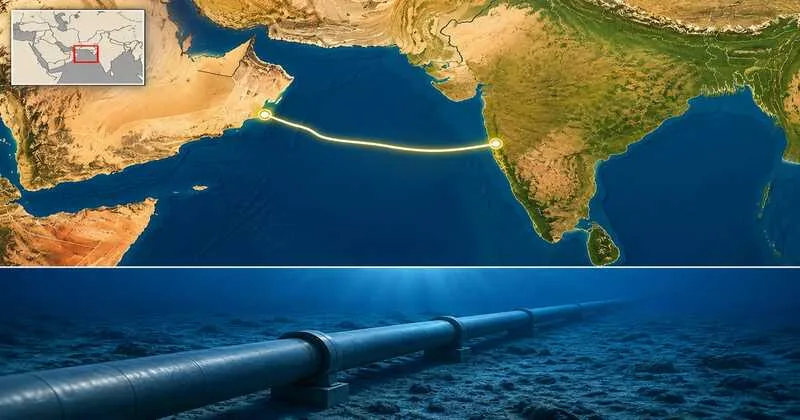
Now, as the Hormuz crisis intensifies and shipping disruptions worsen, Bharat is reviving one of its most ambitious energy infrastructure projects ever proposed, the Rs 40,000 crore ($4.7–4.8 billion) Oman–India deep-sea gas pipeline. The proposed Middle East–India Deep-Water Pipeline (MEIDP) will directly connect Oman to Gujarat through a nearly 2,000-km undersea pipeline beneath the Arabian Sea. The project is designed to bypass the Strait of Hormuz completely, allowing uninterrupted gas supplies even during wars, blockades, sanctions, or maritime disruptions. The Indian Ministry of Petroleum and Natural Gas has now directed state-run giants, GAIL, Indian Oil Corporation and Engineers India Limited, to prepare a detailed feasibility assessment for the mega project. The government is relying on a pre-feasibility study submitted by South Asia Gas Enterprise (SAGE), a New Delhi-based private consortium that originally conceptualised the pipeline.
Hormuz crisis triggered India’s strategic shift
India’s renewed urgency comes directly from the ongoing turmoil in West Asia. The effective closure and disruption around the Strait of Hormuz have left India-bound fuel tankers stranded, severely affecting supply chains and pushing energy costs sharply upward.
Indian oil marketing companies reportedly suffered nearly Rs 62,500 crore in under-recoveries within just one-and-a-half months due to shipping disruptions and soaring LNG prices. Projections indicate this deficit could spiral toward Rs 1.98 lakh crore during the first quarter of 2026 if instability continues.
For India, the threat is not theoretical. The country imports most of its crude oil and increasingly depends on imported natural gas. Unlike oil, India does not maintain large strategic gas reserves, making any disruption in LNG supply immediately dangerous for power generation, industries, fertiliser production, city gas distribution and transport sectors.
This is precisely why policymakers are now accelerating alternatives to Hormuz. Officials believe that a fixed subsea pipeline can permanently reduce India’s dependence on volatile LNG tanker markets and politically vulnerable maritime chokepoints. Instead of relying on spot cargoes moving through conflict zones, India would receive direct and continuous gas supplies through an underwater energy corridor connected to the Gulf.
A 2,000-km undersea energy corridor to Gujarat
The proposed pipeline will originate in Oman and land on the Gujarat coast after travelling beneath the Arabian Sea. It is expected to carry around 31 million metric standard cubic metres per day (mmscmd) of natural gas directly into India. What makes the project extraordinary is its engineering scale.
The pipeline is expected to be laid at a depth of nearly 3,450 metres below sea level, making it one of the deepest undersea gas pipelines in the world. According to SAGE, around 3,000 metres of test pipeline has already been laid previously to study seabed conditions and technical feasibility. Recent advances in deep-sea pipe-laying, underwater repair systems and offshore engineering technologies have significantly strengthened the technical viability of the project. Analysts believe Indian infrastructure firms with strong offshore capabilities, particularly Larsen & Toubro, could emerge as major engineering, procurement and construction beneficiaries if the project receives approval.
Officials estimate the project may take between five and seven years to complete once cleared by the government. But the strategic value goes far beyond Oman alone. The pipeline is envisioned as a gateway into the broader Gulf energy network, giving India direct access to gas reserves from Oman, the UAE, Saudi Arabia, Qatar, Iran and even Turkmenistan. Together, these regions hold nearly 2,500 trillion cubic feet of natural gas reserves. For Bharat, this transforms the project from a bilateral pipeline into a long-term geopolitical energy corridor.
Why India wants gas pipeline instead of LNG tankers
India’s natural gas demand is rising rapidly as New Delhi pushes to increase gas in the country’s energy mix to 15 per cent by 2030. Current domestic consumption stands at roughly 190–195 mmscmd. By 2030, demand is projected to rise to nearly 290–300 mmscmd. LNG imports alone may touch 180–200 mmscmd before the decade ends.
Meeting that demand entirely through imported LNG cargoes would expose India to repeated price shocks, freight disruptions and geopolitical crises.
The Hormuz conflict already demonstrated this vulnerability. The disruption in the Gulf reportedly affected more than 20 per cent of global LNG supplies and triggered a sharp rise in international gas prices. A direct pipeline changes the equation completely.
Pipeline gas is generally more stable and cost-effective than spot LNG imports. Officials believe the Oman–India corridor could reduce fuel import delivery costs by nearly 20 per cent by eliminating tanker transportation risks, insurance spikes, maritime disruptions and floating LNG handling costs.
More importantly, pipeline gas guarantees continuity. Even during wars, sanctions, naval blockades or shipping crises, India would continue receiving uninterrupted energy supplies through a dedicated underwater system that bypasses sensitive maritime routes entirely. The proposed route through Oman and the UAE is specifically being designed to avoid geopolitically volatile zones and major maritime chokepoints.
Bharat’s long-term energy security vision
The revival of the Oman–India deep-sea pipeline reflects a larger strategic shift in India’s energy thinking. For decades, India’s energy security depended heavily on sea lanes vulnerable to geopolitical instability. The Hormuz crisis exposed how quickly a regional conflict can destabilise fuel prices, shipping logistics and national energy planning.
Now New Delhi is trying to build structural resilience into its energy architecture. The subsea pipeline is not merely an infrastructure project. It is part of Bharat’s attempt to create a secure, direct and long-term energy corridor independent of fragile maritime routes.
The project also strengthens India’s strategic presence in the Gulf while deepening long-term energy partnerships with key West Asian producers.
At a time when global supply chains are increasingly weaponised through sanctions, shipping disruptions, tariffs and regional conflicts, India is attempting to reduce exposure to external shocks by physically securing supply lines. The Hormuz crisis has effectively accelerated what was once considered an ambitious future project into a strategic necessity. If completed, the Oman–India deep-sea pipeline could fundamentally reshape India’s energy security model, replacing vulnerable tanker dependence with a permanent underwater energy bridge between Bharat and the Gulf.