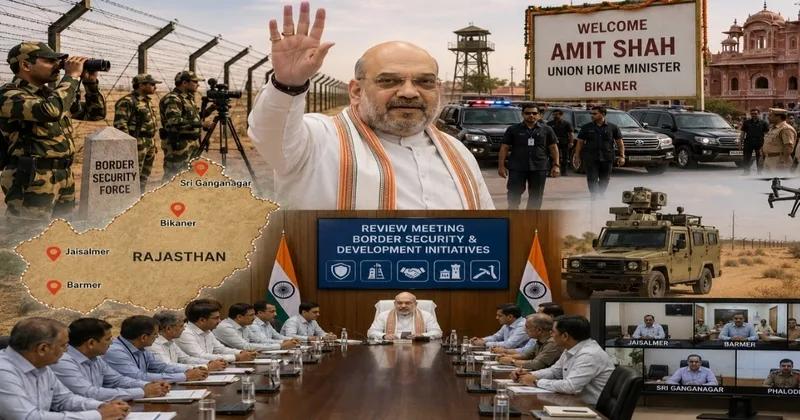
Bikaner: Union Home Minister Amit Shah chaired a high-level security review meeting in Bikaner to assess the security situation in Rajasthan’s border districts along the Indo–Pakistan border. The meeting was attended by Bhajan Lal Sharma, senior state officials, intelligence representatives, Border Security Force officers, and District Magistrates and Superintendents of Police from the five border districts of Bikaner, Jaisalmer, Barmer, Sri Ganganagar and Hanumangarh.
Yesterday, Union Home Minister Amit Shah chaired a high-level security review meeting in Bikaner to assess security issues in Rajasthan’s border districts along the Indo–Pakistan Border. The meeting was attended by the Chief Minister of Rajasthan, senior state officials, and the… pic.twitter.com/MvZyzGsFV9
— Megh Updates 🚨™ (@MeghUpdates) May 27, 2026
The discussions focused on strengthening border governance, improving coordination among agencies, curbing infiltration and smuggling activities, and enhancing security infrastructure in sensitive border regions.
Zero-Tolerance Policy Against Illegal Constructions
One of the key decisions taken during the meeting was the strict implementation of a zero-tolerance policy against illegal constructions near the international border. Amit Shah directed authorities to identify and demolish unauthorised structures that have emerged over the years, particularly within the 0–15 km border belt.
Officials believe that illegal constructions in sensitive areas can potentially be used for smuggling, illegal sheltering, storage of contraband, or logistical support to anti-national activities. District administrations were instructed to take immediate and strict action against such encroachments.
Push for a 360-Degree Border Security Framework
The Home Minister stressed the need for creating a comprehensive “360-degree security framework” for every border district. The proposed model seeks to integrate citizens, village administrations, district officials, police forces, intelligence agencies, and central security organisations into a unified security structure.
According to officials, the objective is to ensure that border security extends beyond physical fencing and patrolling and also covers financial surveillance, cyber vigilance, social awareness, anti-drug operations, and infrastructure development.
Coordinated Action Against Smuggling and Infiltration
A major focus of the meeting was the increasing threat posed by cross-border narcotics trafficking and organised smuggling networks operating along the Indo–Pakistan border. Amit Shah directed border districts to conduct detailed studies into the operational patterns, local networks, financial channels, and support systems behind drug trafficking and smuggling activities. Authorities were instructed to develop long-term solutions to permanently dismantle such criminal ecosystems instead of relying only on periodic crackdowns.
The Home Minister also emphasised coordinated border management involving the Border Security Force, Central Board of Direct Taxes, Narcotics Control Bureau, intelligence agencies, and Rajasthan Police to combat infiltration, narcotics smuggling, terror financing, encroachments, and other trans-border crimes.
The Ministry of Home Affairs assigned enhanced responsibilities to District Magistrates in border districts to strengthen monitoring of financial and commercial activities in sensitive regions.
Officials were instructed to ensure strict legal and financial compliance by banks and business establishments operating in border areas. District administrations have been tasked with tracking mule bank accounts, identifying shell companies, examining suspicious funding sources, and monitoring large financial transactions that may be linked to illegal activities. The meeting also stressed the need to identify fake Aadhaar cards and fraudulent identity documents that could be used by infiltrators and criminal networks.
Focus on Anti-Drone Measures and Surveillance Systems
The security review also focused heavily on the growing use of drones for cross-border smuggling of narcotics, weapons, explosives, and counterfeit currency.
Officials discussed strengthening anti-drone systems, expanding surveillance infrastructure, improving laser fencing technology, and enhancing real-time monitoring systems in vulnerable sectors along the Pakistan border. Authorities are also working on faster intelligence-sharing mechanisms between central agencies and the Rajasthan Police.
During his Rajasthan visit, Amit Shah travelled to the Sanchu Border Outpost, where he interacted with BSF personnel during a “Sainik Sammelan.” He reviewed operational preparedness and assessed the working conditions faced by security personnel deployed in desert border areas. The Home Minister also participated in a plantation drive and virtually inaugurated newly constructed women’s barracks aimed at improving facilities for female BSF personnel stationed in frontier regions.
The meeting highlighted the importance of effectively implementing the Vibrant Villages Programme (VVP)-II in border regions. The programme focuses on strengthening governance, improving infrastructure, filling development gaps, and supporting populations living in remote border villages. Shah directed officials to ensure 100 per cent saturation of government welfare schemes in border villages so that residents receive full access to public benefits and services.
Officials believe economically stronger and better-connected border communities can play an important role in maintaining security and preventing illegal activities. The Home Minister also stressed the importance of effectively using the national cybercrime helpline ‘1930’ to tackle online financial fraud and cyber-related crimes.
In addition, officials were instructed to ensure proper implementation of India’s three new criminal laws across border districts through better administrative coordination and training of local authorities.