Oman–India Gas Pipeline: India to avoid Hormuz disruptions
October 10, 2026
  • Read Ecopy
  • Circulation
  • Advertise
  • Careers
  • About Us
  • Contact Us
Android AppiPhone AppArattai
Organiser
  • ‌
  • Bharat
    • Assam
    • Bihar
    • Chhattisgarh
    • Jharkhand
    • Maharashtra
    • View All States
  • World
    • Asia
    • Europe
    • North America
    • South America
    • Africa
    • Australia
  • Editorial
  • International
  • Opinion
  • RSS @ 100
  • More
    • World Hindu Congress 2026
    • Op Sindoor
    • Analysis
    • Sports
    • Defence
    • Politics
    • Business
    • Economy
    • Culture
    • Special Report
    • Sci & Tech
    • Entertainment
    • G20
    • Azadi Ka Amrit Mahotsav
    • Vocal4Local
    • Web Stories
    • Education
    • Employment
    • Books
    • Interviews
    • Travel
    • Law
    • Health
    • Obituary
  • Subscribe
    • Subscribe Print Edition
    • Subscribe Ecopy
    • Read Ecopy
  • ‌
  • Bharat
    • Assam
    • Bihar
    • Chhattisgarh
    • Jharkhand
    • Maharashtra
    • View All States
  • World
    • Asia
    • Europe
    • North America
    • South America
    • Africa
    • Australia
  • Editorial
  • International
  • Opinion
  • RSS @ 100
  • More
    • World Hindu Congress 2026
    • Op Sindoor
    • Analysis
    • Sports
    • Defence
    • Politics
    • Business
    • Economy
    • Culture
    • Special Report
    • Sci & Tech
    • Entertainment
    • G20
    • Azadi Ka Amrit Mahotsav
    • Vocal4Local
    • Web Stories
    • Education
    • Employment
    • Books
    • Interviews
    • Travel
    • Law
    • Health
    • Obituary
  • Subscribe
    • Subscribe Print Edition
    • Subscribe Ecopy
    • Read Ecopy
Organiser
  • Home
  • Bharat
  • World
  • Operation Sindoor
  • Editorial
  • Analysis
  • Opinion
  • Culture
  • Defence
  • International Edition
  • RSS @ 100
  • Magazine
  • Read Ecopy
Home Bharat

Explained: How India plans to bypass Hormuz with a Rs 40,000 crore Oman–India Gas Pipeline

As the Strait of Hormuz crisis disrupts global energy flows, Bharat is reviving the Rs 40,000 crore Oman–India deep-sea gas pipeline to secure direct and uninterrupted fuel supplies from the Gulf

Dr Vishnu AravindDr Vishnu Aravind
May 27, 2026, 06:00 pm IST
inBharat, World, Asia, International Edition
Follow on Google News
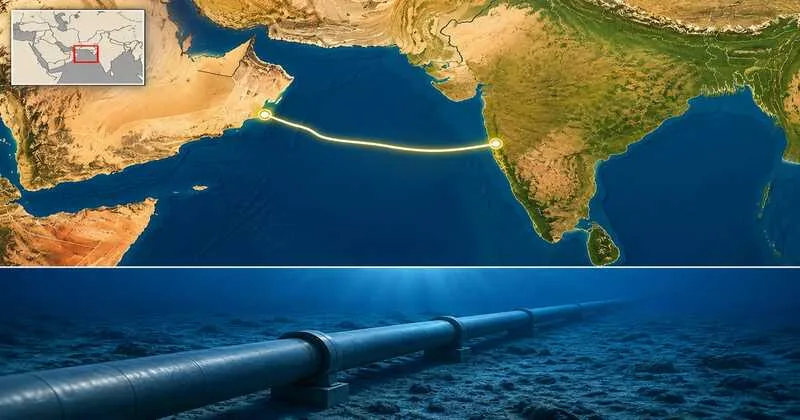
From Hormuz vulnerability to a direct Gulf energy corridor, Bharat is pushing one of the world’s deepest undersea pipeline projects to secure uninterrupted gas supplies for decades

From Hormuz vulnerability to a direct Gulf energy corridor, Bharat is pushing one of the world’s deepest undersea pipeline projects to secure uninterrupted gas supplies for decades

Facebook
Twitter
WhatsAppTelegramEmail

The ongoing conflict in West Asia and the disruption around the Strait of Hormuz have exposed one of the biggest strategic vulnerabilities in the global energy system that dependence on a single maritime chokepoint. Nearly 20 per cent of the world’s oil trade passes through Hormuz, and for Asian countries the dependence is even deeper. Almost two-thirds of India’s LNG imports and nearly 85–90 per cent of LPG imports move through the narrow waterway.

Now, as the Hormuz crisis intensifies and shipping disruptions worsen, Bharat is reviving one of its most ambitious energy infrastructure projects ever proposed, the Rs 40,000 crore ($4.7–4.8 billion) Oman–India deep-sea gas pipeline. The proposed Middle East–India Deep-Water Pipeline (MEIDP) will directly connect Oman to Gujarat through a nearly 2,000-km undersea pipeline beneath the Arabian Sea. The project is designed to bypass the Strait of Hormuz completely, allowing uninterrupted gas supplies even during wars, blockades, sanctions, or maritime disruptions. The Indian Ministry of Petroleum and Natural Gas has now directed state-run giants, GAIL, Indian Oil Corporation and Engineers India Limited, to prepare a detailed feasibility assessment for the mega project. The government is relying on a pre-feasibility study submitted by South Asia Gas Enterprise (SAGE), a New Delhi-based private consortium that originally conceptualised the pipeline.

Hormuz crisis triggered India’s strategic shift

India’s renewed urgency comes directly from the ongoing turmoil in West Asia. The effective closure and disruption around the Strait of Hormuz have left India-bound fuel tankers stranded, severely affecting supply chains and pushing energy costs sharply upward.

Indian oil marketing companies reportedly suffered nearly Rs 62,500 crore in under-recoveries within just one-and-a-half months due to shipping disruptions and soaring LNG prices. Projections indicate this deficit could spiral toward Rs 1.98 lakh crore during the first quarter of 2026 if instability continues.
For India, the threat is not theoretical. The country imports most of its crude oil and increasingly depends on imported natural gas. Unlike oil, India does not maintain large strategic gas reserves, making any disruption in LNG supply immediately dangerous for power generation, industries, fertiliser production, city gas distribution and transport sectors.

Read More: Why America can no longer ignore India as Rubio’s visit signals Washington’s strategic reset

This is precisely why policymakers are now accelerating alternatives to Hormuz.  Officials believe that a fixed subsea pipeline can permanently reduce India’s dependence on volatile LNG tanker markets and politically vulnerable maritime chokepoints. Instead of relying on spot cargoes moving through conflict zones, India would receive direct and continuous gas supplies through an underwater energy corridor connected to the Gulf.

A 2,000-km undersea energy corridor to Gujarat

The proposed pipeline will originate in Oman and land on the Gujarat coast after travelling beneath the Arabian Sea. It is expected to carry around 31 million metric standard cubic metres per day (mmscmd) of natural gas directly into India. What makes the project extraordinary is its engineering scale.

The pipeline is expected to be laid at a depth of nearly 3,450 metres below sea level, making it one of the deepest undersea gas pipelines in the world. According to SAGE, around 3,000 metres of test pipeline has already been laid previously to study seabed conditions and technical feasibility. Recent advances in deep-sea pipe-laying, underwater repair systems and offshore engineering technologies have significantly strengthened the technical viability of the project. Analysts believe Indian infrastructure firms with strong offshore capabilities, particularly Larsen & Toubro, could emerge as major engineering, procurement and construction beneficiaries if the project receives approval.

Officials estimate the project may take between five and seven years to complete once cleared by the government. But the strategic value goes far beyond Oman alone. The pipeline is envisioned as a gateway into the broader Gulf energy network, giving India direct access to gas reserves from Oman, the UAE, Saudi Arabia, Qatar, Iran and even Turkmenistan. Together, these regions hold nearly 2,500 trillion cubic feet of natural gas reserves. For Bharat, this transforms the project from a bilateral pipeline into a long-term geopolitical energy corridor.

Why India wants gas pipeline instead of LNG tankers

India’s natural gas demand is rising rapidly as New Delhi pushes to increase gas in the country’s energy mix to 15 per cent by 2030. Current domestic consumption stands at roughly 190–195 mmscmd. By 2030, demand is projected to rise to nearly 290–300 mmscmd. LNG imports alone may touch 180–200 mmscmd before the decade ends.

Meeting that demand entirely through imported LNG cargoes would expose India to repeated price shocks, freight disruptions and geopolitical crises.

The Hormuz conflict already demonstrated this vulnerability. The disruption in the Gulf reportedly affected more than 20 per cent of global LNG supplies and triggered a sharp rise in international gas prices. A direct pipeline changes the equation completely.

Pipeline gas is generally more stable and cost-effective than spot LNG imports. Officials believe the Oman–India corridor could reduce fuel import delivery costs by nearly 20 per cent by eliminating tanker transportation risks, insurance spikes, maritime disruptions and floating LNG handling costs.

More importantly, pipeline gas guarantees continuity. Even during wars, sanctions, naval blockades or shipping crises, India would continue receiving uninterrupted energy supplies through a dedicated underwater system that bypasses sensitive maritime routes entirely. The proposed route through Oman and the UAE is specifically being designed to avoid geopolitically volatile zones and major maritime chokepoints.

Bharat’s long-term energy security vision

The revival of the Oman–India deep-sea pipeline reflects a larger strategic shift in India’s energy thinking. For decades, India’s energy security depended heavily on sea lanes vulnerable to geopolitical instability. The Hormuz crisis exposed how quickly a regional conflict can destabilise fuel prices, shipping logistics and national energy planning.

Now New Delhi is trying to build structural resilience into its energy architecture. The subsea pipeline is not merely an infrastructure project. It is part of Bharat’s attempt to create a secure, direct and long-term energy corridor independent of fragile maritime routes.

The project also strengthens India’s strategic presence in the Gulf while deepening long-term energy partnerships with key West Asian producers.

At a time when global supply chains are increasingly weaponised through sanctions, shipping disruptions, tariffs and regional conflicts, India is attempting to reduce exposure to external shocks by physically securing supply lines. The Hormuz crisis has effectively accelerated what was once considered an ambitious future project into a strategic necessity. If completed, the Oman–India deep-sea pipeline could fundamentally reshape India’s energy security model, replacing vulnerable tanker dependence with a permanent underwater energy bridge between Bharat and the Gulf.


Topics: Gas pipelineLNGEnergy CorridorGujaratOmanStrait of Hormuz
Dr Vishnu Aravind
Dr Vishnu Aravind
Dr Vishnu Aravind is a researcher, political commentator and writer based in New Delhi, with a PhD from Jawaharlal Nehru University (JNU). His areas of interest include international politics, Indian foreign policy, electoral politics, election analysis, political developments, and cultural affairs. [Read more]
Share
Tweet
SendShareSend
✮ Subscribe Organiser YouTube Channel. ✮
✮ Join Organiser's WhatsApp channel for Nationalist views beyond the news. ✮
Previous News

Assam Passes UCC: Congress party’s proposed amendment over second wife rejected

Next News

Keralam: ED officers attacked by CPI(M) cadre after raids at former CM Pinarayi Vijayan’s residence

Related News

US President Donald Trump

US President Trump weighs fresh strikes on Iran as Pentagon prepares for renewed war: Reports

Representative Image

West Asia Conflict: India condemns attack on MT On Peace vessel; MEA reiterates maritime security, 17 Indians injured

Vadodara’s historic Karoliya Vav is getting a fresh lease of life through a cleanliness and preservation drive

Forgotten water heritage returns: Vadodara’s historic Karoliya Vav gets major revival and conservation push

President Droupadi Murmu has given assent to the Gujarat UCC Bill, 2026, paving the way for its implementation in the state

Gujarat UCC Bill 2026 gets President Droupadi Murmu’s assent, legislation comes into effect across the state

Israel Prime Minister Benjamin Netanyahu

Omani pilot was Radical Islamist: Israel PM Netanyahu exposes attacker’s indoctrination; Tel Aviv joins investigation

Representative Image

Flydubai Hijack Scare: How did a Omani pilot board Tel Aviv flight! Alarms security lapse & a spine in UAE-Israel ties?

Load More

Latest News

DWWA President Mahalakshmi Subramani meets women trainees at NSG Training Academy

From Resilience to Leadership: DWWA President encourages women trainees at NSG academy to embrace ‘Mahila Shakti’

National Investigation Agency

Kishtwar Terror Attack Case: NIA chargesheets OGW Maneer Ahmed; Traces plot directly to Pakistan

Telangana Row: Journo Jalli Rekha Detained With Sick Infant Over Post on CM Revanth Reddy’s Daughter

Outrage as Hyderabad Police grill journalist with sick baby for hours over post on CM Revanth’s daughter’s business

Raghoo Puri, the Indian delegate at the UN

Indian delegate at UN Raghoo Puri mauls Pakistan over terrorism: Calls Shehbaz Govt as illegitimate ‘Form 47’ regime

Indian Knowledge Systems:Adding Ātma to Ātmanirbhar Bhārat

Tamil Nadu and Puducherry Bypolls: TVK wins 2 seats, Dharapuram and Madurantakam; NDA secures Thattanchavady

Five new projects were inaugurated and two major projects were announced at Gau-Vigyan Anusandhan Kendra, Gauteerth, Deolapar by Param Pujaniya Sarsanghchalak Dr. Mohan Bhagwat Ji

Gau-mata is not merely a matter of faith but deeply connected with rural life, environment and economy: Dr Bhagwat

M T Ramesh
BJP State General Secretary (Left), CM Sateeshan with Rahul Gandhi (Right)

Keralam CM Satheeshan should resign if he distrusts electoral system: BJP’s MT Ramesh hits back at SIR stir in Delhi

ABVP demands arrest of Congress Lok Sabha MP and sacked JNU Professor Angomcha Bimol Akoijam

JNU Sexual Harassment Case: ABVP demands immediate arrest of sacked Prof and Congress MP Bimol

Mudigonda Sivaprasad (File Photo)

Obituary: Renowned Telugu historical novelist Mudigonda Sivaprasad passes away at 86

Load More
  • Privacy
  • Terms
  • Cookie Policy
  • Refund and Cancellation
  • Delivery and Shipping

© Bharat Prakashan (Delhi) Limited.
Tech-enabled by Ananthapuri Technologies

  • Home
  • Search Organiser
  • Bharat
    • Assam
    • Bihar
    • Chhattisgarh
    • Jharkhand
    • Maharashtra
    • View All States
  • World
    • Asia
    • Africa
    • North America
    • South America
    • Europe
    • Australia
  • Editorial
  • Operation Sindoor
  • Opinion
  • Analysis
  • Defence
  • Culture
  • Sports
  • Business
  • RSS @ 100
  • Entertainment
  • More ..
    • Sci & Tech
    • Vocal4Local
    • Special Report
    • Education
    • Employment
    • Books
    • Interviews
    • Travel
    • Health
    • Politics
    • Law
    • Economy
    • Obituary
  • Subscribe Magazine
  • Read Ecopy
  • Advertise
  • Circulation
  • Careers
  • About Us
  • Contact Us
  • Policies & Terms
    • Privacy Policy
    • Cookie Policy
    • Refund and Cancellation
    • Terms of Use

© Bharat Prakashan (Delhi) Limited.
Tech-enabled by Ananthapuri Technologies