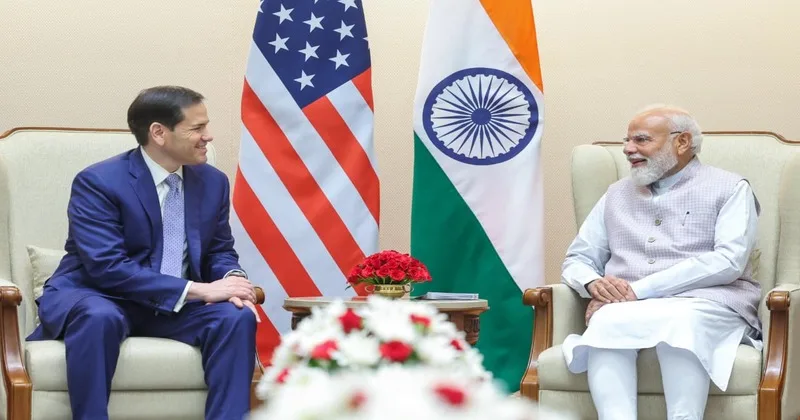
The four-day India visit of Marco Rubio was not merely another diplomatic engagement between Washington and New Delhi. It was, in many ways, a strategic correction. Coming at a time when India-US ties had entered one of their most strained phases in over two decades due to the policies of the Donald Trump administration, Rubio’s visit reflected an unmistakable reality that the United States cannot afford to alienate India in a rapidly changing global order.
The tensions were visible in recent months. Washington’s tariff policies targeting Indian exports, pressure on India to open its dairy and agricultural sectors to American imports, tighter visa restrictions affecting Indian professionals and students, and renewed US engagement with Pakistan had all contributed to discomfort in New Delhi. The “America First” framework of the Trump administration had created friction with several partners globally, and India was no exception. Yet Rubio’s visit demonstrated that despite disagreements, the United States understands India’s growing indispensability in global geopolitics.
Whether it is the Indo-Pacific balance against China, maritime security, supply chain resilience, energy security, emerging technologies, or democratic strategic partnerships, India today occupies a central position that Washington simply cannot ignore. Rubio himself acknowledged this reality repeatedly during the visit. “There’s a lot to work on with India, they’re a great ally and partner,” he said before arriving in New Delhi. Later, during his joint appearance with S. Jaishankar, Rubio went even further, calling India “one of the most important strategic partners of the United States.” The message behind the diplomacy was clear. Washington came to New Delhi not from a position of charity or patronage, but from strategic necessity.
India’s rise has changed the nature of the partnership
One of the most striking aspects of Rubio’s visit was how clearly it reflected the transformation of India-US ties from the old aid-based relationship of the Cold War era into a partnership of equals driven by mutual strategic interests.
The contrast is significant. For decades after independence, India’s engagement with the United States was often framed through economic assistance mechanisms such as the PL-480 food grain programme. Today, the conversation has fundamentally changed. The focus is no longer aid, but advanced technology, defence production, artificial intelligence, maritime cooperation, critical minerals, semiconductors, energy security, and Indo-Pacific strategy. Jaishankar underscored this shift with unusual clarity during the joint press briefing. Referring to the Trump administration’s “America First” doctrine, he remarked that, “Trump administration has been very forthright in putting forward its foreign policy outlook as America first. We have a view of India first. So both of us are obviously driven by our respective national interests.”
https://twitter.com/i/status/2058184779808362843
That statement captured the new maturity in India-US relations. India no longer approaches Washington from a position of dependency. Instead, New Delhi openly articulates its own national priorities and negotiates accordingly.
Rubio appeared to recognise this changing equation. “I don’t view our relation with any country in the world as coming at the expense of our strategic alliance with India,” he said, signalling that Washington increasingly sees India not as a junior partner but as a major independent power whose cooperation is essential. India’s growing leverage also stems from its unique global positioning. It combines three factors that make it strategically indispensable to the West, democracy, technology-trade and China’s rise. At a time when China’s authoritarian rise worries Western capitals, India offers an alternative power centre in Asia with democratic legitimacy and an expanding innovation ecosystem. Washington understands that any long-term Indo-Pacific strategy without India would remain incomplete.
Quad diplomacy and the China factor
Rubio’s participation in the Quad Foreign Ministers’ meeting in New Delhi highlighted why India has become central to Indo-Pacific geopolitics.
The Quad, comprising India, the United States, Australia, and Japan, has increasingly evolved into one of the most important strategic platforms countering China’s growing military and economic assertiveness across the Indo-Pacific region. The meeting attended by Rubio, Jaishankar, Australian Foreign Minister Penny Wong and Japanese Foreign Minister Toshimitsu Motegi announced multiple initiatives covering maritime surveillance, critical minerals, port infrastructure, energy resilience, and maritime domain awareness.
Rubio announced the launch of an Indo-Pacific Maritime Surveillance Cooperation Initiative that would combine the maritime capabilities of Quad countries. The Indo-Pacific Maritime Domain Awareness Initiative was also expanded further among the four nations.
Quad Foreign Ministers’ Meeting delivers strong, concrete results. From enhanced maritime security to new initiatives on maritime security, port infrastructure, critical minerals, and energy resilience – here are the top deliverables from this round of Quad cooperation. Thread… pic.twitter.com/Hmf6XlwuyH
— Ambassador Sergio Gor (@USAmbIndia) May 26, 2026
These are not symbolic announcements. They directly relate to China’s increasing naval expansion, aggressive posture in the South China Sea, growing submarine activity, and attempts to dominate critical sea lanes in the Indo-Pacific.
Jaishankar made it clear that security concerns remain central to the Quad framework. “There must be zero tolerance for terrorism, and nations subject to terrorist attacks have the right to defend themselves,” he said during the meeting. The Quad also condemned the Pahalgam terror attack in Jammu and Kashmir and the Bondi Beach attack in Australia, reflecting a broader strategic convergence on security issues.
For Washington, India’s geography alone makes it indispensable. India sits at the heart of the Indian Ocean region, controls access routes critical to global trade, and remains one of the few powers capable of balancing China without formal military alliances. That is precisely why Rubio repeatedly described India as a cornerstone of the US Indo-Pacific strategy.
Strategic Outcomes: Defence, energy and critical minerals
Beyond symbolism, Rubio’s visit produced concrete strategic outcomes across multiple sectors.
One of the most important developments was the signing of the “Framework on Securing of Supply in the Mining and Processing of Critical Minerals and Rare Earths” between India and the United States. The agreement, signed by Jaishankar and Rubio, seeks to reduce global dependence on China for rare earth processing and critical mineral supply chains. The framework includes cooperation in mining, refining, recycling, financing, and investment.
This is particularly significant because critical minerals are essential for semiconductors, electric vehicle batteries, defence systems, clean energy technologies, telecommunications infrastructure, and advanced manufacturing.
According to the reports, senior Indian official involved in the negotiations described the agreement as “a strategic realignment” rather than a routine trade arrangement. The visit also advanced defence cooperation. Jaishankar pointed out that the 10-year major Defence Partnership Framework Agreement had recently been renewed. A comprehensive Underwater Domain Awareness Roadmap was also signed. Importantly, Jaishankar highlighted India’s insistence on incorporating the “Make in India” approach into future defence cooperation. He stated: “Where defense and security cooperation is concerned, you’re all aware that the 10-year major Defense Partnership Framework Agreement was recently renewed. A comprehensive Underwater Domain Awareness Roadmap was also signed. We discussed the importance of taking into account the Make in India approach and lessons drawn from recent conflicts while going forward in the defense domain.” This reflected India’s broader strategy of avoiding dependency while expanding partnerships.
Addressing the media alongside US @SecRubio.
🇮🇳 🇺🇸 https://t.co/Qg2qZY5qBj
— Dr. S. Jaishankar (@DrSJaishankar) May 24, 2026
Energy security was another major pillar of discussions. With tensions in the Strait of Hormuz following the US-Israel attacks on Iran creating fears of oil supply disruptions, both countries focused heavily on stabilising energy markets. Rubio reportedly assured Prime Minister Narendra Modi that the United States would not allow Iran to “hold the global energy market hostage” and offered expanded US energy exports to India. At the same time, Jaishankar firmly reiterated India’s independent position. “The United States fits the bill in many respects. So do some other countries. So, we will continue to diversify and maintain multiple sources of supply at the most reasonable cost,” he said. That statement once again reflected India’s refusal to align blindly with any bloc while protecting its own energy interests.
India’s economic weight is becoming impossible to ignore
Another important backdrop to Rubio’s visit was India’s growing economic relevance in a fragmenting global economy. India has recently accelerated trade negotiations and completed agreements with Oman, New Zealand, and the United Kingdom in 2025, followed by a major agreement with the European Union earlier this year. Collectively, these agreements connect India to a substantial share of global trade flows. Washington understands that India’s market of 1.4 billion people, combined with its manufacturing ambitions, digital economy, and growing technological ecosystem, gives New Delhi enormous leverage. Rubio therefore sought to reassure India on trade tensions. He argued that the Trump administration’s tariff decisions were global in nature rather than specifically targeted at India.
“There virtually is no country in the world that I could travel to that isn’t going to raise the issue of trade because we did this from a global perspective,” he said. At the same time, both countries indicated progress toward an interim bilateral trade agreement aimed at reducing friction and expanding economic cooperation.
Even on the sensitive issue of US visa restrictions affecting Indian professionals and students, Rubio attempted to calm concerns. He described the changes as part of a broader “modernisation” effort rather than policies directed specifically against India.
The Message from New Delhi
Ultimately, Rubio’s India visit revealed more than just diplomatic engagement. It revealed a changing global power structure. The United States may still remain the world’s leading military and economic power, but Washington increasingly recognises that solving major global crises, from China’s rise and Indo-Pacific tensions to supply chain vulnerabilities, maritime security, energy disruptions, and emerging technologies, requires India’s cooperation. Equally important, India now engages the United States from a position of strategic confidence. New Delhi no longer defines its foreign policy through ideological alignments or external pressure. It negotiates through the lens of national interest. Jaishankar’s repeated emphasis on “India First” during the visit captured that transformation perfectly.
Rubio’s visit therefore was not about Washington granting importance to India. It was about Washington acknowledging a reality that has become impossible to avoid that India has emerged as an essential pillar of the evolving global order. In many ways, the optics of the visit said it all. The Quad meeting took place in New Delhi. The major agreements were signed in New Delhi. Strategic initiatives were announced from New Delhi. And major powers increasingly came to India not merely for dialogue, but to negotiate partnerships critical to the future of the Indo-Pacific.