For the millions of Indians living and working in the United States — software engineers in Silicon Valley, doctors in midwestern hospitals, students burning midnight oil on university campuses — a new resolution introduced in the US House of Representatives carries a pointed message: you belong here.
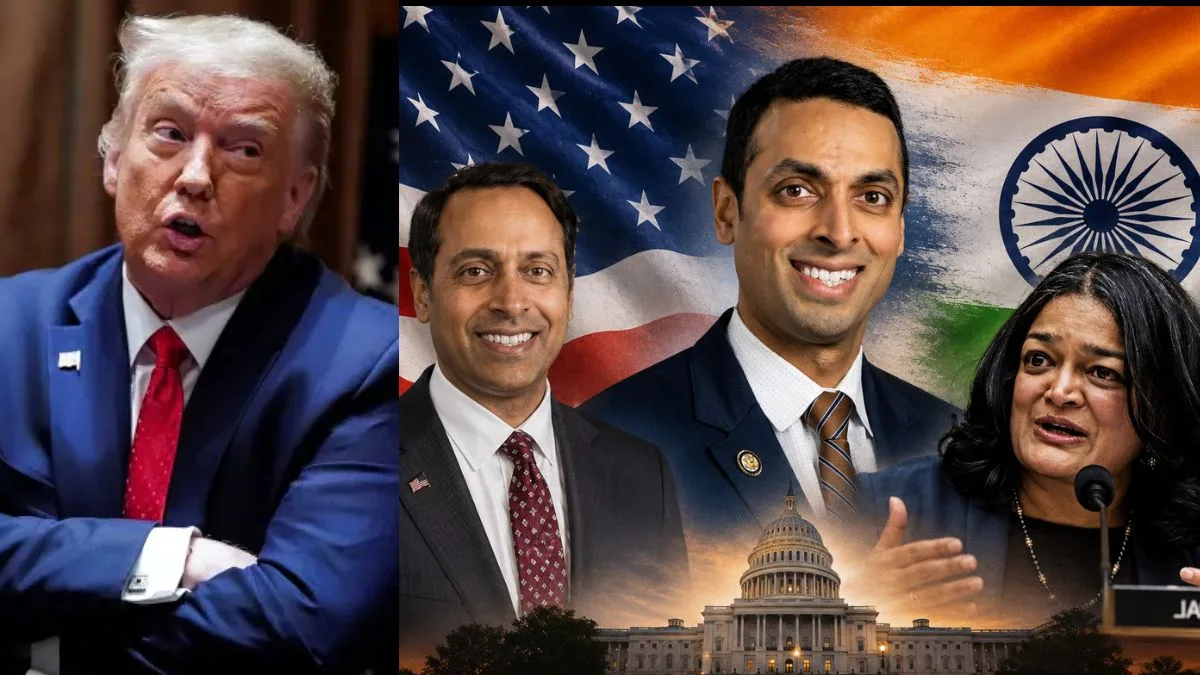
House Resolution 1322, introduced on May 22, 2026, by Congressman Raja Krishnamoorthi along with co-sponsors including Pramila Jayapal, Judy Chu, and Ro Khanna’s ally Suhas Subramanyam, formally condemns racist rhetoric targeting Indian and Chinese Americans — and unusually, it points a finger directly at the President of the United States.
US President Donald Trump’s repost of a far-right podcast calling India and China “hellholes” exploded into a full-blown diplomatic crisis — forcing New Delhi to formally rebuke a US president for the first time in years, and handing Beijing a rare propaganda win without it saying a word.
What triggered this resolution?
On April 22, 2026, the President amplified a Truth Social post calling India and China “hellholes,” suggesting immigrants from these countries lack loyalty and are “not like European Americans.” US President Donald Trump — without a word of his own — reposted a four-page transcript and video from conservative radio host Michael Savage.
The content was a lengthy rant against birthright citizenship but buried in its vitriol was a line that would reverberate from New Delhi to Beijing: “A baby here becomes an instant citizen, and then they bring the entire family in from China or India or some other hellhole on the planet.”
Read the Resolution here…
BREAKING 🚨 U.S. resolution introduced by @CongressmanRaja condemns racist rhetoric and discrimination targeting Indian and Chinese Americans.
At a time when both communities continue to face xenophobia, scapegoating, and harmful stereotypes, this marks an important step toward… pic.twitter.com/SrYWcgYdPl
— Hindu American Foundation (@HinduAmerican) May 26, 2026
What the resolution actually demands
H. Res. 1322 is not a law — it is a formal statement of the House’s position. But its symbolic weight is considerable. The resolution:
- Condemns the racist language amplified by the President targeting people of Indian and Chinese origin
- Affirms that Indian Americans and Chinese Americans are vital to the United States
- Calls on all elected officials — including the President — to stop using language that promotes ethnic division
- Declares that attacks based on national origin or ethnicity are “un-American”
- Condemns all hate against Asian Americans, Native Hawaiians, and Pacific Islanders
India’s government has not formally commented, but this resolution will be watched closely by New Delhi. With hundreds of thousands of Indians on work visas and student visas in the US — and the Indian community forming one of the largest non-citizen populations in America — any escalation in anti-Indian rhetoric in the US has direct human consequences for Indian families.
Indian-origin lawmakers front and centre
The fact that Indian American Congressman Raja Krishnamoorthi led this resolution is noteworthy. So is the involvement of Suhas Subramanyam, another Indian-origin lawmaker. Their presence signals that the Indian diaspora is no longer a passive community in American politics — it is now using legislative muscle to push back against rhetoric that targets it.
Pramila Jayapal, who has long championed immigrant rights, and Judy Chu, a veteran advocate for Asian Americans, lent bipartisan credibility to the effort. The resolution has been referred to the House Committee on the Judiciary.
Future of this Resolution
The resolution is unlikely to pass the full House given the current political arithmetic in Congress, but its introduction sends a clear signal: a growing number of American lawmakers believe the rhetoric targeting Indian and Chinese immigrants has crossed a line that cannot go unaddressed.
How India Responded? India’s official rebuke
India’s Ministry of External Affairs, typically measured to the point of diplomatic neutrality, issued an unusually direct condemnation. Spokesperson Randhir Jaiswal said the remarks were “obviously uninformed, inappropriate and in poor taste” and “certainly do not reflect the reality of the India-US relationship, which has long been based on mutual respect and shared interests.”
Why the MEA’s words matter for the US
India and the US are in the middle of delicate trade deal negotiations — aimed at preventing a repeat of the bruising tariff hikes of 2025. The “hellhole” post arrives just as Washington and New Delhi are negotiating a trade deal. This also happened just before the US Secretary of State Marco Rubio’s visit to India. Against that backdrop, even the subdued MEA language was a diplomatic signal that New Delhi was genuinely rattled.
For China, which has been watching the India-US relationship evolve with wariness, any cooling between the two democracies is strategically convenient.
It should also be noted that Chinese state media, which is normally quick to highlight American racism when it serves a narrative purpose, also stayed notably quiet in the immediate aftermath — consistent with a period when Beijing has been carefully managing its own fragile détente with Washington.
US went into a damage-control mode after Trump’s ‘hellholes’ repost
The US Embassy in New Delhi moved quickly to douse the flames. A spokesperson put out word that Trump had previously called India a “great country” and Prime Minister Modi a “very good friend” — seeking to separate the president’s social media activity from official bilateral policy. It was, in the words of one observer, the diplomatic equivalent of saying “he didn’t mean it like that.”
The immediate diplomatic damage was contained — Trump’s post was offset by the US Embassy’s rapid clarification, and India stopped short of a formal demarche.
The “gangsters with laptops” (Michael Savage used this exact phrase in his podcast rant, which Trump reposted on Truth Social in April 2026) phrase drew particular fury.
For a generation of young Indians who grew up seeing the Indian American tech worker as a symbol of aspiration — proof that hard work could take you from a tier-2 city to Silicon Valley — being cast as a predatory actor gaming the American system was not just offensive. It was a direct attack on a dream.
The Hindu American Foundation, a prominent diaspora advocacy group, condemned Trump’s post in a statement on X: “We are deeply disturbed that the President shared this hateful, racist screed targeting Indian and Chinese Americans.”
India has 5.5 million of its citizens living in the United States. Hundreds of thousands are on work visas. Thousands are students. Every time they are characterised — even in a repost, even from a third party — as disloyal immigrants from a “hellhole,” the human cost falls on real people, not just diplomatic cables.
That is what H. Res. 1322, introduced in the US Congress a month later, sought to address. But the wound had already been opened.