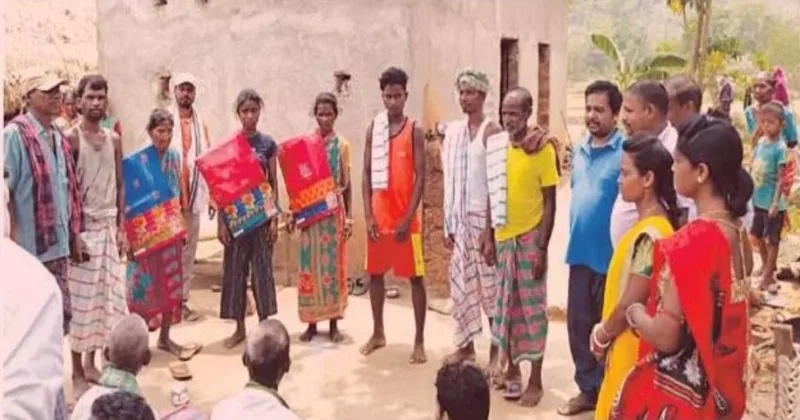
Bhubaneswar: A Santhali tribal family in Odisha’s tribal-dominated Mayurbhanj district has undergone Ghar Wapsi through traditional community rituals after converting to Christianity several years ago under the influence of Christian preachers. The incident, reported from Khunta block, has reignited the debate over religious conversion activities in tribal regions and prompted renewed calls from local groups for stricter enforcement of anti-conversion laws in the state.
Lembu Hansda’s family, residents of Dungurudihi village under Bholagadia panchayat in Nuagaon area, had embraced Christianity approximately five years ago. According to family members and village elders, the conversion occurred during a period of illness and financial distress faced by the household.
Speaking to the media during the Ghar Wapsi programme, Lembu Hansda stated that Christian preachers had assured the family their health and domestic problems would improve if they abandoned their traditional beliefs and accepted Christianity.
“At that time, we were going through severe hardship. We were told that if we accepted the Christian faith, our suffering and illnesses would end. Believing those promises, we moved away from our ancestral traditions,” Hansda said.
Hansda further explained that he was misled by Christian pastors and became disconnected from his roots and traditional faith. After a considerable period, his family realised they had been deceived by Christian preachers. He stated that the promises and assurances used to persuade him to convert had proven false. As a result, he decided to undergo Ghar Wapsi and discussed the matter with the village elders and community leaders.
#WATCH | Odisha: A Santali tribal family in Mayurbhanj district holds a ritual to return to their original religion after 5 years.
ADM Mayurbhanj Netrananda Mallick says, "We have learned that some tribal communities are celebrating… They are following their traditional… pic.twitter.com/FwCKSmdMyc
— ANI (@ANI) May 24, 2026
Village elders said that the matter was discussed collectively before the community approved the family’s return. According to local residents, the family’s re-admission into the Santhali fold was carried out through age-old customary rituals symbolising “rebirth.”
Traditional Ritual Marks “Rebirth”
The Ghar wapsi ceremony drew attention for its unique customs rooted in Santhali tradition. Community leaders explained that re-entry into the faith is viewed as a symbolic rebirth into the tribe’s spiritual and cultural identity.
As part of the ritual, a pit nearly three feet deep was dug in an agricultural field. Family members entered the pit and later emerged, crying like newborn children, to signify a fresh birth into their ancestral faith. Villagers present at the site showered rice grains over them during the process.
In another symbolic ritual, lotus stems tied around their waists, symbolising umbilical cords, were ceremonially cut, representing a separation from their previous religious identity and the beginning of a new life within the community.
Following this, the family members were escorted back to their home, where additional traditional rites were conducted. Villagers symbolically struck the roof of the house, followed by a ritual similar to the tribal “Ekouishia” purification ceremony.
The family members then underwent tonsure rituals and were dressed in new clothes. Sacred paste and holy substances traditionally used in Santhali customs were sprinkled on them before they were formally welcomed back into the community.
A community feast was later organised by the Hansda family to mark the occasion. Traditional rice beer, locally known as “Handia,” was also served during the gathering. Villagers from nearby areas welcomed the family’s return to their roots.
Debate Over Religious Conversion
The incident has sparked discussions in tribal regions regarding religious conversion activities and the role of missionary organisations operating in remote areas.
Several local social activists alleged that vulnerable tribal families are often targeted during periods of illness, poverty, or personal hardship. They claimed that false assurances regarding health, livelihood, and social welfare are sometimes used to encourage conversion among economically weaker communities.
Some activists also demanded stricter monitoring of organisations allegedly involved in unlawful conversion activities. They argued that aggressive proselytisation threatens indigenous tribal traditions, languages, and cultural practices that have existed for generations.
“This is not just about religion. Tribal identity, customs, and social harmony are deeply connected with the faith systems. If such activities continue unchecked, tribal culture could gradually disappear,” a local activist said. Residents from nearby villages who attended the ceremony also called for legal action against individuals found engaging in fraudulent or coercive conversion practices.
Calls for Enforcement of Anti-Conversion Laws
Odisha already has legislation aimed at regulating religious conversion. The Odisha Freedom of Religion Act prohibits religious conversion through force, fraud, or inducement. However, local groups alleged that implementation of the law remains weak in several tribal pockets of the state. Social organisations have urged the state government to strictly enforce existing provisions to prevent what they describe as illegal or deceptive conversion practices in tribal communities.