The geopolitical landscape of the current decade is severely fractured. Escalating conflict in West Asia post the breakdown of a fragile ceasefire coupled with a steep energy crisis has derailed the global economy. On the other hand, the Indo-Pacific is silently, but evidently emerging as a contentious maritime zone. These challenges are further spiralled with spiking climate catastrophes, trade barriers, technology hiccups, unpredictable diplomatic actions and soaring transactionalism across the foreign policy spectrum. The emerging nature of new age warfare backed with cutting-edge technology and the recurring cross-border terrorism with techno-terrorism is further complicating the national and collective security paradigm.
At such a precarious and volatile geopolitical crossroad, India is set to host the high-voltage QUAD Foreign Ministers’ Meet in alliance with the United States, Japan and Australia. Apart from the aforementioned challenges, the Quadrilateral confluence gains further strategic vitality, as it had reached a stalemate, when the US President Donald Trump unleashed tariff tussle and massive trade hiccups. Serious questions were raised regarding the strategic relevance of the QUAD, as India-US relations had hit rock-bottom for a brief duration.
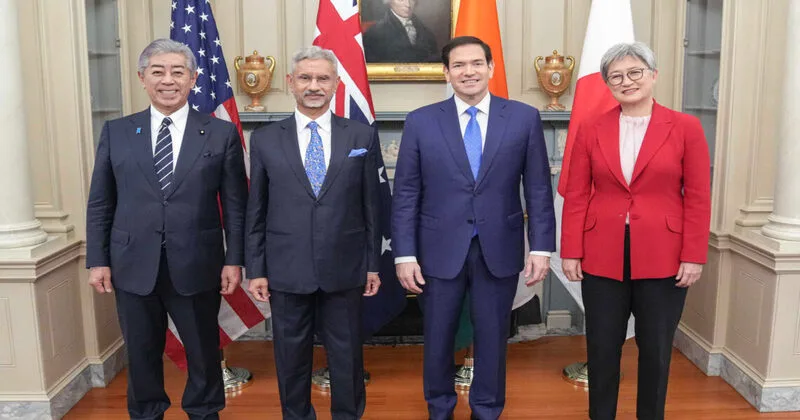
Surpassing all these gridlocks and by regaining the stability in the India-US relations, New Delhi is set to host the QUAD Foreign Ministers’ Meet on May 26, thus aiming to script a solid strategic trajectory to navigate the geopolitical landscape that is suffering from intense fissures. External Affairs Minister Dr. S. Jaishankar will chair the much delayed and much anticipated QUAD Foreign Ministers’ Meet. His counterparts including the United States Secretary of State Marco Rubio, Foreign Minister of Australia and Japan Penny Wong and Toshimitsu Motegi respectively will join EAM Jaishankar to carve a collective diplomatic pathway to counter the common geopolitical bottlenecks encountered.
The meeting will be a continuation of the previous QUAD Foreign Ministers’ Meet held in July 2025 at Washington DC with its core principle of QUAD’s vision for a free, and open Indo-Pacific. “They will exchange views on advancing Quad cooperation across priority areas, review progress on ongoing Quad initiatives, and reflect on recent developments in the Indo-Pacific region and other international issues of mutual concern”, the statement from the Ministry of External Affairs reiterated.
West Asia Crisis, Indo Pacific security expected on the agenda
As per the sources, the QUAD Foreign Ministers’ Meet is deemed as a major breakthrough or a vital revamp of the alliance that had hit a stalemate due to the irrational policies of the Trump administration. The Summit comprising the Head of the State of all the four nations is being repeatedly delayed. Thus, the Foreign Ministers’ Meet is considered as a kinetic push to re-energize the forum to suit the present geopolitical spectrum and navigate the challenges accordingly.
The crisis in West Asia as a compounding effect of the Iran and US-Israel war is said to be discussed in the meeting. The United States, being a major stakeholder in the conflict, the outcomes or the joint statement from the QUAD meet is much anticipated. Will the US give any hint regarding the future trajectory of the war or the goals of Washington in West Asia, has to be awaited. The Russia-Ukraine conflict may be also discussed as per the geopolitical experts.
Another most vital factor that will be discussed in the QUAD Foreign Ministers’ Meet is the Indo-Pacific and the emerging challenges for maritime security, which is infact the core objective and founding pillar of the QUAD grouping. The assertive expansionism and wolf-warrior diplomacy vouched by China under Xi Jinping is deemed as a major threat to collective security in the region. This is the very philosophy with which QUAD was established; to carve, free, open, inclusive and rule-based Indo-Pacific, to accelerate freedom of navigation and ensure balance of power in the strategic maritime corridors of Indo-Pacific, which is resource rich and increasingly evolving as contentious. This realm is expected to be the highlight of the QUAD Foreign Ministers’ Meet.
Apart from these key pillars, leaders can also discuss the channels to ensure energy security amid the mounting crisis. Technology cooperation and transfer of critical technology for mutual benefit is another vital aspect of the QUAD. Cooperation in the defence domain to deal with the emerging nature of warfare where cutting-edge technology is the bedrock can also be expected. Strong statements against cross-border terrorism can be expected which will be a major diplomatic win for India in its relentless fight against terrorism in all its forms and manifestations.
The goals of New Delhi from the QUAD Meet
The agenda on the diplomatic and strategic playbook of New Delhi from the QUAD Foreign Ministers’ Meet is to revamp, re-energize and consolidate the relevance and activeness of the QUAD grouping which was hitherto hit a roadblock. Such a revolutionised QUAD will help India yield its strategic goals across the Indo-Pacific region in terms of maritime security or larger national security. This will also help consolidate collective security against irrational external geopolitical aggression and restore balance of power.
For example, an active and strong presence of the QUAD across the Indo-Pacific can curb maritime smuggling or drug trafficking, infiltration, terror activities and other illicit acts, thus strengthening national security. This can be done via military or security cooperation, technology transfer, resource sharing and exchange of critical information pertaining to national and collective security. Reinforcing such a vitality of the QUAD grouping, the outcomes of the Foreign Ministers’ Meet are much anticipated.
The roots and journey of the QUAD
The QUAD grouping was initially envisioned by Japanese Prime Minister Shinzo Abe in 2007 as the coalition of the nations to ensure collective security across the Indo-Pacific. In 2012, the Japanese Prime Minister redefined and upgraded QUAD as the “Democratic Security Diamond”, meaning the confluence of democratic nations who are the littoral states of the Indo-Pacific to counter expansionism and other illicit actions in the strategic region. It emphasized maritime security, infrastructure development and supply chain resilience among the Indo-Pacific nations, entailing India, Japan, Australia and the United States.
Owing to soaring expansionist threats, QUAD was upgraded and redefined its goals in 2017. The four nations also conduct “Malabar Exercise”, a joint military manoeuvring in the Indo-Pacific to achieve collective and regional security. They also aim at economic cooperation such as streamlining multilateral trade and strengthening people-to-people ties. However, will this core vision and principles be achieved amidst ruptured geopolitical landscape, changed foreign policy priorities of the nations, spiking transactionalism etc. Meanwhile, India seeks to navigate the challenges, hold and reboot the relevance of QUAD with the philosophy of multi-alignment and strategic patience to etch collective benefit.