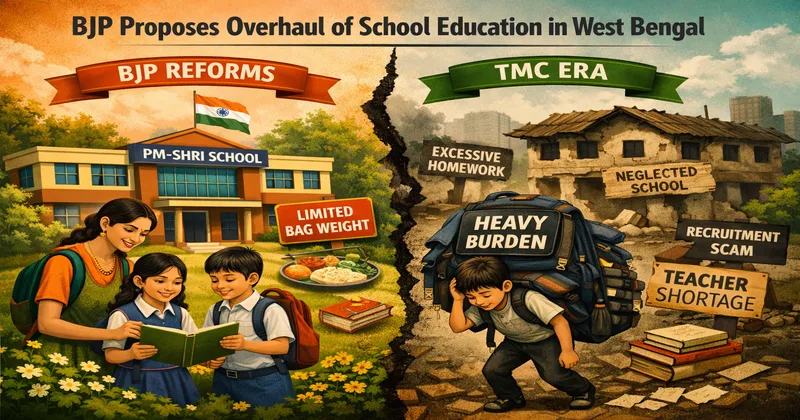
KOLKATA: School education has emerged as a key policy focus area for the Bharatiya Janata Party (BJP) after coming to power in West Bengal. The party has now proposed a set of reforms aimed at restructuring the primary education system. This will surely reduce the student burden and improve classroom experience. These changes have also been presented in contrast to what the BJP describes as long-standing gaps in the education framework under the All India Trinamool Congress government. The reforms made by BJP are being projected as student friendly measures that are aligned with foundational learning goals under NEP 2020. They focus on early-stage education quality, workload reduction, and better learning outcomes.
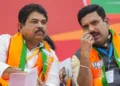
BJP MLAs Sankar Ghosh and Swapan Dasgupta said that a wider review of the school syllabus and possible restructuring of the education system are under consideration after discussions with senior education department officials. They said the government is reviewing the existing framework and changes are expected soon, including removal of “unjustified” content from the syllabus. The discussions also reportedly included the possible implementation of PM-SHRI in West Bengal, along with issues related to college admissions and restructuring of school committees.
BJP govt overhauls Bengal's education system 🪷
> School bags cannot weigh more than 10% of student's weight
> Size of notebook to be reduced to make school bags lighter
> Midday meal to be made available, no need for water bottle + lunch boxes
> Homework abolished upto… pic.twitter.com/CXaw4VIo9Z
— do'o kappa (@viprabuddhi) May 23, 2026
BJP’s Proposed Reforms vs Follies of TMC-Era System
1. School Bag Weight and Physical Burden – Under the BJP’s proposal, school bag weight would be limited to 10 per cent of a student’s body weight. It has also suggested structural changes such as reducing notebook size, simplifying textbook design, and rationalising academic material to make daily school bags lighter. The broader objective is to reduce physical strain on students especially in primary classes and create a more child-friendly learning environment that focuses more on comfort and health.
Whereas, during the TMC-era system, the enforcement of such weight norms has been inconsistent, with no strict uniform monitoring mechanism across schools. This led to continued complaints of heavy school bags in several districts.
2. Homework Policy in Primary Education – The BJP has proposed complete abolition of homework at the primary level and a cap of two hours per week for Classes 3 to 5. The intention behind this is to reduce rote pressure on young learners, encourage classroom-based understanding, and allow more time for play, creativity, and skill development.
In contrast, under the TMC governance, homework policies are mainly guided by general education norms, but implementation varies by school, with uneven workload and lack of standardisation across institutions.
3. Midday Meal and Daily School Logistics – The BJP proposes streamlining the midday meals so that students may not need to carry separate lunch boxes and water bottles. The idea includes improving timing coordination, enhancing hygiene standards, and reducing logistical burdens. The focus is on making the scheme more efficient, uniform, and student-centric, particularly in government schools. Under the current TMC system, logistics such as food distribution timing and infrastructure quality vary across rural and urban schools.
4. Teacher Recruitment and Staffing Stability – The BJP has highlighted irregularities in teacher recruitment processes as a major issue from the TMC era. The proposed plan will allow faster appointment cycles, reduced delays related to administration, and stronger accountability mechanisms.
The existing system has also seen multiple controversies and legal scrutiny around recruitment processes which has contributed to uncertainty in teacher appointments and administrative delays.
5. Teacher Availability Across Regions – The reforms aim to create a more balanced education environment which will indirectly address the uneven teacher distribution. If everything goes as per plan, then better staffing balance would directly improve classroom engagement and learning outcomes.
Currently, under the TMC era framework, there are reported disparities in teacher availability, with rural and semi-urban schools often facing shortages as compared to urban areas.
6. Infrastructure and Learning Environment – The BJP has pointed to the need for simplified, child-friendly schooling with better focus on basic learning conditions. Moreover there will be modern school infrastructure which will have better sanitary facilities, access to digital learning tools, etc. In the existing system, there is uneven infrastructure development, that includes overcrowded classrooms in some areas and limited digital learning facilities in others.
The Bharatiya Janata Party has described its proposals as corrective reforms in which they are planning to reduce students’ stress and improve early education outcomes. The party is of the view that the focus should shift from heavy burden schooling to skill-based foundational learning as per NEP 2020.