Long before hospitals, IV fluids or emergency helplines, India built a civilisation in some of the world most heated nation. It did not do so by accident. It did so with tamarind, breath, basil seeds and gooseberries and in 2026 the government publishes an advisory which confirms that system still works.
The sun over the Gangetic plain in May is not a gentle thing. It arrives before 5 am and does not relent until after 7 pm. Ground temperatures can exceed 55 degrees Celsius. The air above it shimmers and warps. This is the same sun that blazed over Varanasi, Pataliputra and Mathura two thousand years ago over markets, temples, harvests, armies, pilgrimages and ordinary lives. Millions of people lived, worked and thrived under it.
They had no ORS sachets, no air-conditioned emergency wards, no meteorological red alerts. What they had was panna, sattu and sheetali pranayam breath technique. Along with a deep understanding, refined over three millennia, of exactly what the human body needs when heat tries to kill it.
In May 2026, India’s Ministry of Health & Family Welfare quietly confirmed what traditional communities never forgot that ancient India’s summer lifestyle was not primitive adaptation. It was precision medicine.
A Civilisation Lifestyle for Survival
India did not simply endure its climate. It engineered around it. Every layer of daily life in the ancient subcontinent the timing of meals, the architecture of homes, the rhythm of work, the contents of the midday drink was calibrated to the thermal reality of living between the Tropic of Cancer and the Equator.
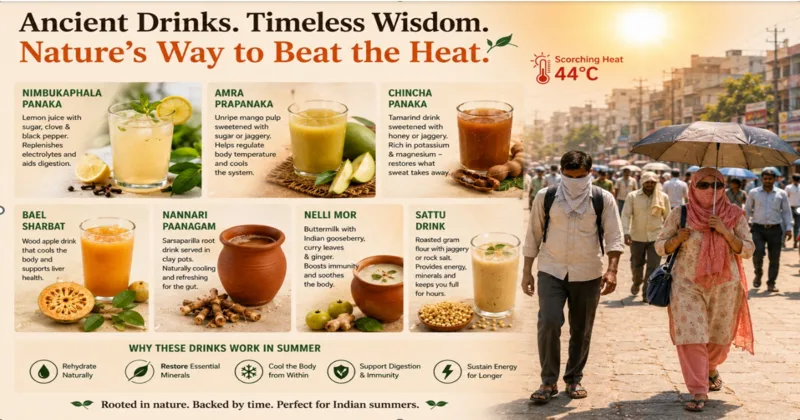
The logic was observational and cumulative, passed from vaidya to apprentice, mother to daughter across hundreds of generations. When Ayurvedic physicians prescribed Nimbukaphala Panaka lemon juice in sugar water with clove and black pepper for summer heat, they were not guessing. The clove aided digestion under heat-induced stress. Black pepper enhanced nutrient absorption. Lemon replaced the acids and minerals the body sweated out. In the language of modern sports medicine, it was a precisely formulated electrolyte and metabolic recovery drink. They built it from a garden.
The Amra Prapanaka unripe mango pulp macerated into sweetened water worked through pectin and tartaric acid, both of which help regulate core body temperature during sustained heat exposure. The Chincha Panaka, made from tamarind soaked in water and sweetened with honey, delivered potassium and magnesium in bioavailable form, the precise minerals that disappear when a body sweats for hours under a fierce sun and whose absence leads first to muscle cramps, then to cardiac irregularity then individual collapses. These were not remedies for the sick. They were daily life for the living.
The Body as Its Own Cooling System
Ancient India understood something that took modern physiology centuries to formally document, that the body can be instructed to cool itself, if you know the right language. Sheetali— Pranayama the tongue curled into a tube, cool air drawn across its wet surface, exhaled through the nose, is that language made physical. The mechanism is precise evaporative cooling on the tongue drops incoming air temperature, reducing the thermal load on the hypothalamus, the brain’s thermostat. Heart rate declines. Core temperature measurably falls. The body for a few minutes believes, it has moved into shade.
Yogic traditions developed this not as a philosophy but as a practical survival tool for those spending hours under the Indian summer sun. It was taught in groups, embedded in morning practice, passed down as life-skill. The 2026 heatwave advisory recommends it for exactly this purpose for individuals and groups during extreme heat and links to a WHO-affiliated app. Two and a half thousand years of practice, now on the Play Store.
The Unani tradition, which arrived in India through the medieval period and absorbed and adapted indigenous knowledge, went even further in its external cooling protocols. Its heatwave remedies include a herbal foot bath of willow leaves, blue lotus flowers, white moonflower blossoms, and wheat husk a soak that works through both temperature reduction and dermal absorption of anti-inflammatory compounds. For the face, it prescribed a paste of psyllium mucilage, quince seeds, gum acacia and purslane a natural film-forming emollient that reduces UV absorption, minimises trans-epidermal water loss, and cools skin on contact. Contemporary dermatology would call it a sophisticated topical treatment. Ancient physicians called it a Tuesday routine.
The Summer Diet as Heat Shield
The most profound aspect of ancient India’s heatwave survival strategy was not any single remedy, it was the architecture of the entire summer diet. The subcontinent’s traditional summer foods were not chosen for taste alone. Sattu a roasted barley and Bengal gram mixed with jaggery or rock salt was the original slow-release energy system of the Gangetic plain. Low glycaemic, mineral-rich and built on ingredients that cost almost nothing, it kept a body functional for hours under 45-degree heat. The jaggery gave iron, magnesium and potassium. The rock salt restored sodium. Labourers carried it to fields. Soldiers carried it on campaigns. Children ate it before the school walk.
Bael sharbat from wood apple is hepatoprotective, soothing the liver, which bears the greatest metabolic burden during heat stress. Nannari Paanagam was sold from clay pots because clay-cooled liquid absorbs faster than ice-cold water on a heat-stressed gut. Nelli Mor buttermilk with Indian gooseberry, curry leaves and ginger which delivers probiotics, vitamin C and anti-inflammatory compounds in a single clay tumbler. A recovery drink cooling agent and an immunity supplement simultaneously.
The ancient Indian home enforced this discipline architecturally. Thick mud or stone walls, small windows and internal courtyards created convection cooling and maintained interior temperatures well below the outside. Sleeping on the lower floor in summer was standard.
What Was Lost in Urbanisation, Aayush advisory has it
The tragedy is not that this knowledge disappeared. It was never fully lost only devalued. The panna vendor did not vanish because the drink stopped working. The nannari cart disappeared because refrigerated cola seemed more modern. The sattu tin was pushed aside because packaged supplements seemed more scientific. The afternoon nap became laziness in an economy that romanticised round-the-clock productivity.
India 2026 heatwave advisory has perhaps assembled the most comprehensive official argument for reversal. Its Ayush addendum does not present traditional remedies as cultural heritage. It presents them as protocol with ingredient quantities, preparation methods and dosage instructions, placing Chincha Panaka beside clinical heatstroke guidance.
The ancient lifestyle was never about nostalgia. It was about survival skills with daily, practical, non-negotiable survival in a land that demanded physiological intelligence from everyone who wished to live in it.
That intelligence is not vanished. It is waiting in a tamarind, in breath, in clay pot of buttermilk and gooseberry on a May-June afternoon. The government has finally put it back on the record through Aayush.