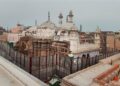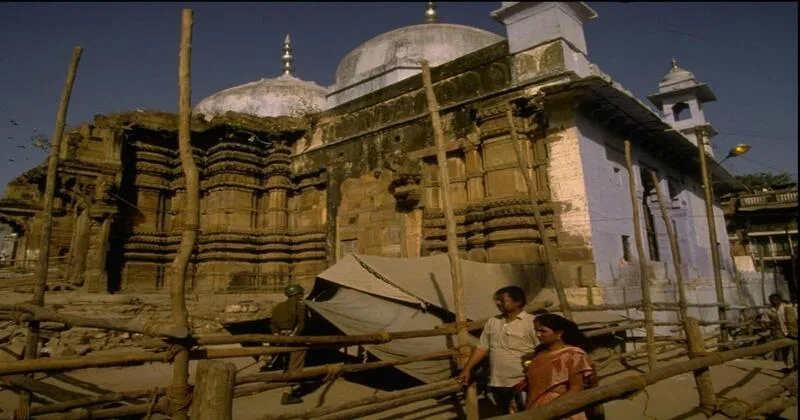
In the narrow lanes of Varanasi, where ancient stone walls seem to breathe history itself. A question has haunted pilgrims, priests, and lawyers for over three decades: Who does Gyanvapi truly belong to? The answer is now slowly emerging from the dust of centuries, carried forward not by slogans or swords, but by the authority of law and democratic institutions. The story of the Gyanvapi mosque complex is no longer a tale of faith in conflict.
The Wound That History Left Behind
The Gyanvapi mosque stands metres away from the Kashi Vishwanath mandir in Varanasi, one of Hinduism’s most sacred cities. For centuries, Hindus have believed that the original Vishweshwara mandir, a grand shrine dedicated to Lord Shiva, was razed under the orders of Mughal Emperor Aurangzeb around 1669 CE and replaced with the mosque that stands today. Historical accounts confirm that this Vishweshwara mandir had already survived one earlier destruction in the 12th century, was rebuilt under Akbar’s reign and was ultimately demolished again under Aurangzeb’s orders.
Within the Kashi Vishwanath mandir compound stands a statue of Nandi, the sacred bull of Lord Shiva. Unlike every other Nandi in a Shiva mandir, this one does not face a Shiv lingam within the mandir premises. It faces the Gyanvapi mosque. For generations of Hindu devotees, this silent stone witness has said everything that words could not. The Nandi does not face where a lingam was installed. It faces where the real one always was.
“Tyrants tried to destroy Varanasi but it remained as sultanates rose and fell. Kashi is not just a city, it is the civilisational soul of India. Long periods of slavery broke our confidence, but today we reclaim what was always ours.” — Prime Minister Narendra Modi,
Decades of Legal Struggle
The legal battle for Gyanvapi is not a manufactured controversy of politics. It stretches back to 1991, when priests from Varanasi first filed a petition at a Civil Court seeking access to pray on the premises. Their cause was repeatedly stayed, transferred and delayed, the courts moving at the unhurried pace of Indian jurisprudence while Hindu devotees waited.
The landscape shifted dramatically after the Supreme Court’s 2019 verdict in the Ayodhya Title Dispute, which awarded Ram Janmabhoomi to Shri Ram Virajman. That judgment observed that the Places of Worship Act, 1991, should not be weaponised to deny Hindus the right to even have their spiritual claims heard. The Ayodhya verdict opened a door. Gyanvapi walked through it.
In August 2021, five Hindu women filed a petition in a Varanasi Civil Court seeking permission to worship Maa Shringaar Gauri and other deities located within the Gyanvapi compound. By April 2022, the court had ordered a videographic survey of the premises. What that survey found would change the conversation forever.
The Shiv Lingam and the Sealed Wazukhana
On May 16, 2022, during the court-mandated videographic survey, a structure was discovered inside the mosque wazukhana, the ablution tank. The Hindu side declared it was a Shiv Lingam. The mosque management committee countered that it was merely a fountain. The Varanasi Civil Court immediately ordered the sealing of the area. The Supreme Court, while allowing Muslims to continue offering namaz in the rest of the mosque structure, remains protected.
This moment crystallised what many Hindus had believed for centuries. For crores of devotees denied access to their sacred site for over 350 years, the sealing of that tank felt like the first official acknowledgement that something far more significant than a fountain might lie within Gyanvapi’s walls.
“The ASI report is conclusive. A large Hindu mandir existed prior to the construction of the existing structure.” — Advocate Vishnu Shankar Jain, Hindu Side.
The ASI Report
In July 2023, the Varanasi District Court ordered the Archaeological Survey of India to conduct a comprehensive scientific survey of the Gyanvapi complex. The mosque management committee challenged this in the Allahabad High Court, which dismissed their plea. The Supreme Court also declined to stay the survey.
On January 25, 2024, the 839-page ASI report was shared with both parties. It concluded that a large Hindu mandir had existed at the site prior to the construction of the current structure. Pillars from the original Hindu mandir had been reused in building the mosque, with deliberate attempts made to erase the ancient carvings on them. Inscriptions in Devanagari, Telugu, Kannada and other Indian scripts were found. Sanskrit inscriptions naming Hindu deities such as Janardana, Rudra and Umeshwara were discovered. Arabic-Persian inscriptions confirmed the mosque was built in the 20th regnal year of Aurangzeb, corresponding to 1676–77 CE. Over 120 pieces of material evidence supported the existence of a pre-existing Hindu mandir.
“Unfortunately, people call Gyanvapi a mosque, but Gyanvapi is Sakshat Vishwanath. The walls are screaming and saying something. There is a trishul inside. There is a jyotirlinga, dev pratimas. If we call it a mosque, there will be a dispute. I feel whoever has been blessed with sight by God should see.” — Chief Minister Yogi Adityanath.
The Ongoing Courtroom Battle
The Gyanvapi case continues through India’s courts with remarkable momentum. As in April 2025, the Allahabad High Court was scheduled to hear a petition regarding an ASI survey of the wazukhana itself, the very sealed area where the Shiv lingam-like structure was found in 2022. The Hindu side has moved the Supreme Court to de-seal the wazukhana, arguing that devotees deserve access to pray at the sacred structure.
The Allahabad High Court, in December 2023, had already dismissed multiple pleas from the Muslim side challenging the maintainability of suits seeking restoration of a mandir. The judiciary, step by careful step, has been permitting the Hindu side’s claims to be heard, not dismissed but examined with the full force of India’s constitutional machinery.
Varanasi Speaks: Faith on the Ground
Walk through the ghats of Varanasi and speak to the priests, pilgrims and the old men who sit in the shadow of Kashi Vishwanath’s golden spires. Their voice is uniform, not of anger, but of patience tested across centuries. “Hamare Mahadev ko ek din insaaf milega,” one elderly pujari told us. Our Mahadev will get justice one day. That day now seems closer than ever.
For the millions who travel to Kashi to seek the blessings of Vishweshwar, the Lord of the Universe. It is an open wound in their spiritual landscape. The question they ask is simple: if a Shiva mandir was destroyed and replaced, should that not be acknowledged honestly?
A Religious City Reforming With Its Past
The Gyanvapi case is part of a larger and legitimate process unfolding across India, a reckoning with the violent erasure of Hindu religious sites during centuries of foreign rule. From Mathura Krishna Janmabhoomi to Varanasi’s Kashi, India is not inflaming old wounds; it is healing them through the institutions of a democratic nation, such as courts, archaeology and the rule of law.
The government has consistently maintained that it respects judicial processes in matters of religious sites. Prime Minister Modi’s laying of the Ram mandir foundation stone in Ayodhya in 2020, following the Supreme Court judgment, represented exactly this approach, not through mob justice or political vendetta but the fulfilment of a legal verdict. The Gyanvapi matter proceeds on identical rails.
The Places of Worship Act of 1991 was passed to freeze the identity of religious sites as of August 15, 1947. But it cannot freeze the truth. It cannot instruct science to unsee what the ASI surveys have uncovered. It cannot ask the Nandi to stop pointing where it has always pointed. It cannot silence inscriptions etched in stone a thousand years before the act was written.
The Bhojshala Effect: A Nation-Changing Precedent
The Gyanvapi dispute has gained extraordinary new urgency in the wake of a landmark judgment delivered just days ago. On May 15, 2026, the Indore Bench of the Madhya Pradesh High Court recognised the Bhojshala complex in Dhar as the Vagdevi Mandir, a site dedicated to Goddess Saraswati and granted the Hindu side the exclusive right to worship there. The court stated that its verdict was based on a detailed examination of the ASI survey report, historical documents, inscriptions, architectural remains and other evidence submitted during the hearings.
The previous ASI order of April 7, 2003, which had allowed the Muslim community to offer namaz at the site, was completely revoked by the court ruling that henceforth only Hindu worship shall take place at the complex. In a sweeping symbolic gesture, the court also directed the government to make formal efforts to repatriate the ancient idol of Goddess Saraswati, currently housed in the British Museum in London, originally installed by King Bhoj of the Parmar dynasty between 1010 and 1055 AD. Justice, it appears, has no statute of limitations.
The Bhojshala verdict is a direct mirror of the Gyanvapi situation, an ASI survey, contested by the Muslim side as biased, accepted by the court as conclusive evidence of a pre-existing Hindu place of worship. The ASI survey at Bhojshala found mandir remains, Sanskrit inscriptions, broken idol pieces and Hindu religious symbols inside the structure, precisely the kind of evidence the ASI has already documented at Gyanvapi. For Hindu petitioners in Varanasi, the Bhojshala ruling is not just a distant legal victory. It is a powerful precedent and an unmistakable signal that Indian courts are willing to follow the evidence wherever it leads, however inconvenient that journey may be for those who prefer the past remain buried.
“For Ek Bharat, Shreshtha Bharat, Gyanvapi should be returned to Sanatan Dharma.” — CM Yogi Adityanath, Maha Kumbh Mela, Prayagraj, January 2025
Who does Gyanvapi belong to? The courts are determining that. But what the ASI survey, the judicial orders and the centuries of Hindu belief have together made clear is this: beneath the current structure lies a history that cannot be denied and will not be forgotten. The Hindu community has not sought demolition. It has sought truth, access and recognition, the most reasonable demands any people of faith can make. Varanasi, the eternal city, has waited long. The Nandi still watches. India, as a civilisational democracy, must find the courage to complete the work not for revenge but for civilisational progress and justice for the future.