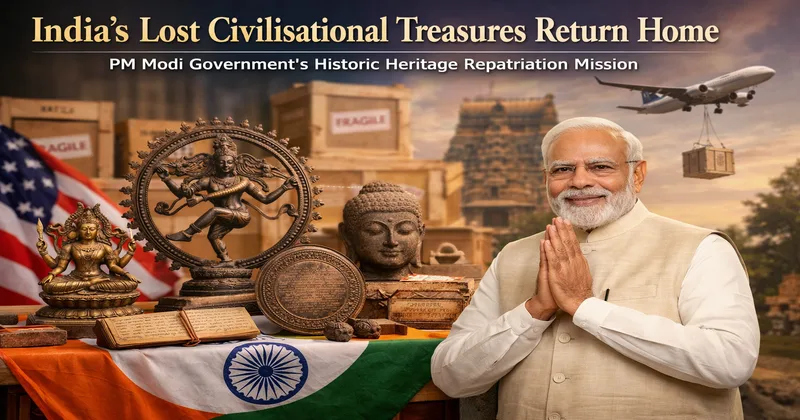
NEW DELHI: India has witnessed an unprecedented revival of its civilisational pride under the leadership of Narendra Modi, with more than 640 stolen antiquities and sacred artefacts brought back to the country since 2014. From ancient temple idols and Chola bronzes to rare manuscripts and dynastic copper plates, the large-scale repatriation effort is one of the world’s most remarkable efforts to restore and reclaim stolen cultural heritage in modern times. The recovery of these priceless treasures shows a major transformation in India’s approach towards protecting and reclaiming its own cultural heritage.
Between 1947 and 2014, only 13 stolen antiquities were officially returned to India. However, over the past decade, the Modi government has transformed heritage repatriation into a major diplomatic and cultural priority, leading to the return of hundreds of artefacts from countries across the world.
Officials and heritage experts have described the development as more than just the recovery of historical objects. According to them, the return of these artefacts represents the restoration of India’s civilisational identity, spiritual traditions, and historical memory that had been scattered across global black markets and private collections for decades.
The repatriated objects include sacred murtis of mandirs, bronze sculptures, Chola-era artefacts, ancient manuscripts, stone carvings, coins, ceremonial objects, and rare copper plates linked to India’s medieval dynasties. Many of these artefacts had been smuggled out of India through illegal trafficking networks operating over several decades, particularly targeting temples in southern India.
Under PM Narendra Modi Ji’s (@narendramodi ) leadership, India has witnessed an unprecedented recovery of its stolen civilisational heritage. 🇮🇳
▪️ 640+ antiquities and sacred artefacts brought back to Bharat since 2014
▪️ Returned in just 10–11 years, compared to only 13… pic.twitter.com/vAyfZrlx30
— Pradeep Bhandari(प्रदीप भंडारी)🇮🇳 (@pradip103) May 17, 2026
One of the earliest and most symbolic victories came in July 2014, when Australia returned the sacred Sripuranthan Nataraja murti, a priceless Chola-era bronze stolen from a temple in Tamil Nadu. The murti’s return drew global attention and signalled the beginning of an aggressive diplomatic campaign by India to reclaim its stolen heritage.
The United States has emerged as the largest contributor to India’s repatriation efforts. It has returned more than 578 antiquities in recent years. In November 2014, the US handed over 61 Indian antiquities, including ancient bronze murtis and temple artefacts. This was followed by the return of 19 more antiquities in September 2015 connected to South Indian temple heritage.
In January 2016, an important bronze murti of Devi stolen from Tamil Nadu temples was returned to India. Later that year, in November 2016, India received 111 antiquities from the United States, which at the time was among the largest returns of stolen heritage objects in the country’s history.
The momentum continued over the following years. In July 2019, the United States handed over 68 artefacts, including rare Chola bronzes and ancient sculptures. In October 2020, another massive consignment of 157 stolen antiquities was returned to India, reinforcing growing international cooperation against cultural smuggling.
In December 2021, further artefacts were repatriated when the United States returned 23 antiquities to India, including bronze idols and ancient coins. In July 2022, India received 70 more artefacts comprising manuscripts, sacred statues, and ceremonial objects connected to India’s spiritual traditions. During Prime Minister Modi’s visit to the United States in July 2023, another 50 antiquities were officially handed over. In January 2024, the US returned 29 additional artefacts linked to India’s ancient temple heritage.
Several other countries have also participated in the restoration of India’s cultural wealth. Singapore returned sculptures and manuscripts in 2017, while the United Kingdom handed over a rare 13th-century stone sculpture in 2018. Australia returned 17 Indian cultural artefacts in 2020, and the Netherlands repatriated several Indian sculptures and heritage objects in 2023.
Among the most historically significant developments was the return process related to the famous Leiden Plates. The 11th century Chola copper plates are associated with the reign of Rajendra Chola. The diplomatic efforts taken by the PM Modi government around these artefacts show the rising stature of India in global heritage discussions and renewed international respect for India’s cultural claims.
The campaign of protecting Bharat’s civilisational heritage involves diplomatic efforts, international legal support, archaeologists, and coordination between different agencies to trace and bring back stolen artefacts from around the world. The effort has also received widespread appreciation from historians, archaeologists, and cultural organisations, many of whom believe that India is now taking a far more assertive role in protecting its heritage than ever before.