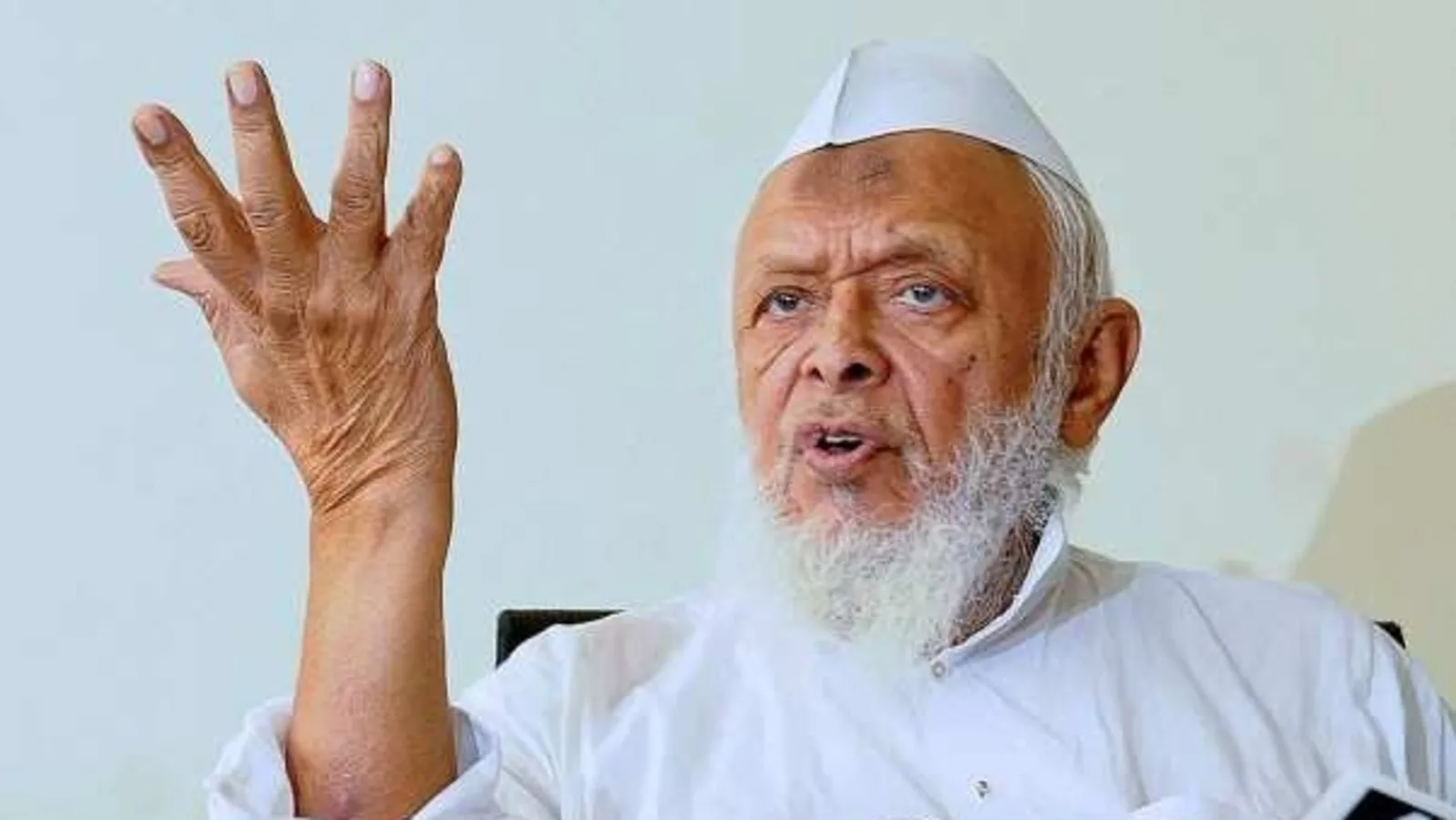
A fresh political controversy has erupted after Arshad Madani, president of Jamiat Ulama-i-Hind, issued a sharply worded declaration accusing the government and constitutional institutions of enabling “rising communalism,” targeting “Islamic symbols,” and allegedly attempting to intimidate Muslims in the country.
The statement was issued following a two-day meeting of the Working Committee of Jamiat Ulama-i-Hind, where the organisation claimed that the “current situation in the country” was “extremely alarming.” However, Madani’s aggressive tone and repeated references to Muslims “never bowing down” that immediately drew attention and criticism on social media and political circles.
“Muslims have never bowed down and will never bow down. They may bow out of love, but they can never be subdued through force, threats, or oppression,” the declaration stated.
The organisation further alleged that “politics of hatred” in India had transformed into “politics of intimidation,” claiming there was an attempt to force Muslims to “live under imposed conditions.”
Why are Madani’s remarks raising questions?
The language used by the Jamiat leadership appears deliberately confrontational at a time when debates around the Uniform Civil Code (UCC), madrasa reforms, illegal encroachments, Waqf issues and voting transparency are already politically sensitive.
Many have questioned why reforms being debated constitutionally and democratically are repeatedly being projected by Islamist bodies as “attacks on Islam” rather than policy matters open to legal and public scrutiny.
Declaration of the Two-Day Meeting of the Working Committee of Jamiat Ulama-i-Hind:
The current situation in the country, the rising communalism, the silence of constitutional institutions, the increasing measures against Muslims and Islamic symbols, and politics based on hatred…
— Arshad Madani (@ArshadMadani007) May 17, 2026
In its declaration, Jamiat specifically attacked measures such as the Uniform Civil Code, making “Vande Mataram” mandatory, action against mosques and madrasas, and voter verification exercises, describing them as part of a “planned attempt to transform the country into an ideological state.”
The statement further claimed that “earlier only Muslims were targeted; now Islam itself has become a target.”
Such rhetoric attempts to blur the line between criticism or reform of institutions and an attack on an entire religion, thereby emotionally mobilising the Muslim community around fear and identity politics.
“Islam under threat” narrative resurfaces
This is not the first time sections of clerical leadership have framed legal or administrative measures as existential threats to Islam.
The Jamiat declaration repeatedly invoked historical and religious imagery, stating that “history bears witness that those who sought to erase Islam themselves vanished,” while asserting that Islam “will remain alive until the Day of Judgment.”
Such remarks have raised concerns many argue that instead of encouraging integration and constitutional engagement, hardline rhetoric risks deepening communal polarisation and reinforcing a siege mentality within parts of the Muslim community.
Questions are also being raised about whether invoking phrases like “Muslims will never bow down” serves any constructive democratic purpose or whether it is intended to signal political resistance and communal consolidation ahead of future electoral battles.
Debate over constitutional reforms intensifies
A major portion of the Jamiat statement focused on opposition to the Uniform Civil Code and actions against illegal madrasas and disputed religious structures.
However, supporters of these reforms argue that issues like gender justice, uniform legal rights and regulation of educational institutions are constitutional matters that affect governance and accountability, not attacks on religion.
Similarly, singing “Vande Mataram” or discussions around common civil laws have been debated publicly for decades and cannot automatically be equated with persecution of minorities.
The declaration also accused constitutional institutions of maintaining “silence,” an allegation that has sparked counter-questions over whether repeated attempts are being made to undermine public trust in democratic institutions whenever decisions do not align with the demands of certain pressure groups.
West Bengal remark adds Political angle
The Jamiat statement also referred to a reported remark by a newly elected West Bengal Chief Minister allegedly saying he would “work only for Hindus,” calling it unconstitutional and divisive.
While the organisation attempted to position itself as defending constitutional values and minority rights, many argue that Jamiat’s own language appeared equally polarising by repeatedly framing national political developments through a purely communal lens.
Several social media users questioned why Islamist organisations often oppose reforms or regulations concerning religious institutions by immediately portraying them as attacks on Islam rather than participating in broader democratic debate.
The controversy has once again revived larger questions surrounding identity-based mobilisation in Indian politics.
Organisations such as Jamiat Ulama-i-Hind continue to frame national debates almost exclusively through religious identity, portraying Muslims as permanently under siege while avoiding introspection on issues such as reform, modernisation, gender rights and radicalisation within sections of the community.
Others fear that repeated use of emotionally charged language may further sharpen communal divisions at a time when the country is already witnessing heated political polarisation.
Regardless of intent, the declaration has intensified political debate over whether such rhetoric contributes to democratic dialogue or fuels deeper mistrust between communities.