For centuries, the sacred confluence at Prayagraj has been revered as the meeting point of three rivers: the visible Ganga and Yamuna, and the unseen Saraswati. To millions of Hindus, this was never a matter of doubt or metaphor but a living truth carried through ritual and faith, even when it eluded physical sight.
And now this new research finding by the CSIR, the Council of Scientific and Industrial Research, vindicates the Sanatan belief in what their ancestors told them. After all, the CSIR, established in 1942 and headquartered in New Delhi, is India’s largest government-funded multidisciplinary research and development (R&D) organisation with no mean credentials. It operates as an autonomous body under the Ministry of Science and Technology, Government of India.
A Scientific Discovery Beneath the Doab
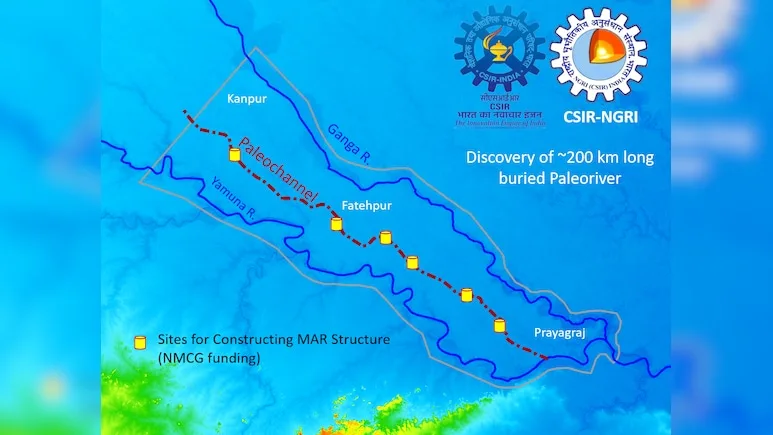
The recent discovery by scientists from the CSIR-National Geophysical Research Institute has introduced a powerful new dimension to this belief. Using heliborne transient electromagnetic technology and confirmatory drilling, researchers have identified a nearly 200 kilometre long palaeo-channel buried 10 to 15 metres beneath the surface between Prayagraj and Kanpur.
This is not a minor or fragmented formation. The channel is estimated to be 4 to 5 kilometres wide and lies at a base level comparable to both the Ganga and the Yamuna. Its scale, structure and depth have led scientists to conclude that it is not merely an abandoned course of an existing river but could represent an entirely separate and independent river system.
https://t.co/1opGDSZ4Mb@DrJitendraSingh @DrNKalaiselvi @DrShaileshNaya1 @CSIR_IND #ngri
— CSIR-NGRI Offl. A/c (@csirngri) May 13, 2026
Dr Subhash Chandra, Senior Principal Scientist who led a team of scientists of CSIR-NGRI, has stated that the physical existence of this buried river has been confirmed through dedicated drilling. The channel also follows a meandering path similar to the two visible rivers, suggesting that it once flowed alongside them.
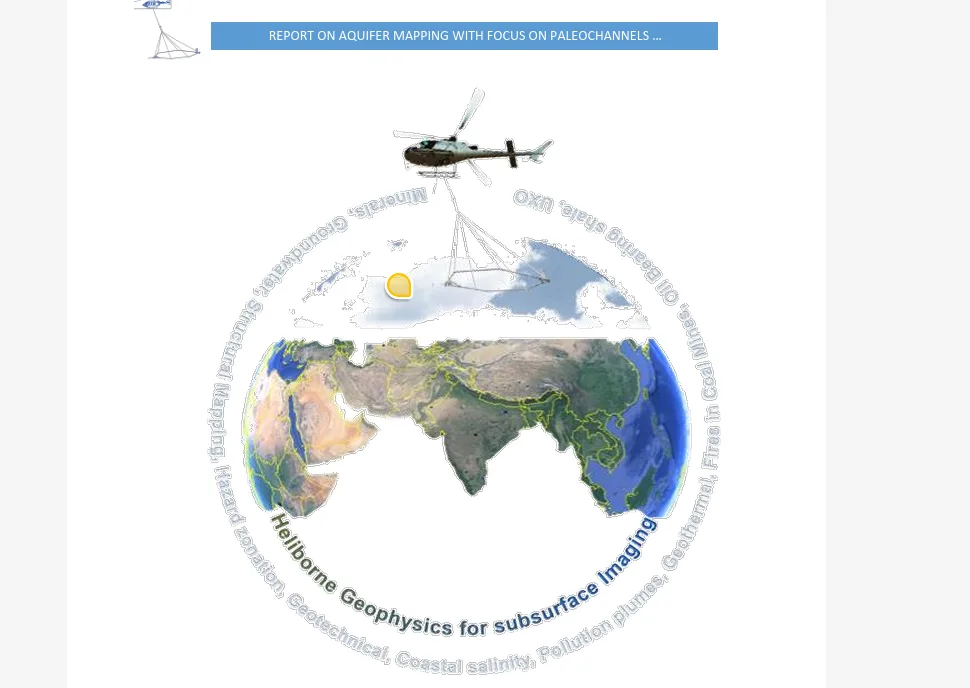
The CSIR-National Geophysical Research Institute (NGRI) uses Helicopter-borne Airborne Electromagnetic (AEM) surveys as a primary tool to map buried paleochannels (ancient, dried-up riverbeds). This technology transmits electromagnetic pulses into the earth, mapping subsurface resistivity to detect water-saturated, granular paleochannels hidden beneath thick alluvium.
“The 45 km long buried paleochannel that was discovered between Sarai Akil (Prayagraj) and Shamshabad (Kaushambi) villages, is found continuing with connectivity to further westward up to Kanpur that adds ~160 km additional buried course in meandering pattern passing through villages viz., Fura, Sultanpur Sato, Sangaon, Bindki, upto Devkali in the western margin of the study area. Total length of discovered paleochannel including its extension up to Kanpur exceeds 200 km,” reads the research paper.
Based on AEM results, ten shallow wells have also been drilled and logged with geophysical measurements that have validated the findings.
Saraswati and the Question of Memory
The immediate question that follows is inevitable. Could this be the Saraswati described in ancient Hindu texts?
Scientists have exercised restraint and have not formally identified the channel as Saraswati. However, the geographical alignment cannot be ignored. The discovery lies precisely in the region where Vedic literature situates the Saraswati, flowing between the Ganga and Yamuna and eventually disappearing.
For generations, the idea of an invisible Saraswati at the Sangam has persisted without physical evidence. Pilgrims have continued to invoke it, scriptures have continued to describe it, and tradition has refused to discard it. What modern science is now uncovering is not a validation of faith in simplistic terms, but a deeper recognition that civilisations often preserve knowledge in ways that transcend written documentation.
This raises a more profound possibility. What if the Saraswati was never mythology but memory, carried forward across centuries even after the river itself vanished from the surface?
The Role of CSIR-NGRI and Policy Support
The discovery also reflects the importance of institutional intent and scientific commitment. The project gained momentum during the tenure of BJP-led NDA government with Uma Bharti as Union Minister for Water Resources, when a directive was issued to investigate groundwater systems in the Ganga basin using advanced geophysical tools. Uma Bharti’s directive was that the Doab area be explored for the possible insights into the pre-existence of a river system now gone dry.
This led to extensive surveys across the Ganga Yamuna Doab, eventually mapping over 5000 linear kilometres of subsurface data. The result is one of the most significant hydrological discoveries in recent Indian research.
The CSIR-NGRI team has demonstrated how modern science, when supported by policy vision, can uncover layers of history that were long assumed to be lost or inaccessible. This is not about confirming belief but about expanding the scope of inquiry to include questions rooted in India’s own civilisational framework.
Water Security and National Relevance
Beyond its historical and cultural implications, the discovery has immediate practical importance. The palaeo-channel is composed of highly porous and permeable geological material, making it an excellent natural aquifer.
At a time when groundwater levels across the Gangetic plains are declining rapidly, this underground river system offers a critical opportunity. Scientists have already identified multiple sites where managed aquifer recharge can be implemented. By directing rainwater and surplus surface water into this channel, it is possible to replenish groundwater reserves and support river flow during dry seasons.
This transforms the find into a strategic resource for water management, with the potential to benefit millions.
Science and Civilisation Converge
The rediscovery of a buried river beneath the Prayagraj Kanpur stretch marks a rare convergence of science and civilisational continuity. For decades, the narrative around India’s past has often oscillated between uncritical glorification and dismissive scepticism.
This discovery offers a more grounded path. It shows that traditional knowledge systems may contain kernels of historical truth that modern methods can investigate and understand. It also reinforces the idea that absence of evidence is not evidence of absence, especially in a land where knowledge has often been preserved through oral and ritual traditions.
The Saraswati debate will continue, as it should. Scientific validation requires time, data and interdisciplinary study. But one fact is now firmly established. A third major river system once flowed between the Ganga and Yamuna and now lies hidden beneath the earth.
A Story Still Unfolding
At the Triveni Sangam, where faith has always spoken of three rivers, science has now identified the physical traces of a third.
Triveni is a Sanskrit word that translates to “confluence of three sacred rivers” (from tri meaning three, and veni meaning braid or stream).
Whether this channel is ultimately linked to the Saraswati or not, it has already reshaped the conversation.
India’s past is not a closed chapter waiting to be interpreted. It is a layered narrative that continues to reveal itself through discovery, inquiry and memory.
Sometimes, what a civilisation remembers turns out to be closer to truth than what history once chose to record.