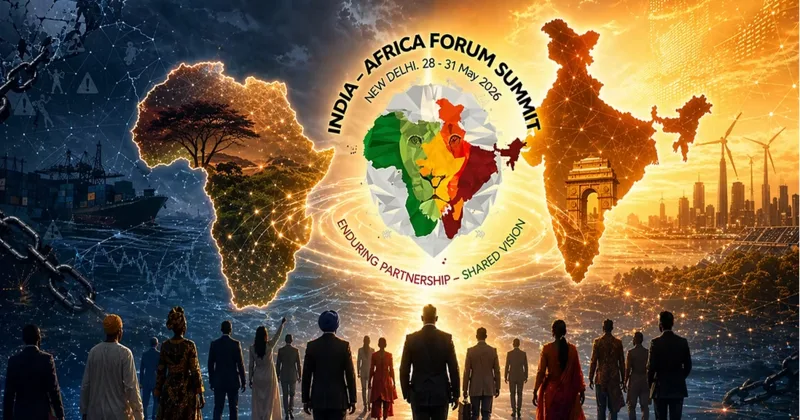
Summit level institutional dialogue becomes a significant government-led steady initiative in Bharat’s invigorated outreach to Africa in recent years. Significantly, the India-Africa Forum Summit (IAFS-IV) is going to be held in New Delhi on May 31, 2026 in collaboration with the African Union Commission under the theme “IA SPIRIT: India Africa Strategic Partnership for Innovation, Resilience and Inclusive Transformation.” This summit builds upon the strong foundation laid by the previous three India-Africa Forum Summits culminating in the adoption of three declarations and the three roadmap documents along with ten points Uganda principles.
The Third India-Africa Forum Summit (IAFS-III), held in New Delhi from 26–30 October 2015, was organized under the theme “Partners in Progress: Towards a Dynamic and Transformative Development Agenda,” during which the Delhi Declaration and the India-Africa Framework for Strategic Cooperation were adopted. Prior to this, the Second Africa India Forum Summit was held on 24–25 May 2011 in Addis Ababa under the theme “Enhancing Partnership: Shared Vision,” resulting in the adoption of the Addis Ababa Declaration and the Africa India Framework for Enhanced Cooperation. The First India-Africa Forum Summit, held in New Delhi from 8–9 April 2008 under the theme “Partners in Progress: Towards Sustainable and Inclusive Development,” marked the beginning of this institutional partnership and led to the adoption of the Delhi Declaration and the India Africa Framework of Cooperation.
It is a matter of gravest concern that this IAFS initiative has been subjected to perceived gap in genuine academic stakeholder ship. As people’s linkages essentializes natural interrelationship between Bharat and Africa, three fundamental questions are, therefore, raised here. First, what is the historical insight of this partnership? Second, what are the contemporary nuances of it? Third, what is the role of academia in such partnership? Pertinently, continuity, captivity and creativity define contour of connectivity among people in Bharat and Africa.
Bharat and Africa share common geo-cultural space that makes their interlinkages natural and historic. Their pre-existing connectivity that is predicated upon spontaneous exchange of ideas and needs degenerates into confinement of lives and livelihood under slavery and colonialism. This painfully brutalizing process of seizing people and land has manifold motivational dimensions including theological mission, military misadventurism, resource extraction, skill deprivation, capital-technology formation, political domination and above all the terrible complex of West European civilisational exceptionalism. As civilizational march is an end-less course, its decisive discontinuity is reversed by a strong moral critique, forceful resistance, exhaustion in inter-imperial wars, and sense of elevated confidence among colony soldiers and commanders. It leads to inevitability of political decolonization, subsequent economic liberalization and ongoing cultural resurgence.
The quest for resource sovereignty and self-ownership of production defines the common aspirations that are expressed by public sector-led command economy model and state-led import substitution industrialization in independent Bharat and countries in Africa while confronting cold war syndrome. The historic resolution for New International Economic Order (NIEO) in Lusaka Summit of NAM 1970 is a case in point. When the civilizational march moves from political decolonization to economic liberalization, private sector-led demand economy and market-driven export-led growth paradigm underpin economic rationalization and structural adjustment campaigns in Bharat and Africa under the overarching influence of ‘Triumph of Liberalism’. Here, trade is preferred to aid, necessitating retrieval of systemic depleted capacity. It coincides with proclamation of ‘African Renaissance’ while going for New Partnership for Africa’s Development (NEPAD).
The political decolonization and later on economic liberalization, however, hardly make any difference to accentuating perpetuation of global production asymmetry under controlled resource transfer pacts namely, Lome and Cotonou conventions. It is a vivid illustration of coloniality traveling to normative, institutional and procedural edifices of formally independent countries, consequently impelling their ongoing tryst with cultural resurgence. As Prime Minister of Bharat Narendra Modi vouched in Johannesburg in July 2016 for Vasudhaiva Kutumbkam and Ubuntu as global templates of unity in existence and shared prosperity. Endeavours and commitments for intra-continental synergy in Africa have been encouraged by constant elevation in its comprehensive partnership with Bharat through her mutually reciprocal policy frameworks namely, ITEC schemes, Focus Africa programmes, TEAM-9 initiatives, Pan-Africa E-Network and IAFS processes. It serves enlightened interests in reversing entrenched fragmentations in political and other related spheres inflicted by continued coloniality and unleashing regenerative potential of both Bharat and Africa. Aptly, clarion call for Adhyatamik and Viksit Bharat of 2047 coincides with a deep urge for collective self-reliant Africa under Agenda 2063, inspiring Bharat-led efforts in mainstreaming African Union through its much needed induction into nucleus of the global power configuration grouping G-20.
Culturally resurgent partnership between Bharat and Africa tends to shape evolving cosmic habitations and eco-conscious aspirations that ensure happiness in lives and dignity in livelihood, owing to their valued and shared nature worship heritage. It pre-supposes function of a comprehensive development matrix comprising sustainable production, all-inclusive distribution, ethically restrained consumption. Academia is a natural stakeholder in this inescapable trajectory of progress, as much talked about ‘triple helix’ approach suggests tri-leveled interventions of intellectual curiosity for fundamental knowledge, social value creation of such treasures by business and other related stake-holders, conducive governance milieu of public authorities in the best possible societal interests aspired in cosmos including Bharat and Africa.