India’s eastern frontier faces real and documented threats. But conflating border security with cartographic conspiracy theories does not make the nation safer, it makes the conversation harder.
The map continues to exist because it first appeared at Dhaka University in April 2025 and later appeared on a book cover which Muhammad Yunus presented to Pakistan’s military chief in October of that same year. The map currently exists because Indian television studios and social media platforms repeat the same question: does Bangladesh want to swallow eastern India? The honest answer, which tends to get lost in the noise, is this, no credible evidence suggests that the government of Bangladesh has any such territorial doctrine. But that inconvenient fact does not mean India has nothing to worry about on its eastern frontier. It means we are worrying about the wrong things.
4,156 Total km of India-Bangladesh border.
2,216 km of border shared with West Bengal alone.
6,400+ Bangladeshi nationals apprehended 2017-2021.
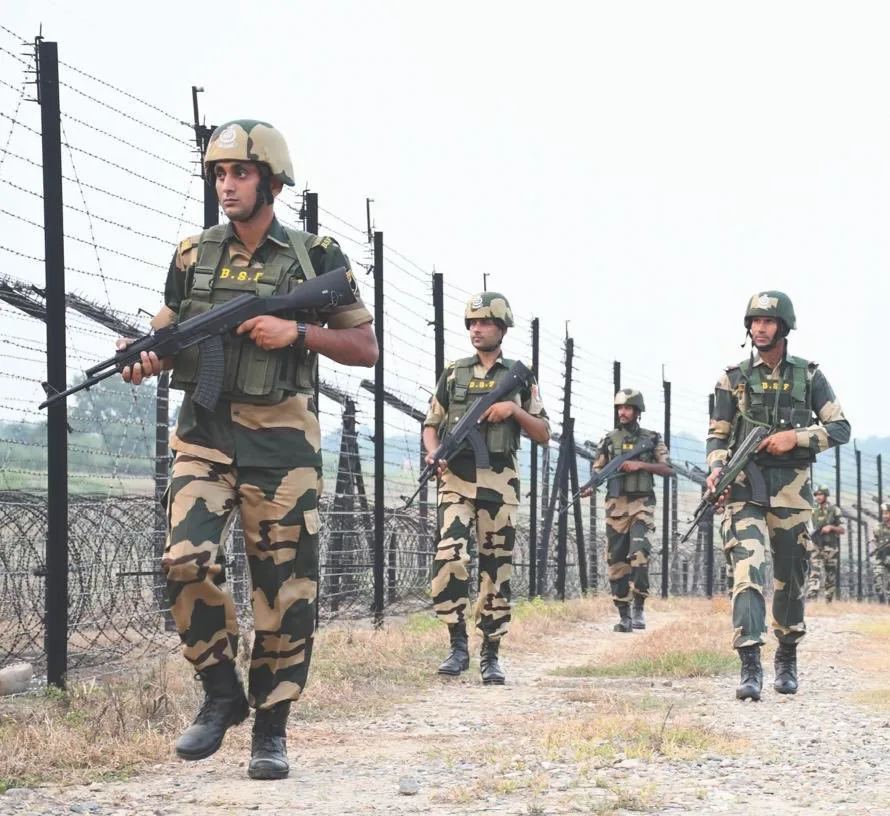
Let’s introspect with what is established. West Bengal has the longest border with Bangladesh among all Indian states which stretches for approximately 2216 kilometers. The border includes extensive river areas which prevent the installation of traditional fencing systems. Villages sit on both sides of boundary lines that colonial administrators drew with little regard for the communities they bisected. Cross-border movement has been a feature of this landscape for a century, not a recent invention of any political actor. Today undocumented migration has developed complex operational systems which enable local agents to manage border crossings while illegal identity documents and Aadhaar cards and ration cards and PAN cards exist within networks that sell them at prices between ₹15,000 and ₹50,000 for each set. The Indian authorities between 2017 and 2021 detained more than 6400 Bangladeshi citizens who entered the country without permission. For every person caught, the number who passed through undetected remains unknown, and that is the operative security problem.”
These are real enforcement failures, documented by the Enforcement Directorate, the NIA, and state police forces across multiple governments of different political persuasions. The 2024 Jharkhand raids discovered printing machines that produced counterfeit identification documents which made the operation an India-wide news event that did not belong to either the BJP or the Congress party. The West Bengal authorities took no strong measures against this situation because they saw it as a political risk which would damage their chances of winning elections so they preferred to ignore the problem instead of facing accusations of targeting specific religious groups.
The map that launched a thousand editorials
Into this genuine and documented vulnerability, the “Greater Bangladesh” narrative arrived like a lit match near petrol. The April 2025 exhibition at Dhaka University displayed a map associated with the historic Bengal Sultanate, a medieval polity whose boundaries bore no relationship to modern nation-states. The group behind the display, “Sultanat-e-Bangla,” reportedly had links to a Turkish NGO, viz. Turkish Youth Federation. Bangladesh’s own fact-checking platform found no evidence of the group being operationally active in the country, and exhibition organisers denied any political agenda. None of this complexity survived the journey from Dhaka to Delhi’s prime-time news cycles.
The October incident involving the book viz. Art of Triumph (or Art of Triumph: Graffiti of Bangladesh’s New Dawn), gifted to Pakistan’s army chief Munir was more significant, not because of the map on its cover, which Bangladesh’s government called fabricated reporting, but because of what the meeting itself signalled. Yunus hosting Pakistan’s military leadership for conversations about defence cooperation, at a time when Sheikh Hasina’s ouster had already created strategic uncertainty, was legitimately worth scrutiny. India’s Ministry of External Affairs was right to monitor it closely. The map was a distraction from the more consequential diplomatic reality.
The real geography of Indian concern
India’s actual strategic anxieties about its eastern frontier are more complex, and more serious, than any cartographic fantasy. The Siliguri Corridor, which serves as the main land connection between Northeast India and the rest of India, constitutes the country’s most critical geographic vulnerability. The Indian assessment of its security situation depends on any external intervention that occurs during times of unrest in Bangladesh when foreign powers engage in activities within the Bay of Bengal area, this directly affects India’s calculus. Yunus’s description of Bangladesh as the “only guardian of the ocean” for India’s landlocked Northeast, made during his April 2025 China visit, was a pointed diplomatic signal, not an exhibition of naivety, but of negotiating leverage. India should read it as such.
Claim verification summary
True – Map displayed at Dhaka University (April 2025), historical exhibition, political intent disputed
Context – Bangladesh government has no official “Greater Bangladesh” territorial doctrine
True – West Bengal border is extensively documented as India’s most porous land frontier
True – Forged Aadhaar, ration cards, PAN cards, established racket, verified by ED raids
Pending – BJP’s 45-day border fencing promise, government just formed; timeline not yet verifiable
True – BJP now governs West Bengal, Assam, and Tripura, all three primary Bangladesh-facing states
After May 4: promise meets geography
The BJP’s decisive victory in West Bengal on May 4, 2026, 207 of 294 seats, does change the structural conditions for border management. The three states that border Bangladesh face their first opportunity for operational coordination because all three states West Bengal, Assam, and Tripura now have their respective governments controlled by the same political party. Assam Chief Minister Himanta Biswa Sarma has called the West Bengal result “India’s victory,” and on the narrow question of border security, there is logic to that framing. A deportee rejected by Assam who simply re-entered through West Bengal was not really deported at all. Under the Suvendu Adhikari government this gap will be fulfilled and the borders will be tightened.
The 45-day fencing promise requires serious attention because it should be treated as a commitment instead of being regarded as an accomplishment. Home Minister Amit Shah’s pledge required land to be made available for fencing which served as the essential requirement before actual fencing could begin. The rivers will continue to flow without interruption. The communities that straddle the boundary will not disappear. The forged-document networks will not dissolve because a new government has taken office. What can change is political will and resource allocation. Whether they actually change is a question that deserves a factual answer in 45 days, not a partisan one.
The larger lesson of the “Greater Bangladesh” episode is not about Bangladesh at all. It is about the Indian information environment. The Bangladesh government recognizes the existence of a geopolitical doctrine which emerged from a fringe historical exhibition and a book cover that evolved into the official Bangladesh national doctrine. The actual dangerous situation which involves Pakistan-Bangladesh defense cooperation and Chinese military activities in the Bay of Bengal and the Siliguri Corridor security risks received only limited media attention. India maintains actual security dangers along its eastern border. The map debate was mostly not one of them. Keeping that distinction clear is not naivety. It is the precondition for any serious response.