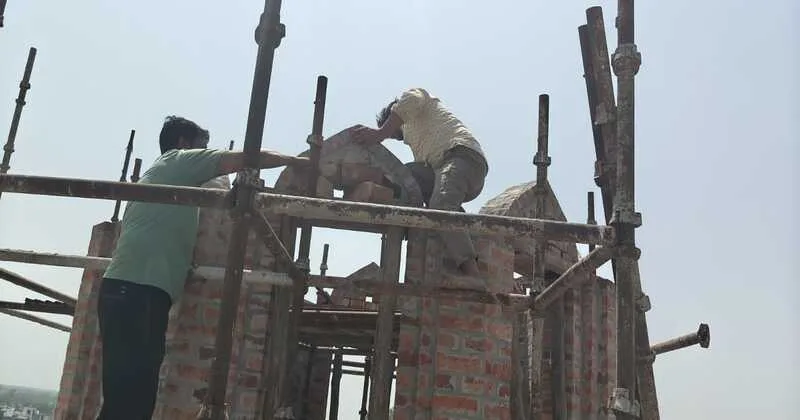
HARIDWAR: In the Sultanpur Nagar Panchayat of Haridwar district—often referred to as the capital of Sanatan culture in Uttarakhand—an administrative team arrived to halt construction work on a mosque. The team issued a stern warning to the mosque managers to demolish the minarets themselves, failing which the administration would proceed to seal the entire complex.
Haridwar District Magistrate (DM) Mayur Dixit stated that taking cognizance of reports circulating on social media regarding the mosque building and its minarets, a notice had previously been served to the management. Despite the notice, the illegal construction was not removed. Today, under the leadership of the SDM, an administrative team revisited the site and warned the managers that the premises would be sealed if the unauthorized construction was not dismantled. Following this, the management began the process of self-removing the objectionable minarets.
DM Dixit added that the unauthorized structure is being dismantled using the same systematic process by which it was erected.
Context of the Controversy
It is worth noting that about ten months ago, the construction and towering minarets of what is touted as Uttarakhand’s largest mosque were found to violate standard guidelines. Furthermore, no prior permission had been sought from the district administration or the local development authority. Recently, scaffolding (bullies) was spotted at the site again, indicating a resurgence in construction activity.
When the matter gained traction on social media, DM Haridwar ordered a halt to the construction and issued a formal notice, after which work was temporarily suspended.
The Mosque Came into the Spotlight in October 2025
The construction of Uttarakhand’s largest mosque in the Sultanpur Nagar Panchayat area of Haridwar district, along with the sheer height of its minarets, had previously made major headlines. Although the Haridwar district administration halted the work and issued a notice, no response was reportedly received—making it evident that the mosque was being constructed without any government authorization.
Per Supreme Court directives from 2009 and 2016, no religious building or structure can be constructed without the explicit permission of the District Magistrate. The rationale behind this directive is twofold: to ensure that religious structures are not built on government land, and to ensure that every safety aspect is thoroughly evaluated during construction.
Multiple Mosques Operating Without Permissions
Data available with the Uttarakhand government indicates that over 722 mosques have been constructed across the state. The highest concentration is in the sacred Ganga district of Haridwar, which accounts for 322 mosques.
Additionally, there are 155 mosques in Dehradun district, 144 in Udham Singh Nagar, and 48 in Nainital district. Notably, grand expansion or beautification work is reportedly underway in almost all of these locations. Observers note that in certain identified areas, mosques have begun expanding aggressively in both scale and grandeur, almost as if competing to build the tallest minarets or the largest structure.
Encroachment on Government Land
A major point of concern is that none of these projects are seeking the requisite construction permits. This is largely because securing administrative approval requires submitting land deeds, institutional registration, and financial/audit records—documents that many mosque managements lack. Several of these structures have reportedly been built by encroaching on government land and were subsequently registered with the Waqf Board. Consequently, the administration historically hesitated to take punitive action.
Similar complications surfaced recently during the drive to register Waqf Board properties on the ‘Umeed’ portal. Meanwhile, local Sanatan organizations have expressed concern over the rising proliferation of Islamic symbols across Uttarakhand, the land of the gods (Devbhoomi).
Violation of Regulations
According to reports, standard construction guidelines were completely ignored during the building of this mosque. Since no structural blueprint or map was approved, no No-Objection Certificates (NOCs) were obtained from the Fire Safety Department, the Public Works Department (PWD), or any other concerned authority.
Typically, when a citizen builds a house, strict standards dictate the permissible height and parking spaces. However, no such parameters were followed here. While the permissible height for residential or commercial buildings in hilly regions is restricted to 12 meters, plains allow up to 30 meters (approximately 100 feet). In contrast, the mosque’s 250-foot-tall minaret is deemed non-compliant at first glance under any standard metric. Furthermore, regulations mandate that any structure exceeding 100 meters requires state government clearance alongside structural technology approvals from institutions like the IIT.