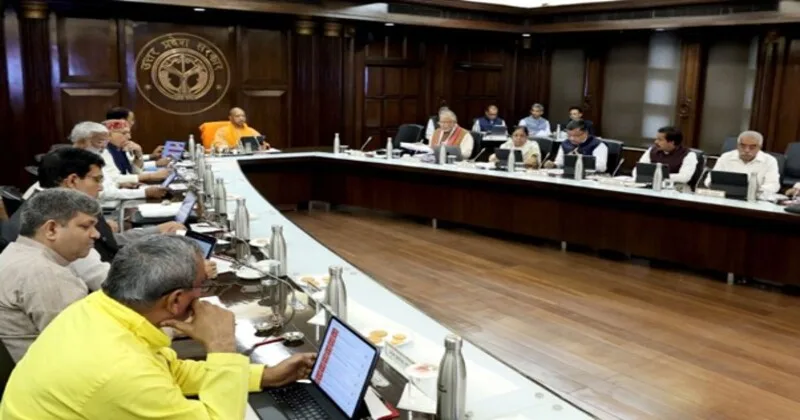
In a decisive representation of unity with Prime Minister Narendra Modi call for national discipline and resource conservation, Chief Minister Yogi Adityanath chaired the first meeting of his expanded cabinet in Lucknow, thus issuing a comprehensive set of directives that reflect both administrative resolve and a deep sense of national duty. The meeting focused over Uttar Pradesh, which intends not just to follow the Centre’s lead but to set a benchmark for the rest of the nation.
A Nation First Approach
At the heart of the cabinet meeting was an unambiguous message fuel conservation is not only an economic necessity, it is a national obligation. Drawing from Prime Minister Modi’s appeal to citizens in the context of prevailing global conditions, CM Yogi made clear that his government would model the very behaviour it expects from the people of Uttar Pradesh. “The UP cabinet must itself set an example,” the Chief Minister emphasised while framing the initiative not as a bureaucratic exercise but as a patriotic commitment.
In an era when global energy markets remain volatile and geopolitical uncertainties continue to affect supply chains, PM Modi call for austerity and self-reliance has found a strong institutional echo in Lucknow. Yogi cabinet has operationalised that appeal into concrete, measurable policy directives by turning a national vision into state-level action.
Ministers to Take Public Transport : A Symbolic and Substantive Step
Among the directives there is a instruction, that all ministers will use public transport metro, bus, e-rickshaw or carpooling at least one day every week. This decision carries both symbolic and practical weight. At a time when civic culture in governance often runs parallel to the lives of ordinary citizens, the UP Cabinet is being asked to bridge that gap.
The government has also mandated a 50 per cent reduction in its official vehicle fleet. Combined with a six-month moratorium on foreign travel by ministers and senior officials, these measures represent a significant shift in how the state’s administrative machinery will function. The emphasis is on doing more with less and doing it visibly.
Digital Governance and Hybrid Work: Building for the Future
CM Yogi directives go beyond immediate cost-cutting. The meeting laid the groundwork for a longer-term transformation of UP’s governance culture. Interdistrict meetings, training programmes and government consultations are to be conducted increasingly in hybrid mode thus, reducing travel costs, minimising carbon footprint and ensuring that governance is not held hostage to logistical constraints.
Work-from-home arrangements are to be actively promoted where applicable and the use of digital tools across the administration is to be expanded. These are not radical decision, but it will build on a trajectory the Modi government has championed nationally of tech-enabled, lean and citizen-centric governance.
Energy Conservation as a Cultural Shift
Inside government offices, the Chief Minister directed that air conditioners be maintained between 24 and 26 degrees Celsius in line with national energy conservation norms and that natural lighting be maximised wherever possible. Electricity use is to be need-based, not default. These instructions, reflects an important philosophical principle that the state must itself practise what it preaches on sustainability.
CM Yogi also called for expanding the use of solar energy, electric vehicles and piped natural gas (PNG) over LPG across the state not as environmental policy, but as a mass movement. The vision is for these choices to become embedded in daily life, a Jan Andolan (people’s movement) that transforms consumption habits from the grassroots up.
Vocal for Local: Strengthening the Atmanirbhar Framework
Consistent with PM Modi Atmanirbhar Bharat (self-reliant India) vision, CM Yogi urged minimising the use of imported goods and prioritising local products in government procurement, in public life and even in social occasions. He called for domestic venues to be preferred for weddings and social gatherings, and specifically encouraged the gifting of products made in Uttar Pradesh.
UP is a manufacturing and agricultural powerhouse and embedding preference for locally made goods into social culture has real economic consequences supporting MSMEs, artisans and the broader UP economy.
What distinguishes the Yogi Cabinet decisions is their clarity of intent and comprehensiveness of scope. These are not aspirational resolutions but directive policy, backed by the Chief Minister’s personal commitment to leading from the front. Uttar Pradesh has, under Yogi Adityanath consistently positioned itself as a state that does not merely receive policy from New Delhi but internalises it while translating the Prime Minister’s national vision into governance on the ground.
As India navigates a complex global environment, this kind of support where states amplify and implement the Centre’s priorities with energy and conviction is exactly what the nation needs.