Four special commemorative postage stamps dedicated to India’s diverse handloom traditions will be released at the national function. During the event, two important publications Earth, Root, Thread: Aal Dyed Handloom Textiles of Central India and the Handloom Award Book 2025 will also be launched.
A total of 22 awards will be conferred for outstanding craftsmanship and innovation for the year 2025, comprising 3 Sant Kabir Handloom Awards and 19 National Handloom Awards. A special exhibition of award-winning handloom products will be organised for visitors, alongside live demonstrations of the traditional ‘Kani weaving’ and ‘wall-hanging weaving’ techniques.
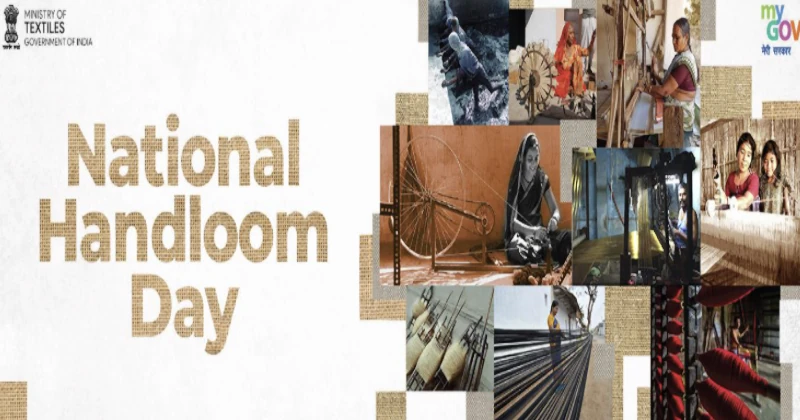
The Union Ministry of Textiles will observe the 12th National Handloom Day on 7 August 2026 at the Rashtrapati Bhavan Cultural Centre (RBCC) in New Delhi. President Droupadi Murmu will attend the national function as the Chief Guest. The occasion will also be graced by Union Textiles Minister Giriraj Singh, Union Minister of State for Textiles Pabitra Margherita, Secretary (Textiles) Neelam Shami Rao and Development Commissioner (Handlooms) Dr M. Beena. The celebrations will bring together Sant Kabir Handloom Awardees and National Handloom Awardees along with their families, handloom weavers from across the country, members of the Awards Selection Committee, eminent personalities associated with the sector and senior government officials.
According to the Ministry of Textiles, Indian handloom sector sustains the livelihoods of more than 35 lakh people, with women accounting for over 70 per cent of the workforce. This figure alone underlines that the handloom industry is not merely a traditional occupation but a powerful engine of rural and, in particular women’s economic empowerment.
National Handloom Day was first observed on 7 August 2015. The date was chosen, since it was on 7 August 1905, at Calcutta Town Hall, that the Swadeshi Movement was launched, calling on Indians to boycott foreign goods and embrace indigenous products. Prime Minister Narendra Modi linked this historic legacy to modern India’s pursuit of economic self-reliance when he instituted National Handloom Day in 2015. Every year since, the day has served as an occasion to honour the skill, dedication and creativity of Indian weavers, while reaffirming the government’s commitment to the preservation and sustainable development of the handloom sector.
How the Event Promotes Handicrafts and Handlooms
Occasions such as National Handloom Day are not a ceremonial event, its structure is designed to advance handicrafts simultaneously at the level of tradition, market and policy.
First, recognition and awards play a critical role. The Sant Kabir Handloom Award is the sector’s highest honour, conferred for a lifetime of dedication and exceptional craftsmanship, while the National Handloom Award recognises excellence in design innovation, weaving technique and product quality. Such awards are not merely symbolic, they translate into economic and social prestige for weavers, encouraging younger generations to take up and continue the craft.
Second, exhibitions and live demonstrations create direct contact between consumers and craft. Live demonstrations of intricate techniques such as Kashmir’s Kani weaving and wall-hanging weaving allow citizens, policymakers and the media to witness first-hand the complexity and labour-intensiveness behind products that otherwise appear only as finished pieces on a store shelf.
Third, the publication of books such as Earth, Root, Thread: Aal Dyed Handloom Textiles of Central India is significant from a documentation standpoint. Weaving traditions from Central India based on Aal, a natural vegetable dye, often remain outside mainstream fashion discourse. Such scholarly and illustrated documentation not only provides valuable reference material for researchers and designers, but also aids in preserving techniques that risk fading into obscurity.
Fourth, the release of commemorative postage stamps, though symbolic, carries lasting impact. Stamps become part of the national memory and institutionalise India’s handloom diversity as a permanent element of national identity, helping sustain a sense of pride in these crafts across generations.
What Has Changed in the Handloom Sector Since 2014
Following the change of government at the Centre in 2014, the handloom and handicraft sector was elevated to a policy priority. Previously, the sector remained largely fragmented, unorganised and on the margins of government schemes. Over the past decade, several concrete steps have been taken
National Handloom Development Programme (NHDP) This central sector scheme of the Ministry of Textiles includes components such as the Cluster Development Programme, Handloom Marketing Assistance, Mega Handloom Clusters, projects linked to Indian Institutes of Handloom Technology (IIHTs) and concessional credit. Under the Mega Handloom Cluster component, clusters with 15,000 or more looms receive assistance of up to roughly Rs 30 crore for world-class infrastructure.
India Handloom Brand Launched in 2015, this is a quality-certification mark for genuine handloom products, which has helped establish the authenticity of handmade textiles in both domestic and global markets.
Weaver MUDRA Scheme This has provided weavers with concessional working capital and credit, freeing lakhs of weaver families from dependence on moneylenders.
Raw Material Supply Scheme (RMSS) Weavers receive quality yarn at subsidised rates along with freight reimbursement, lowering production costs.
The Comprehensive Handloom Cluster Development Scheme and initiatives such as the e-Dhaga mobile app have streamlined the supply chain, while the Handloom Weavers Comprehensive Welfare Scheme has widened the net of social security.
Geographical Indication (GI) tagging has been pursued in mission mode, giving legal recognition and brand protection to weaving traditions such as Banarasi, Kanjeevaram, Chanderi, Pochampally and Sambalpuri.
The combined result of these efforts is that India today holds the largest share of the world’s handloom textile exports, reaching more than 125 countries. Over the past five years, handloom exports have recorded a compound annual growth rate (CAGR) of roughly 7 per cent. Aligned with the Digital India campaign, platforms such as GeM, Amazon Karigar and Flipkart Samarth have allowed weavers to reach consumers directly, reducing dependence on middlemen.
The pace of GI tagging is also worth noting. Darjeeling Tea became India’s first GI-tagged product in 2004-05, progress was slow initially but has accelerated markedly over the past decade. India now has more than 650 registered GI-tagged products, a significant share of which belong to the handloom and handicraft sector. This legal protection is more than certification, it is a shield for weavers’ economic interests. The recent controversy over an Italian luxury brand showcasing designs inspired by the GI-tagged Kolhapuri chappal without attribution is a reminder of how essential it is to safeguard the originality of Indian craft traditions internationally, with GI tagging serving as an important, if still insufficient, legal defence.
India’s Handicrafts on the Global Stage
Indian handicrafts and handloom products are no longer confined to the domestic market, they have become a powerful instrument of India’s cultural diplomacy worldwide. The Banarasi silk saree of Varanasi, Kanjeevaram silk of Tamil Nadu, Pashmina shawls and carpets of Kashmir, Pochampally Ikat of Andhra Pradesh-Telangana, Chanderi and Maheshwari of Madhya Pradesh, Sambalpuri and Ikat sarees of Odisha, Baluchari of West Bengal, Phulkari of Punjab, Bandhani and Ajrakh prints of Gujarat-Rajasthan, Chikankari embroidery of Lucknow, Madhubani paintings of Bihar, Channapatna toys of Karnataka and Jaipur’s Blue Pottery have all established a presence on international fashion ramps and as gifts to world leaders.
The presence of Indian handloom and handicraft items among the gifts presented to world leaders during the G20 Summit signalled that the government views these crafts not merely as economic activity but as an expression of soft power. Terms such as “saree diplomacy” and “khadi diplomacy” have entered international discourse as a means of projecting India’s cultural richness on the global stage. From fashion weeks to United Nations platforms, Indian handloom textiles are increasingly cited as examples in the global conversation on sustainable, eco-friendly fashion, given that the sector’s energy footprint is negligible and its production remains entirely hand-driven and pollution-free.
Despite these achievements, it would be premature to conclude that every challenge facing the handloom sector has been resolved. Competition from cheap powerlooms and machine-made imitations, the GST burden on raw materials, a declining interest among younger generations in this labour-intensive occupation and the continued grip of middlemen remain persistent issues. Sustained effort at the level of government, industry and consumers alike is needed to ensure that the distinction between genuine handmade products and machine-made copies is made clear to buyers, so that weavers receive fair value for their labour.
The 12th National Handloom Day is not merely an annual ritual but a reflection of the sustained policy journey that has, over the past decade, moved Indian handloom sector from the unorganised margins to the heart of Atmanirbhar Bharat and Vocal for Local. Awards, exhibitions, publications and postage stamps together ensure that the weaver at the loom remains not just an artisan, but a bearer of both Indian cultural identity and its economic self-reliance.