China raises Beijing–Shanghai high-speed rail fares by 20 per cent
June 9, 2026
  • Read Ecopy
  • Circulation
  • Advertise
  • Careers
  • About Us
  • Contact Us
Android AppiPhone AppArattai
Organiser
  • ‌
  • Bharat
    • Assam
    • Bihar
    • Chhattisgarh
    • Jharkhand
    • Maharashtra
    • View All States
  • World
    • Asia
    • Europe
    • North America
    • South America
    • Africa
    • Australia
  • Editorial
  • International
  • Opinion
  • RSS @ 100
  • More
    • Op Sindoor
    • Analysis
    • Sports
    • Defence
    • Politics
    • Business
    • Economy
    • Culture
    • Special Report
    • Sci & Tech
    • Entertainment
    • G20
    • Azadi Ka Amrit Mahotsav
    • Vocal4Local
    • Web Stories
    • Education
    • Employment
    • Books
    • Interviews
    • Travel
    • Law
    • Health
    • Obituary
  • Subscribe
    • Subscribe Print Edition
    • Subscribe Ecopy
    • Read Ecopy
  • ‌
  • Bharat
    • Assam
    • Bihar
    • Chhattisgarh
    • Jharkhand
    • Maharashtra
    • View All States
  • World
    • Asia
    • Europe
    • North America
    • South America
    • Africa
    • Australia
  • Editorial
  • International
  • Opinion
  • RSS @ 100
  • More
    • Op Sindoor
    • Analysis
    • Sports
    • Defence
    • Politics
    • Business
    • Economy
    • Culture
    • Special Report
    • Sci & Tech
    • Entertainment
    • G20
    • Azadi Ka Amrit Mahotsav
    • Vocal4Local
    • Web Stories
    • Education
    • Employment
    • Books
    • Interviews
    • Travel
    • Law
    • Health
    • Obituary
  • Subscribe
    • Subscribe Print Edition
    • Subscribe Ecopy
    • Read Ecopy
Organiser
  • Home
  • Bharat
  • World
  • Operation Sindoor
  • Editorial
  • Analysis
  • Opinion
  • Culture
  • Defence
  • International Edition
  • RSS @ 100
  • Magazine
  • Read Ecopy
Home World

China raises Beijing–Shanghai high-speed rail fares by 20 per cent amid rising energy costs and debt pressure

China’s decision to raise fares by up to 20 percent on its busiest high-speed rail corridor has triggered public criticism and renewed concerns over rising living costs, mounting railway debt and growing energy pressures linked to disruptions in oil supplies through the Persian Gulf and the Strait of Hormuz

Dr Vishnu AravindDr Vishnu Aravind
May 16, 2026, 10:10 am IST
in World, China, International Edition
Follow on Google News
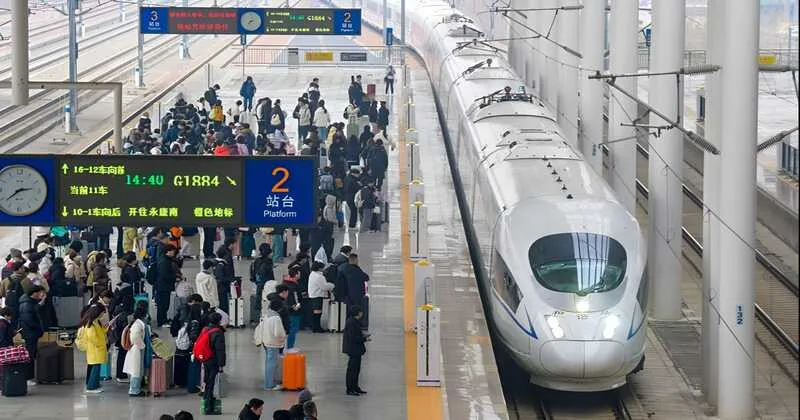
China’s Beijing–Shanghai high-speed rail corridor carries between 500,000 and 700,000 passengers daily

China’s Beijing–Shanghai high-speed rail corridor carries between 500,000 and 700,000 passengers daily

FacebookTwitterWhatsAppTelegramEmail

Beijing: China is set to increase fares on its busiest high-speed railway corridor by up to 20 per cent later this month, a decision that has triggered criticism online and intensified concerns about mounting economic pressure linked to energy costs, public debt and rising living expenses. The fare revision affects the Beijing–Shanghai high-speed railway, one of the country’s most heavily used transport corridors, which handles an estimated 500,000 to 700,000 passengers every day. The move comes at a time when China’s state railway system is carrying trillions of yuan in debt, while disruptions to oil supplies through the Persian Gulf are pushing up costs across multiple sectors of the economy. Beijing–Shanghai High-Speed Railway, the listed company operating the line, announced on May 11 that it would “optimize and adjust” ticket prices on the Beijing–Shanghai and Hefei–Bengbu routes beginning May 26.

Ticket prices to rise across multiple train categories

The revised pricing applies to high-speed bullet trains operating at speeds between 300 and 350 kilometers per hour, as well as services running between 200 and 250 kilometers per hour. The company said the changes were part of a “market-oriented pricing mechanism” and added that discounted fares would continue to be available depending on travel season, time slots and seating categories. The published fare serves as the upper limit for ticket pricing, meaning actual prices may continue to fluctuate. However, the new ceiling allows fares to climb roughly 20 percent higher than existing levels.
For example, a second-class ticket from Beijing to Shanghai that currently costs around 600 yuan, or about 88 US dollars, could rise by as much as 120 yuan, equivalent to roughly 18 dollars, under the revised system.

Also Read Five-Nation Visit : PM Modi secures critical crude and LPG deals in high-stakes UAE stop

The announcement quickly sparked backlash on state-controlled Chinese social media platforms, where many users questioned the justification behind the increase. One commenter mocked the official explanation, saying authorities were raising prices while simultaneously claiming the move was intended to “meet customer demand.” Another user wrote that high-speed rail had once represented affordability and convenience, but had gradually become too expensive for ordinary people.

Several passengers also pointed out that even conventional slower trains had become significantly more costly in recent years. One user said a ticket from Shanghai to Bengbu on a “green train” previously cost 34 yuan but had now increased to 62 yuan. Another recalled that train tickets between Shanghai and Hangzhou were slightly above 40 yuan when the line first began operations, but currently stand at around 70 yuan.

Energy costs and oil supply concerns

Many online discussions linked the fare increase to surging energy costs. One commenter argued that rising oil and electricity prices eventually affect all forms of transportation because operators pass those expenses on to consumers. Analysts monitoring China’s economy say the railway fare increase reflects growing pressure from the energy sector and could signal additional price hikes in other industries.

Although China’s high-speed trains operate on electricity rather than petroleum, economists note that the country still depends heavily on coal-fired power generation. Coal extraction, transportation and electricity grid operations all require extensive use of fuel-powered machinery and logistics networks.

As costs rise across those sectors, electricity generation becomes more expensive, ultimately increasing the operational burden on railway networks.
Economists have also linked the development to instability in global oil markets, particularly disruptions connected to the Persian Gulf.

China remains highly dependent on imported energy supplies, especially crude oil from Iran. Economists l warned that disruptions around the Strait of Hormuz could intensify cost pressures throughout China’s economy.

The Strait of Hormuz, a narrow but strategically critical waterway, carries roughly one-quarter of global seaborne oil trade. Since late February, vessel movement through the route has sharply declined after the United States and Israel carried out air strikes on Iran, followed by retaliatory Iranian efforts to obstruct maritime passage. Daily ship traffic through the strait has reportedly fallen to between two and five vessels, compared to nearly 70 ships per day before the conflict escalated.

Data from the U.S. Energy Information Administration showed Brent crude oil prices surged to 138 dollars per barrel on April 7, averaged 117 dollars throughout the month, and have remained above 100 dollars per barrel.

China is considered the most vulnerable major economy to disruptions in the strait. Around 45 to 50 percent of Chinese crude oil imports usually pass through the Hormuz route. China also accounts for 37.7 percent of all crude and condensate shipments moving through the passage, giving it greater exposure than any other country.

Concerns over inflation and consumer pressure

Economists say signs are emerging that Chinese households are increasingly preparing for future price increases by stockpiling essential goods and supplies. Some analysts believe the railway fare hike could become part of a broader trend affecting additional sectors in the months ahead.

The increase also highlights the financial strain facing China’s state-run railway system. According to the annual report of China State Railway Group, the company ended 2024 with total assets valued at 9.76 trillion yuan, or approximately 1.4 trillion US dollars, while liabilities stood at 6.2 trillion yuan, equal to around 910 billion dollars. In January, the company stated that it had reduced its debt-to-asset ratio by one percentage point to 62.5 percent by the end of 2025. Despite that adjustment, total debt levels still remain above 6 trillion yuan.

The Beijing–Shanghai fare revision follows similar increases introduced elsewhere across China’s rail network in 2024. Authorities previously raised maximum fares by roughly 20 percent on several major lines, including Wuhan-Guangzhou, Shanghai–Hangzhou, Shanghai–Kunming and Hangzhou–Ningbo routes. Officials attributed those adjustments to higher spending on maintenance, rolling stock, technical equipment and labor. The latest increase comes even as Chinese authorities continue urging local governments to stimulate domestic consumption and encourage household spending in order to support economic growth.


Topics: ChinaHike in high-speed rail fares
ShareTweetSendShareSend
✮ Subscribe Organiser YouTube Channel. ✮
✮ Join Organiser's WhatsApp channel for Nationalist views beyond the news. ✮
Previous News

Karnataka: Bonded labour racket busted in Vijayanagara, 37 Odisha workers rescued from brick kiln

Next News

Five-Nation Visit: PM Modi lands in Netherlands to deepen India-Europe trade and technology partnership

Related News

Chairman of the Rastriya Swatantra Party of Nepal Rabi Lamichhane meets PM Modi in New Delhi

From the China Card to Development Diplomacy: Nepal opens a new chapter in its political reset with India

Singapore acts against China-linked posts targeting Indian community, cites threat to social harmony

Singapore Invokes OCHA: Facebook, YouTube and X ordered to block anti-Indian content originating from China

As fuel shortages rippled across Asia, New Delhi expanded supplies to its neighbours while Beijing sought to turn energy security into strategic influence.

The Hormuz Test: How India’s energy assistance outshines China’s conditional approach

Bangladesh’s reported JF-17 push has triggered fresh scrutiny after India’s Ops Sindoor exposed the vulnerabilities of Pakistani-Chinese defence systems and precision strike capabilities

Shadows of Operation Sindoor: Questions loom over Bangladesh’s JF-17 ambitions amid Sino-Pakistani tech vulnerabilities

As Beijing tightens its grip ahead of June 4, dissidents inside China face surveillance and intimidation while activists abroad keep alive the memory of the 1989 Tiananmen crackdown

Tiananmen at 37: How China suppresses remembrance of the massacre through fear, censorship and surveillance

Tiananmen Square Massacre: When Tanks Met Students—The Night China Crushed Its Democratic Hope!

Tiananmen Square Massacre: When Tanks Met Students—The Night Communist China Crushed Its Democratic Hope!

Load More

Latest News

12 years of Modi Govt: Meaningful philosophy or manufactured phenomenon; Bharat’s tryst with democracy

Prime Minister Narendra Modi during an overseas visit, greeting members of the Indian diplomatic and community delegation upon arrival. (File Photo)

Trade, Defence and Diaspora: PM Modi eyes Indo-Pacific reset with three-nation tour

Accused Nida Khan reportedly admits taking victim for religious instruction, teaching Islamic rituals

Nashik TCS Corporate Jihad: ‘I taught her how to do namaz,’ says Nida Khan; victim pressured to observe 30 ramzan roza

Germany: Sri Ganesha temple opens in Berlin: Europe’s largest Hindu Mandir reflects India’s cultural & dharmic spirit

Rajasthn | RSS centenary journey embodies dedication to nation-building: Dr Ramesh Agrawal

Decades of illegal infiltration from Bangladesh have driven profound demographic shifts in Assam, fundamentally altering its religious, linguistic, and political landscape

Unnatural demographic change: The termite threat

The Rs 200-crore MAHA Water Mission seeks to boost water security and democratise research funding in India

From Rigveda to Research Labs: How ANRF’s Rs 200 crore water mission is securing India’s future

(Right) Prakhar Shrivastava, Senior Consulting Editor and Anchor at Delhi Doordarshan Kendra at a Narada Jayanti programme in Guwahati (Left) Prakahar Srivastava addressing the gathering

Narada Jayanti by VSK Assam: “Half-truths more dangerous than lies,” says senior journalist Prakhar Shrivastava

Everest Survivor being taken to the hospital on a stretcher

Everest Survivor ICU Interview: BBC under fire for interviewing Sherpa without family’s consent

Phillipines Earthquake: 7.8 magnitude deadly earthquake leaves 15 dead, 200 injured; Rescue operation underway

Load More
  • Privacy
  • Terms
  • Cookie Policy
  • Refund and Cancellation
  • Delivery and Shipping

© Bharat Prakashan (Delhi) Limited.
Tech-enabled by Ananthapuri Technologies

  • Home
  • Search Organiser
  • Bharat
    • Assam
    • Bihar
    • Chhattisgarh
    • Jharkhand
    • Maharashtra
    • View All States
  • World
    • Asia
    • Africa
    • North America
    • South America
    • Europe
    • Australia
  • Editorial
  • Operation Sindoor
  • Opinion
  • Analysis
  • Defence
  • Culture
  • Sports
  • Business
  • RSS @ 100
  • Entertainment
  • More ..
    • Sci & Tech
    • Vocal4Local
    • Special Report
    • Education
    • Employment
    • Books
    • Interviews
    • Travel
    • Health
    • Politics
    • Law
    • Economy
    • Obituary
  • Subscribe Magazine
  • Read Ecopy
  • Advertise
  • Circulation
  • Careers
  • About Us
  • Contact Us
  • Policies & Terms
    • Privacy Policy
    • Cookie Policy
    • Refund and Cancellation
    • Terms of Use

© Bharat Prakashan (Delhi) Limited.
Tech-enabled by Ananthapuri Technologies