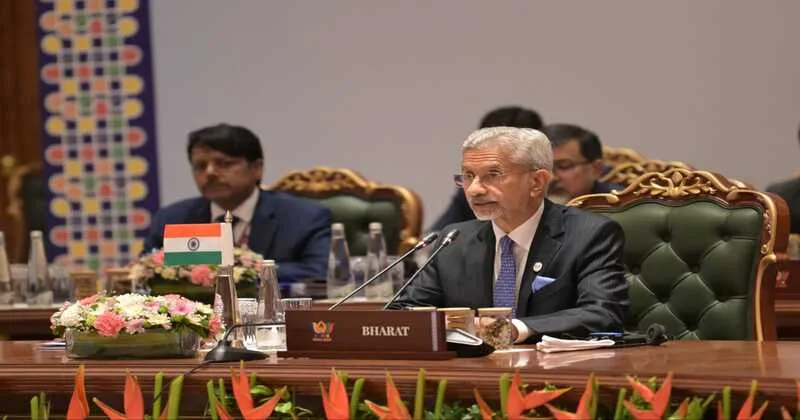
NEW DELHI: External Affairs Minister S. Jaishankar on May 14 delivered a strong message against sanctions-driven foreign policy and unilateral coercive actions while addressing the opening session of the BRICS foreign ministers’ conclave hosted by India.
Without naming any specific country, Jaishankar appeared to take a veiled swipe at the United States and other powers that rely on sanctions as instruments of foreign policy. He cautioned that such measures, especially when imposed outside the framework of international law, end up harming developing countries the most.
“Such measures disproportionately affect developing countries. These unjustifiable measures cannot substitute dialogue, nor can pressure replace diplomacy,” Jaishankar said during his address. The minister’s remarks came amid growing international concern over the escalating crisis in West Asia and its impact on global trade, energy security and maritime movement.
Concerns over West Asia and global trade
Jaishankar said the ongoing conflict and instability in West Asia required urgent international attention because of the wider implications for global economic stability. He pointed to rising tensions around major shipping routes and energy infrastructure as signs of an increasingly fragile situation. “The conflict in West Asia merits particular attention. Continuing tensions, risks to maritime traffic, and disruptions to energy infrastructure highlight the fragility of the situation,” he stated.
My welcome remarks to #BRICS Foreign Ministers’ Meeting, 2026. #BRICSIndia2026 https://t.co/IvtYBkeQZZ
— Dr. S. Jaishankar (@DrSJaishankar) May 14, 2026
He stressed that uninterrupted maritime movement through strategic waterways such as the Strait of Hormuz and the Red Sea remained critical for the smooth functioning of the global economy.
Calling for diplomacy instead of confrontation, Jaishankar underlined that respect for sovereignty and territorial integrity must continue to form the basis of international relations. He said peace and stability could not be pursued selectively and warned against attacks on civilian and public infrastructure. “Stability cannot be selective, and peace cannot be piecemeal. It is essential to uphold international law, protect civilians, and avoid targeting public infrastructure,” he said. Jaishankar added that India was prepared to support all efforts aimed at reducing tensions and restoring stability in the region.
India raises Gaza, terrorism and regional crises
The External Affairs Minister also expressed concern over the humanitarian situation in Gaza. He reiterated India’s call for a sustained ceasefire, unhindered humanitarian assistance and meaningful progress towards a two-state solution.
Apart from Gaza, Jaishankar referred to the continuing crises in Lebanon, Syria, Sudan, Yemen and Libya, and urged greater international coordination to address the conflicts affecting these regions. The India-hosted BRICS meeting is taking place against the backdrop of mounting worries over disruptions in global energy supplies and wider economic uncertainty linked to the West Asia conflict.
Among the leaders attending the conclave are Iranian Foreign Minister Abbas Araghchi, Russian Foreign Minister Sergey Lavrov, Brazilian Foreign Minister Mauro Vieira, Indonesian Foreign Minister Sugiono and South African minister Ronald Lamola.
Jaishankar also reiterated India’s stand on terrorism, asserting that “cross-border terrorism violates the basic principles of international relations” and insisting that “zero tolerance must remain an uncompromising and universal norm.”
Meanwhile, China expressed support for India’s leadership of BRICS. Chinese Foreign Ministry spokesperson Guo Jiakun said Beijing was willing to work with all parties to ensure a successful BRICS foreign ministers’ meeting. He described BRICS as an important platform for cooperation among emerging economies and said China remained committed to strengthening strategic partnership and solidarity within the grouping.