
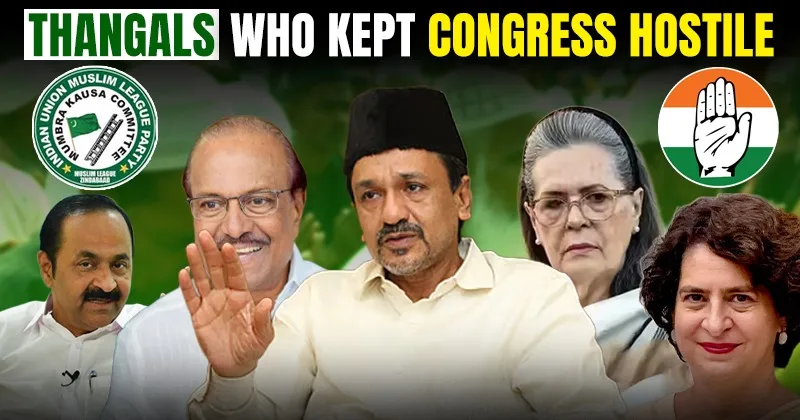
The result on May 4 was unambiguous. The United Democratic Front had won 102 of 140 assembly seats — a mandate so sweeping it should have resolved itself into a Chief Minister within 48 hours. Instead, Kerala waited ten days. And when the waiting ended, it was not in Delhi’s Congress headquarters that the government was truly formed. It was in Malappuram — at Panakkad House, the residence of Sadiq Ali Shihab Thangal, state president of the Indian Union Muslim League.
After ten days of dramatic political marathons that gripped the nation, V.D. Satheesan—an Opposition leader who has never once held a ministerial portfolio—has been named the Chief Minister-designate. His elevation was driven by the UDF’s most powerful ally, a force that appeared to be a step ahead of the Congress leadership itself. If the Gandhi family and the Delhi High Command were merely there to rubber-stamp his name, one must ask: what was the point of the spectacle in the capital?
In reality, the true ‘High Command’ was operating from Panakkad, in the heart of Malappuram, where a specific community’s interests dominate. From that Northern Kerala stronghold, P.K. Kunhalikutty—the true architect of these decisions—steered the deal-making on ministerial berths and key portfolios. While the UDF was supposed to be led by the Congress, the strings are clearly being pulled from Panakkad.
The Congress high command called it a consensus. The League called it the natural outcome. Kerala called it ten days late and entirely predictable — at least, in hindsight.
How a 22-Seat Ally Ended Up Deciding the CM Face of a 63-Seat Congress
It is also, those close to the negotiations say, the story of a dependency Congress built over years and could not undo in days. The gates of Panakkad House in Malappuram have seen decades of Kerala’s political history pass through them. But on the evening of May 13 — the ninth day after a historic UDF landslide — the men who gathered under its roof were not celebrating. They were done waiting.
Mail, Phone call to Sonia Gandhi- How the Muslim League called the shots and who approved it?
On day seven, Thangal placed a call to Priyanka Gandhi. The conversation, described by sources with knowledge of its contents, was brief and precise. The message: a Chief Minister should be an elected MLA, not a sitting MP. It was an indirect hint that the Thangals don’t want the high command ‘Pick’ KC Venugopal to be the next CM of Kerala.
The “principle” was not the point. It was a vehicle — a way of dressing a political veto in constitutional clothing and placing it in the hands of the Rajiv Gandhi family to carry, should they choose to resist, in public.
They chose not to resist. For Sonia Gandhi, Rahul and Priyanka, ignoring the IUML isn’t without personal risk. The League commands significant influence in Wayanad, where Priyanka now has a direct political stake. Slighting the ally merely to favour a family courtier could create friction not only within the UDF but also in Priyanka’s future electoral prospects in the constituency.
This is the quiet reality that nobody in Congress wants stated publicly: the Gandhi family’s own electoral future in Kerala is tied to IUML goodwill. Priyanka’s Wayanad seat is not simply a constituency — it is a symbol of the family’s engagement with Kerala politics. A League that feels ignored or overruled on the CM question is a League that could make Wayanad very uncomfortable in the next election.
In other words, the CM of Kerala has been decided by what is good for a Lok Sabha MP from a different constituency entirely.
“Wayanad will be the next Amethi” – says Posters in Wayanad
“Wayanad will be the next Amethi” Posters appeared in Wayanad before dawn on May 14, hours before the CM announcement. The posters bore no party symbol. No one claimed them. No one needed to. The reference to Rahul Gandhi’s former constituency — lost in 2019, a wound the family has never fully closed — required no elaboration in Kerala’s political vocabulary.
The posters were a warning for the Rajiv Gandhi family. Congress did not respond publicly to the posters. No party claimed them. No denial was issued. The silence, this time, was Congress’s — and it meant something different from the League’s earlier silence. It meant the calculation had been made.
Congress’s position in these negotiations for their favorite candidate was simply weak. The problem with the party was structural, not situational. Congress had spent a decade building a coalition in which the League’s ground presence was not supplementary but foundational — particularly in the northern districts, in the Malabar belt, in every constituency where the Muslim vote crossed twenty per cent of the electorate. Over years of dependence, the party had traded away the one thing it needed most in its moment of victory: the ability to make its own decision.
How the Congress’ most influential family in Malappuram played its cards
In Malappuram, the League workers who had spent ten days watching Delhi stall received Thursday’s announcement with the composed satisfaction of people who had never seriously doubted the outcome. There were no public celebrations — that would have been tactless. But in the League offices, in the tea shops near the party district headquarters, in the WhatsApp groups that had been running since May 4, the mood was unmistakable.
They had delivered their part. Their leadership had delivered the rest. The system had worked. Five ministries, Education, Health, Industries, Local Self-Government, Women and Child Development, Revenue — the same cluster of resource-heavy portfolios that had, in the last UDF government, will be theirs, which would lead an effective administrative control over the machinery of the next state government too.
Marathon discussions by Malikarjuna Kharge with MLAs and party workers
AICC president Malikarjuna Kharge consulted for ten days. He summoned former KPCC presidents, sitting office-bearers, senior veterans, A.K. Antony. He listened. He waited. He looked for a consensus that the League was specifically designed to prevent from forming around any name other than Satheesan. And on the tenth morning, he announced V.D. Satheesan — and called it a consensus. Even the same rounds were done by Rahul Gandhi, just to create a narrative of High Command deciding things of congress which were not…
Several senior Congress figures, reached after the announcement, but declined to speak on record. One said, simply: “Satheesan is a good man. He will govern well.” He said it the way people say things when they have decided there is nothing more useful left to say.
Congress is portrayed with genuine sympathy: it earned its mandate, it ran a real campaign, Venugopal and Satheesan are both presented as legitimate. The tragedy is structural — twenty years of dependence have made Congress incapable of exercising power even when it wins. That makes them sympathetic without making them incompetent, which is the more interesting version of cornered.
The Three Candidates
K.C. Venugopal — Congress national general secretary, the money man, the organisational backbone of the UDF’s campaign. A majority of the MLAs backed Venugopal — over 40 of 63 Congress legislators. He has the numbers. He has the high command’s ear. And he appears to have the Gandhi family’s quiet preference. However, he doesn’t have Muslim League support.
V.D. Satheesan — the Opposition leader, Muslim League has publicly backed Satheesan. He has the popular mandate argument and the League’s full force behind him.
Ramesh Chennithala — the veteran, the loyalist, the man with four Lok Sabha terms and six assembly stints and a career’s worth of waiting. Chennithala, by publicly agreeing to abide by whatever the high command decides, has virtually opted out of the race.