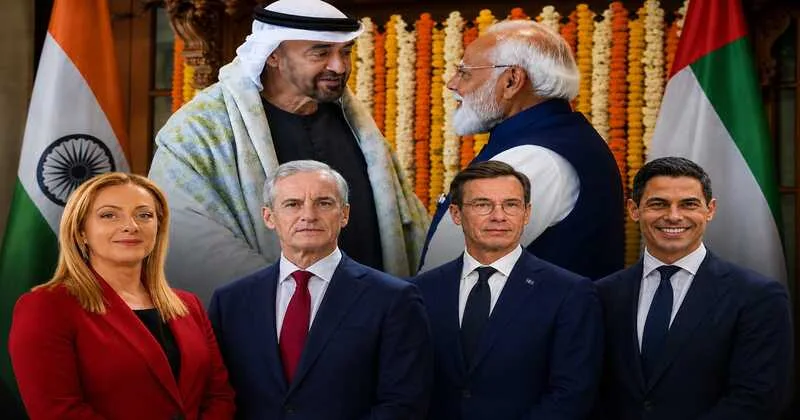
New Delhi: As war and instability in West Asia rattle global energy markets and strategic trade routes, Prime Minister Narendra Modi is preparing for a high-stakes diplomatic tour across the UAE, the Netherlands, Sweden, Norway and Italy aimed at securing India’s energy future and technological ambitions. From Abu Dhabi’s critical oil corridors to the semiconductor and green technology hubs of Europe, the six-day, five-nation outreach is expected to shape India’s economic and strategic positioning amid deep geopolitical turbulence and supply chain disruptions.
UAE visit focuses on energy security and Indian diaspora
The tour will begin with a crucial stopover in Abu Dhabi on May 15, where Prime Minister Modi will meet UAE President Mohamed bin Zayed Al Nahyan. The visit assumes major geopolitical significance as tensions in West Asia continue to affect global energy markets and maritime trade routes. India’s comprehensive strategic partnership with the UAE has increasingly become vital in the energy sector. The UAE recently exited OPEC+, making direct bilateral energy cooperation even more important for New Delhi. India imports natural gas and petroleum products from Abu Dhabi, while the UAE remains one of India’s most important energy partners in the Gulf region.
The conflict in West Asia since late February has placed severe pressure on international energy markets. Iran’s effective closure of the Strait of Hormuz disrupted shipping routes and raised concerns about global crude supplies. The UAE was also affected directly during the nearly 40 days of hostilities in the region. The Modi-MBZ talks are expected to include detailed discussions on energy cooperation, regional security and broader international developments.
According to the Ministry of External Affairs, the two leaders will also review the progress of the bilateral Comprehensive Strategic Partnership, which is underpinned by strong political, economic, cultural and people-to-people ties. Trade and investment cooperation are also expected to feature prominently during the discussions.
The UAE is India’s third-largest trading partner and the seventh-largest source of cumulative foreign investment into India over the past 25 years. With more than 4.5 million Indians living in the UAE, the welfare of the Indian diaspora is also expected to be discussed during the visit.
Netherlands visit to prioritise semiconductors and advanced manufacturing
Following the UAE visit, Prime Minister Modi will travel to the Netherlands from 15 to 17 May at the invitation of Dutch Prime Minister Rob Jetten. This will be Modi’s second visit to the Netherlands after his 2017 trip. During the visit, Prime Minister Modi will call on King Willem-Alexander and Queen Maxima and hold bilateral talks with Prime Minister Jetten, who assumed office at the end of February. Modi is also expected to meet several senior Dutch officials during the visit.
The visit comes at a crucial moment for India-Europe economic ties, particularly after the conclusion of negotiations for the India-European Union Free Trade Agreement earlier this year.
India is expected to prioritise cooperation in semiconductors, artificial intelligence and advanced manufacturing during the talks. New Delhi has long been interested in acquiring lithography machines manufactured by the Dutch company ASML, which are critical for semiconductor production.
The Netherlands remains one of India’s most important economic partners in Europe. Bilateral trade between the two countries stood at USD 27.8 billion during 2024-25, while the Netherlands is India’s fourth-largest investor with cumulative FDI worth USD 55.6 billion.
The visit is also expected to further strengthen cooperation in technology and innovation at a time when India is seeking to expand domestic manufacturing capacities and reduce vulnerabilities in global supply chains.
The Netherlands had also engaged closely with India earlier this year, with former Dutch Prime Minister Dick Schoof attending the AI Impact Summit held in New Delhi in February.
Sweden visit highlights India’s Nordic technology push
Prime Minister Modi will travel to Gothenburg, Sweden, on May 17 & 18 at the invitation of Swedish Prime Minister Ulf Kristersson. The visit underlines New Delhi’s growing focus on deepening engagement with Nordic countries that are leaders in advanced manufacturing, innovation and green technologies. This will be Modi’s second visit to Sweden after attending the first India-Nordic Summit in Stockholm in 2018.
During the visit, Modi and Kristersson are expected to review the full spectrum of bilateral relations and explore new areas of cooperation in trade, green transition, artificial intelligence, emerging technologies, resilient supply chains, defence, startups, climate action, space cooperation and people-to-people ties.
Bilateral trade between India and Sweden reached USD 7.75 billion in 2025, while Swedish foreign direct investment into India stood at USD 2.825 billion between 2000 and 2025.
Sweden’s importance to India has also increased due to the India-EU Free Trade Agreement announced in January 2026, which is expected to become operational in early 2027. As a member of the European Union, Sweden is expected to play an important role in strengthening India’s economic engagement with Europe.
Prime Minister Modi and Prime Minister Kristersson are also expected to jointly address the European Round Table for Industry along with European Commission President Ursula von der Leyen. The forum brings together leading pan-European business leaders and is expected to focus on industrial cooperation, innovation and investment opportunities. The Sweden visit is also expected to support India’s efforts to diversify supply chains and strengthen partnerships in critical technologies amid shifting global geopolitical conditions.
Norway and India-Nordic summit to centre on green transition
Prime Minister Modi will then undertake an official visit to Norway from May 18 &19 for bilateral engagements and the 3rd India-Nordic Summit in Oslo.
The visit will mark Modi’s first-ever visit to Norway and the first prime ministerial visit from India to Norway in 43 years. The summit, originally delayed in 2025 because of regional tensions, is expected to focus on green hydrogen, renewable energy, Arctic cooperation, sustainability, blue economy partnerships and emerging technologies.
According to the Ministry of External Affairs, the summit will bring together the leaders of Norway, Denmark, Finland, Iceland and Sweden. Prime Minister Modi will participate alongside Norwegian Prime Minister Jonas Gahr Store, Danish Prime Minister Mette Frederiksen, Finnish Prime Minister Petteri Orpo, Icelandic Prime Minister Kristrun Frostadottir and Swedish Prime Minister Ulf Kristersson.
The summit builds upon the earlier India-Nordic Summits held in Stockholm in 2018 and Copenhagen in 2022. Discussions are expected to impart a more strategic dimension to India’s ties with Nordic nations in areas such as renewable energy, innovation, sustainability, Arctic engagement, defence, space cooperation and resilient supply chains. Norway occupies a particularly important position in India’s European economic strategy because of the operational India-EFTA Trade and Economic Partnership Agreement, which came into effect in October 2025.
Apart from the summit, Modi will hold bilateral talks with Norwegian leaders and address the India-Norway Business and Research Summit. The discussions are expected to focus on trade, investments, clean technologies and digital public infrastructure.
Several agreements are also expected between India and Norway, particularly in health cooperation and digital infrastructure. Bilateral trade between India and Norway stood at approximately USD 2.73 billion in 2024. Norway’s Government Pension Fund Global has invested nearly USD 28 billion in the Indian capital market, making it a significant long-term investor in India.
The broader Nordic region has also emerged as an important economic partner for India. India’s bilateral trade with Nordic countries reached nearly USD 19 billion in 2024, while cooperation in green technologies and advanced manufacturing continues to expand rapidly.
Prime Minister Modi had originally planned to visit Norway and the Netherlands in May 2025, but the trip was cancelled because of Operation Sindoor.
Italy visit to deepen strategic and defence cooperation
Prime Minister Modi will conclude the tour with an official visit to Italy from May 19 & 20. The visit comes amid rapidly expanding India-Italy strategic cooperation, especially in defence, technology, innovation and connectivity. Italian Defence Minister Guido Crosetto had visited New Delhi at the end of April, reflecting growing defence engagement between the two countries. During the visit, Prime Minister Modi will call on Italian President Sergio Mattarella and hold bilateral talks with Prime Minister Giorgia Meloni. Modi had last visited Italy in June 2024 for the G7 Summit.
Italy has also been actively pushing for its ports to become part of the India-Middle East-Europe Economic Corridor (IMEC), positioning itself as a gateway for India’s access into Europe.
The visit takes place in the backdrop of the Joint Strategic Action Plan 2025-2029 being proactively implemented by both sides. The roadmap covers cooperation across trade, investment, defence, security, clean energy, science and technology, innovation and people-to-people ties. Bilateral trade between India and Italy reached USD 16.77 billion in 2025, while cumulative Italian FDI into India stood at USD 3.66 billion between April 2000 and September 2025.
As Prime Minister Modi prepares to begin the five-nation diplomatic mission, the tour is expected to play a major role in strengthening India’s energy security, accelerating technology partnerships, expanding strategic trade ties and reinforcing India’s position as the world’s fastest-growing major economy amid continuing global instability and geopolitical turbulence.