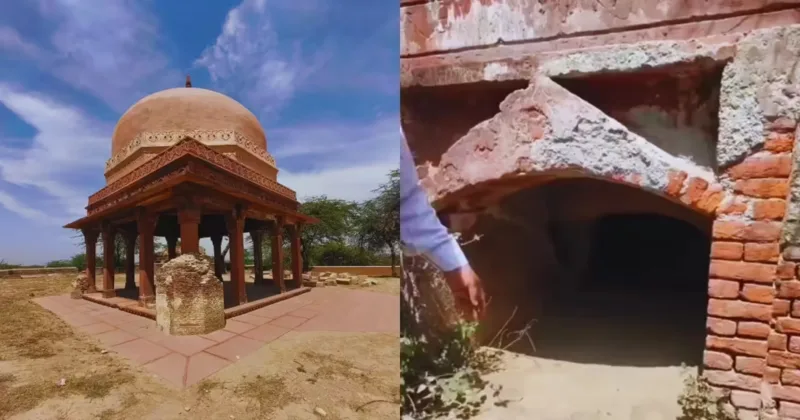
Lucknow: In a development that sits at the intersection of law, history, and administrative accountability, the Uttar Pradesh government has removed the ancient Lakshagraha site in Baghpat from the list of Waqf properties. The move follows a February 5, 2024 court ruling that identified the site as Lakshagraha, rejecting claims that it functioned as a dargah, mazar, or a Muslim cemetery.
The decision also brings into focus the role of the UMEED (Unified Waqf Management, Empowerment, Efficiency, and Development) Portal, a 2025 initiative by the Ministry of Minority Affairs to digitise and geo-tag Waqf properties across India. Waqf properties are assets permanently dedicated by a Muslim for religious, charitable, or pious purposes under Islamic law.
While the platform aims to improve transparency and legal clarity, the Lakshagraha case illustrates how data entry without due scrutiny can trigger disputes over historically significant sites.
Court ruling and administrative action
The controversy intensified after the Lakshagraha site was listed as a dargah on the UMEED portal in late 2025. This categorisation sparked objections from local stakeholders and heritage groups, who pointed to the site’s long-recognised identity as an ancient structure associated with early Indian civilisation.
The matter, however, had already been adjudicated months earlier. In its February 2024 ruling, the Baghpat civil court concluded that the site is indeed the Lakshagraha. It dismissed claims made by the Muslim side that the land housed a religious structure such as a dargah or graveyard.
Acting on this judgment, district authorities forwarded a report to the state government. Baghpat District Minority Welfare Officer Kailashchand Tiwari clarified that the administration’s role was limited to implementing the court’s order. Following due process, the state government removed the site from the Waqf property list on the UMEED portal.
A legal dispute spanning five decades
The roots of the case trace back to 1970, when a petition was filed in a Meerut court by a Barnawa resident, Mukim Khan. The petition claimed that approximately 36 bighas of land, recorded under Khasra number 3377, contained a dargah, the tomb of Badruddin, and a graveyard.
The Lakshagraha Gurukul, represented by its founder Brahmachari Krishnadutt Maharaj, contested these claims. Following the creation of Baghpat district in 1977, the case was transferred there. Over the decades, both sides presented documentary and oral evidence to support their positions.
Both Hindu and Muslim parties presented evidence in support of their claims. In this case, the Civil Judge (Junior Division), First, delivered a verdict on February 5, 2024, recognizing the ancient mound as Lakshagraha. The court rejected the claims of the Muslim side.
The Muslim side challenged the decision of the Civil Judge (Junior Division), First. The appeal is currently being heard in the Court of the Additional District and Sessions Judge, First.
Despite this, in December 2025, when an order was issued to register all Waqf properties across the country on the Umeed portal, Lakshagraha was listed as a dargah.
As soon as people learned that Lakshagraha had been registered as a dargah on the government’s Umeed portal, protests began. Rajpal Tyagi, minister of Shri Gandhi Dham Samiti Gurukul Lakshagraha, lodged an objection. Following this, the process to exclude Lakshagraha from Waqf property began.
The 2024 verdict marked a turning point, firmly identifying the site as Lakshagraha and rejecting the alternative claims. However, the matter is not entirely closed. The decision has been challenged and is currently under appeal before a higher court.
Understanding Waqf and the UMEED portal
A Waqf property, under Islamic law, is a permanent dedication of property for religious or charitable purposes. Once designated, it is considered irrevocable, meaning it cannot be sold, transferred, or inherited. That is why accurate identification and documentation becomes critical, especially when historical or archaeological sites are involved.
The UMEED portal was launched to bring greater transparency and efficiency to Waqf property management. By digitising records and enabling geo-tagging, it aims to reduce disputes and improve oversight. Yet, as seen in the Lakshagraha case, the inclusion of contested or historically sensitive sites without conclusive verification can complicate matters rather than resolve them.
Baghpat: A historically layered region
Baghpat’s significance extends well beyond this legal dispute. Historically known as Vyaghraprastha, or the “land of tigers,” the region has long been associated with early Indian civilisation. Another interpretation of its ancient name, Vakyaprastha, suggests it was a centre for discourse and assemblies.
During the Mughal period, the region came to be known as Baghpat, likely due to its gardens and agrarian landscape. Administratively, it remained part of Meerut until being designated a separate district in 1997.
Lakshagraha: history and archaeology
The Lakshagraha site in Barnawa is today recognised as a protected mound by the Archaeological Survey of India (ASI). Its significance lies not only in textual references but also in its physical and archaeological presence.
The structure is traditionally understood to have been constructed using highly flammable materials such as lac, resin, and bamboo, indicative of sophisticated planning and architectural intent in ancient India. Excavations and surveys in the region point to the existence of an early settlement, reinforcing its historical importance.
Importantly, the identification of such sites is not based solely on literary tradition but also on geographical continuity, archaeological remains, and long-standing local recognition.
What Baghpat was called in Mahabharata times
To prevent the Mahabharata war, the Pandavas (via Lord Krishna) asked Duryodhana for five villages (prasthas or locations). The most popular, widely accepted identification of these places, currently located around modern-day Delhi and Haryana, are:
- Indraprastha – Present-day Delhi (specifically near the Indraprastha estate/Purana Qila)
- Swarnaprastha – Present-day Sonipat, Haryana
- Panaprastha – Present-day Panipat, Haryana
- Vyaghraprastha – Present-day Baghpat, Uttar Pradesh
- Tilaprastha – Present-day Tilpat, Faridabad (Haryana
These five places are mentioned in the Mahabharata. Yudhishtira proposed these five locations as a final compromise to avoid war. Duryodhana refused, leading to the devastating war at Kurukshetra.
A case of law, history, and governance
The removal of Lakshagraha from the Waqf list is not merely an administrative correction, it reflects the primacy of judicial determination in resolving complex claims over land and heritage.
At the same time, the episode highlights the need for diligence in digitisation efforts. Platforms like UMEED have the potential to streamline governance, but their effectiveness depends on the accuracy of the data they carry.
For now, the state’s position is clear: based on the court’s ruling, Lakshagraha is recognised as a historical and archaeological site, not a Waqf property. The final word, however, may yet come from the appellate court, where the matter remains under consideration.
The big takeaway
The Lakshagraha case underscores a larger principle, heritage sites, especially those tied to India’s ancient past, require careful handling backed by evidence, law, and institutional accountability.
As India continues to digitise records and formalise land ownership frameworks, such cases serve as reminders that history, law, and identity often intersect in complex ways, and resolving them demands both precision and restraint.