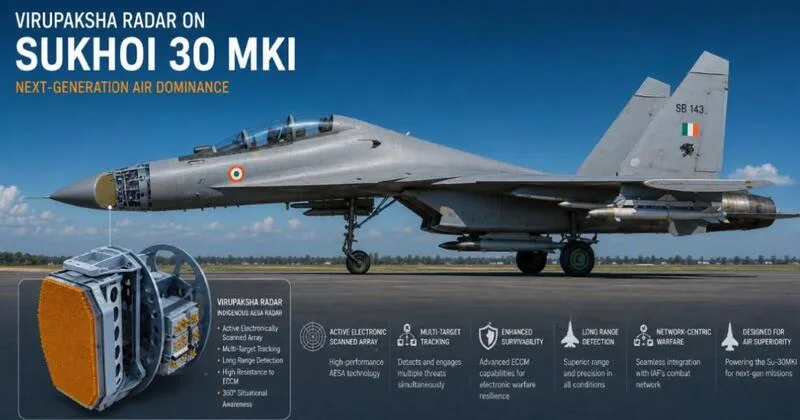
In February 2026, the Indian Defence Research and Development Organisation (DRDO) achieved a milestone: the Virupaksha Active Electronically Scanned Array (AESA) radar successfully completed its first power-on test, a phase engineers call First Light. Developed by DRDO Electronics and Radar Development Establishment (LRDE) in Bengaluru, this fully indigenous radar is designed to replace the ageing Russian-origin N011M Bars PESA radar currently fitted on the Indian Air Force’s (IAF) Su-30MKI fighter jets. It forms the technological heart of the ambitious Rs 63,000 crore Super Sukhoi upgraded programme.
What is the Virupaksha Radar?
Virupaksha is a GaN (Gallium Nitride)-based AESA radar built around approximately 2,400 Transmit/Receive (TR) modules. It is named after the ancient Hindu deity Virupaksha, an epithet of Lord Shiva, symbolising all-seeing watchfulness for a radar tasked with detecting near-invisible stealth aircraft.
The radar was formally approved by DRDO in October 2024. At Aero India 2025, DRDO officials confirmed that its design phase was complete and subsystem realisation had begun. In 2025, dedicated assembly lines and production jigs were established for hardware integration. The First Light test in February 2026 marked the transition from design to active hardware evaluation.
Key Technical Specifications
The following specifications are based on DRDO disclosures and confirmed reporting by LRDE officials:
• TR Modules: Approximately 2,400 GaN-based Transmit/Receive Modules
• Stealth detection range: Up to 200 km against low-RCS (0.01 m²) stealth aircraft such as China’s J-20
• Conventional target range: 300–400 km for fighter-sized (1 m² RCS) targets
• Multi-target tracking: 64 to 100 aerial targets simultaneously
• Simultaneous missile guidance: 6 missiles against 6 different targets at once
• Antenna diameter: 950 mm, fitting the Su-30MKI’s existing nose cone without structural modifications
Why GaN Technology Matters?
GaN semiconductors offer up to five times the power density of older Gallium Arsenide (GaAs) technology. This means that Virupaksha can emit stronger radar pulses while generating less heat, improving both detection range and resistance towards electronic jamming. The First Light tests in February 2026 focused on calibrating the radar’s beam-forming software and verifying that the liquid cooling systems can manage the heat produced by these high-power modules. GaN efficiency also means the radar can operate within the Su-30MKI’s existing AL-31F engine power output, thus avoiding costly aircraft modifications.
The Super Sukhoi Programme
Virupaksha is the centrepiece of the Rs 63,000 crore (approx. $7.2 billion) Super Sukhoi upgrade programme, which aims to modernise 84 of the IAF’s 260 Su-30MKI aircraft. Beyond the radar, the upgrade includes a new digital cockpit, advanced avionics and indigenous electronic warfare systems. HAL (Hindustan Aeronautics Limited) will carry out the physical upgrades, which are projected to extend each jet’s service life by 25–30 years, keeping the Su-30MKI relevant as a 4.5+ generation multirole fighter well into the 2050s.
Industry Support and Atmanirbhar Bharat
In July 2025, LRDE issued a Request for Proposal (RFP) for a Development-cum-Production Partner (DcPP). Bids were received by October 2025. Astra Microwave Products Limited is leading GaN module production, with L&T and HAL contributing to manufacturing and system integration. BEL (Bharat Electronics Limited) is also part of the supply chain. This consortium-based approach reflects DRDO’s push under India’s Atmanirbhar Bharat defence policy to build end-to-end domestic production capability for critical radar technology.
Testing Roadmap and Countering Enemy
Following the February 2026 First Light tests, engineers are preparing a static Su-30MKI nose section for electromagnetic compatibility (EMC) testing. Subsystems are also being validated on DRDO’s dedicated airborne radar testbed, a modified Hawker 800 business jet. Approximately 200 flight sorties are planned for full developmental trials. The first Virupaksha radar deliveries are targeted for mid-2027. Onboard flight trials aboard a specially modified Su-30MKI operated by the Aircraft and Systems Testing Establishment (ASTE) are expected to begin in early 2028. Full induction into the IAF fleet with 84 upgraded jets is planned after 2030.
The Virupaksha directly addresses a critical operational gap. India’s current Su-30MKI fleet uses the Russian N011M Bars, a passive-array radar that cannot match modern stealth threats like China’s J-20 or Pakistan’s potential future J-35A acquisitions. An IAF official stated that Virupaksha’s X-band frequency can penetrate certain stealth coatings, reducing the operational advantage of low-observable aircraft. Paired with the DRDO indigenous Astra Mk-III beyond-visual-range missile (which has a reported range exceeding 150 km), the upgraded Su-30MKI could engage stealth threats before they enter firing range.
The Virupaksha First Light in February 2026 is more than a technical checkpoint; it is proof that India can develop one of Asia’s most capable airborne radar systems entirely in-house. If development stays on schedule, the Su-30MKI fleet will possess a radar that rivals the best Western and Chinese systems, firming the Indian position as a first-tier military aerospace power. The radar success will also inform the parallel development of AESA systems for the Tejas Mk-II and AMCA, multiplying its strategic impact across India’s next-generation combat aircraft fleet.