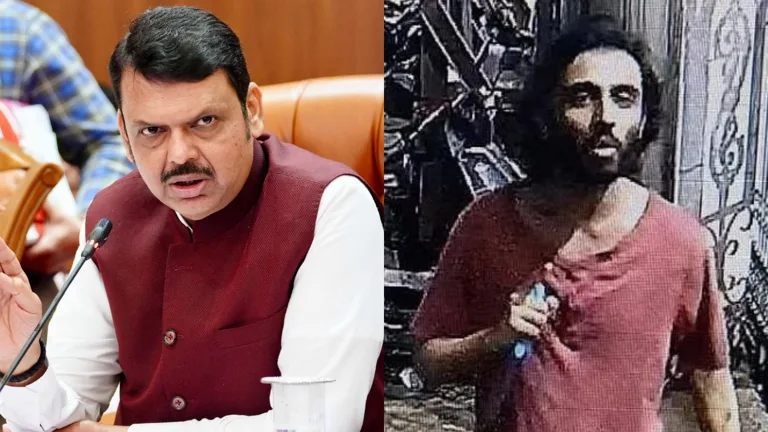
Maharashtra Chief Minister Devendra Fadnavis said the Mira Road stabbing incident near Mumbai is being investigated as a possible case of “self-radicalisation,” with preliminary findings indicating that the accused intended to target members of the Hindu community in the name of jihad.
The case, now being jointly probed by the Maharashtra Anti-Terrorism Squad (ATS) and the National Investigation Agency (NIA), has raised fresh concerns over lone-wolf radicalisation and possible extremist links.
Fadnavis says accused was radicalised
Taking cognisance of the incident, Fadnavis said investigators recovered incriminating material and radical literature from the residence of the accused, identified as 31-year-old Jabar Zubair Ansari.
“This appears to be a case of self-radicalisation. Some books and incriminating material were recovered from the accused’s residence. He lived in the United States and had recently returned. Preliminary investigations have revealed that he was radicalised and had a desire to attack members of the Hindu community in the name of jihad, which led him to carry out this incident,” the Chief Minister said.
He further stated that the investigation would not remain limited to the accused alone and would also examine whether any larger network or conspiracy played a role in the radicalisation process.
“The case is currently being investigated by the Anti-Terrorism Squad and the National Investigation Agency and the state government is providing full cooperation to these agencies. The scope of the investigation will not be limited to the accused, but it will also investigate the individuals or networks behind his radicalisation. The entire case will be thoroughly investigated to uncover any possible conspiracy,” he added.
How the Mira Road attack unfolded
The incident took place in the early hours of Monday in the Naya Nagar area of Mira Road, a suburb near Mumbai.
According to police, Ansari first approached two security guards stationed in the locality under the pretext of seeking directions. He later returned and allegedly questioned the guards about their religion.
Investigators said the accused allegedly forced one of the guards to recite the Islamic Kalma. When the guard failed to do so, Ansari allegedly attacked both men with a sharp-edged weapon.
The victims were identified as Rajkumar Mishra and Subroto Ramesh Sen. Both sustained serious injuries and were rushed to hospital.
Officials said Mishra remains in critical condition, while Sen is currently undergoing treatment.
Arrested within 90 minutes
Police said the accused was arrested within 90 minutes of the attack after CCTV footage from the area helped investigators trace and identify him.
A case of attempted murder has been registered, following which the Maharashtra ATS formally took over the investigation due to the suspected terror and radicalisation angle.
During searches conducted at Ansari’s residence, officials reportedly recovered handwritten notes in which he allegedly expressed his desire to join ISIS and described the stabbing attack as the “first step” towards achieving that objective.
Investigators are also examining digital evidence, including electronic devices and online activity, to determine whether the accused had links with extremist handlers, online radical networks, or international terror outfits.
Lone-wolf radicalisation under scanner
The case has once again brought attention to the growing concern around “lone wolf” radicalisation, where individuals allegedly become radicalised through online propaganda, extremist content, or ideological influence without direct operational involvement from organised terror groups.
Security agencies are now probing whether Ansari acted entirely alone or whether he was influenced, guided, or assisted by a larger ideological or operational network.
The ATS and NIA are expected to examine his travel history, digital footprint, communication records, and possible online interactions as part of the wider investigation.