May 10, 1857 holds immense historical significance in the annals of history as it heralded nation-wide armed freedom struggle against colonial rule in India. This date marks the formal beginnings of the great Independence War of 1857. Scholars tried to attribute many labels to the movement ranging from ‘insurgency’, to ‘sepoy mutiny” to ‘anti-colonial resistance’. But, it was V.D. Savarkar who recognised the nationalist aspirations of the movement and called the movement the “War of Independence”. The struggle for freedom was aimed at the emancipation of the nation from the clutches of the exploitative British regime. The leaders of this movement came from different social groups, but their goal was the same. In our commemoration of the 168th anniversary of the Great Indian Independence War, let us also remember what did the armed revolt against the British rule means to us, and why it holds so much importance in the history of India.
The Independence War of 1857 was the result of a long list of grievances from the British regime. The first half of the 19th century is symptomatic of the expansion of British hegemony, not only in the political sphere but in practically every sphere of Indian society. The Indian rulers found themselves dispossessed and marginalised through their cunning administrative policies like the Subsidiary Alliance and Doctrine of Lapse, which allowed the Britishers to conquer large parts of the Indian subcontinent. On the other hand, the landed aristocracy and the agrarian classes suffered badly because of the ill-planned land policies like the Permanent Settlement system, Ryotwari and Mahalwari system, which not only impoverished the peasants but also led to the dispossession of the landed aristocracy in India. The tribal population was vary of their marginalisation from the forest land and its resources, which was the source of subsistence for these classes.
Another cause for concern was the encroachment of Christianity in the tribal areas, which posed a threat to the indigenous culture of the tribal region. The Sanyasis lost their source of patronage, which had enabled them to undertake pilgrimages. The sepoys were perturbed by the discrimination between Indian and British soldiers and were distressed by the racial segregation and patronization practiced by the Britishers. There was a growing sense of nationalist fervour among Indians because of the growing socio-political consciousness and intellectual enrichment of society in the first half of the 19th century. Adding fuel to the fire was the deployment of the Enfield Rifles by the British, which was a ploy to hurt the sentiments of Hindus and Muslims by using cow and pig fats in the cartridges, which had to be cut with teeth.
On March 29, at Barrackpore near Calcutta, Mangal Pandey opened fire on a European officer and his comrades refused to arrest him on the orders of their European superiors. He was soon captured and hanged in early April, but the sepoys’ anger could not be contained. All of these developments exploded with the revolt of the soldiers and the subsequent martyrdom of Mangal Pandey, which started the chain of developments leading to the revolt of 1857. The year 1857 was also significant because it marked 100 years since the Battle of Plassey, which is considered to be the beginning of British imperialism.
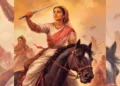
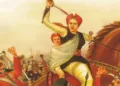
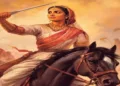
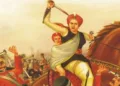
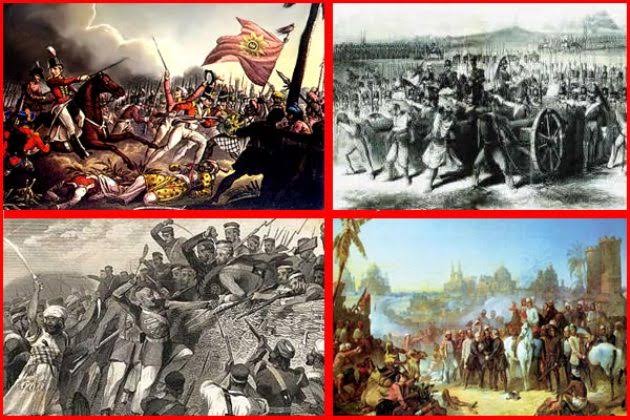
The formal beginning of the revolt is marked by the resistance of the soldiers of Meerut on 10th May. The rebellion from Delhi soon spread to other military centers in the North-Western Provinces and Oudh and soon took the form of a civil uprising, as the disgruntled rural population extended a helping hand. The revolution was a Pan-Indian movement, as against the general misconception that the movement was limited to the Northern belt of the Indian subcontinent with barely any impact in the South. In the South, the 8th Light Cavalry of the Madras Regiment joined the revolt. In Assam, the revolt was led by Maniram to oust the Britishers and reinstate the Ahom Monarchy. In Uttrakhand, the local people of the Haldwani region revolted against the Britishers and received capital punishment at a place known as the “Fansi ka Gadhera”. In western India, the 1857 revolt was centered around regions like Naseerabad which soon expanded to the Rajputana states of Pratapgarh, Banswara, Mewar, etc. Some of the leaders of the revolt were – Nana Sahib, the adopted son of the Peshwa Baji Rao II, at Kanpur; Begum Hazrat Mahal at Lucknow; Khan Bahadur at Rohilkhand; Rani Lakshmibai at Jhansi; the zamindar, Kunwar Singh at Arrah; and Tantia Tope at Bareilly. The British government made a huge supply of men, money, and weapons to the country to suppress the revolt. Even with their limited resources, Indian freedom fighters offered strong resistance to the British army.
Lord Canning gathered British troops in Calcutta and sent them to Delhi. On September 20, 1857, Delhi was finally recaptured and Bahadur Shah Zafar was imprisoned and later exiled, but this did not yet mean the end of the struggle. Very slowly Banaras, Allahabad, and Kanpur were captured. Between the spring of 1858 and the beginning of 1859, British troops gradually occupied Gwalior, the Doab, Lucknow, the rest of Awadh, Rohilkhand, and the rest of central India. The Rani of Jhansi died on the battlefield on 17 June 1858. By 1859, Kunwar Singh, Bakht Khan, Khan Bahadur Khan of Bareilly, Nana Sahib’s brother Rao Sahib, and Maulvi Ahmadullah were all dead, while the Begum of Awadh were forced to hide in Nepal. By the end of 1859, British authority over India was completely re-established, but the sacrifice of the many was not in vain. It is a proud milestone in our history that needs to be cherished and commemorated every day.
The Independence War of 1857 may not have been completely successful in reaching its desired objectives, but it was truly revolutionary and visionary in more than one way. Firstly, it shook the roots of British hegemony and showed to the world that Britishers are not infallible, and could be defeated as long as the society remains united. The revolt gave hope to the Indians to strive for independence. The revolt of 1857 led to an informed sense of political consciousness among the Indians, which fuelled the Indian national movements in the late 19th and 20th centuries. The problems of the Freedom struggle of 1858 were addressed and rectified through the political consolidation of Indian leaders to demand political rights for themselves. The revolt of 1857 was successful in bringing decisive administrative changes in the colonial regime ranging from the introduction of the British crown in India to a change in the policy of the Government of India towards the Indian princes. It also led to the abolishment of repressive measures like the Doctrine of Lapse, and reforms were brought into the administration and the entry of Indians into key administrative positions became easier. Also, there was a massive reorganization of the army in India as the recruitment of British men and North Indian soldiers was taken over by the martial races like Gurkhas, Sikhs, Jats, and Rajputs of Punjab.
Finally, the freedom struggle of 1857 is a reminder for all of us of the bravery of our leaders. Many of our freedom fighters attained immortality by dying on the battlefield like Rani Lakshmibai, Tantya Tope, Nana Saheb Peshwa, Mangal Pandey, and many more, but many local heroes of the struggle are yet unknown and unsung, and this is the day to remember them as well. Sidhu and Kanu Murmu led the Santhal rebellion in modern-day Jharkhand, tribal leaders like Gonoo led the Kol tribes in Jharkhand, and Vir Narain Singh was instrumental in leading the revolt in Chattisgar. Women played an equally important role in carrying the revolution forward. Who can forget the sacrifices of Rani Laxmibai, Begum Hazrat Mahal, Uda Devi Pasi, Jhalkari Bai, and many more who sacrificed their lives for the nation during the revolt. There were scores of women who provided financial assistance to the revolutionaries or played the role of spies to rally confidential information to the revolutionaries. 1857 is the day for us to celebrate our great warriors who led the “First War of Independence ”.
For many, it was a failure as the rebellions failed to achieve their goals. But, for a few, the revolt of 1857 created a legacy for the freedom struggle. It also proved to be a turning point in Indian history. The revolt became a water divide because it ended the old ruling class. They were either eliminated or surrendered. It paved the path for new leadership – an educated middle class who had supported the British during the revolt but went against them after 1861.