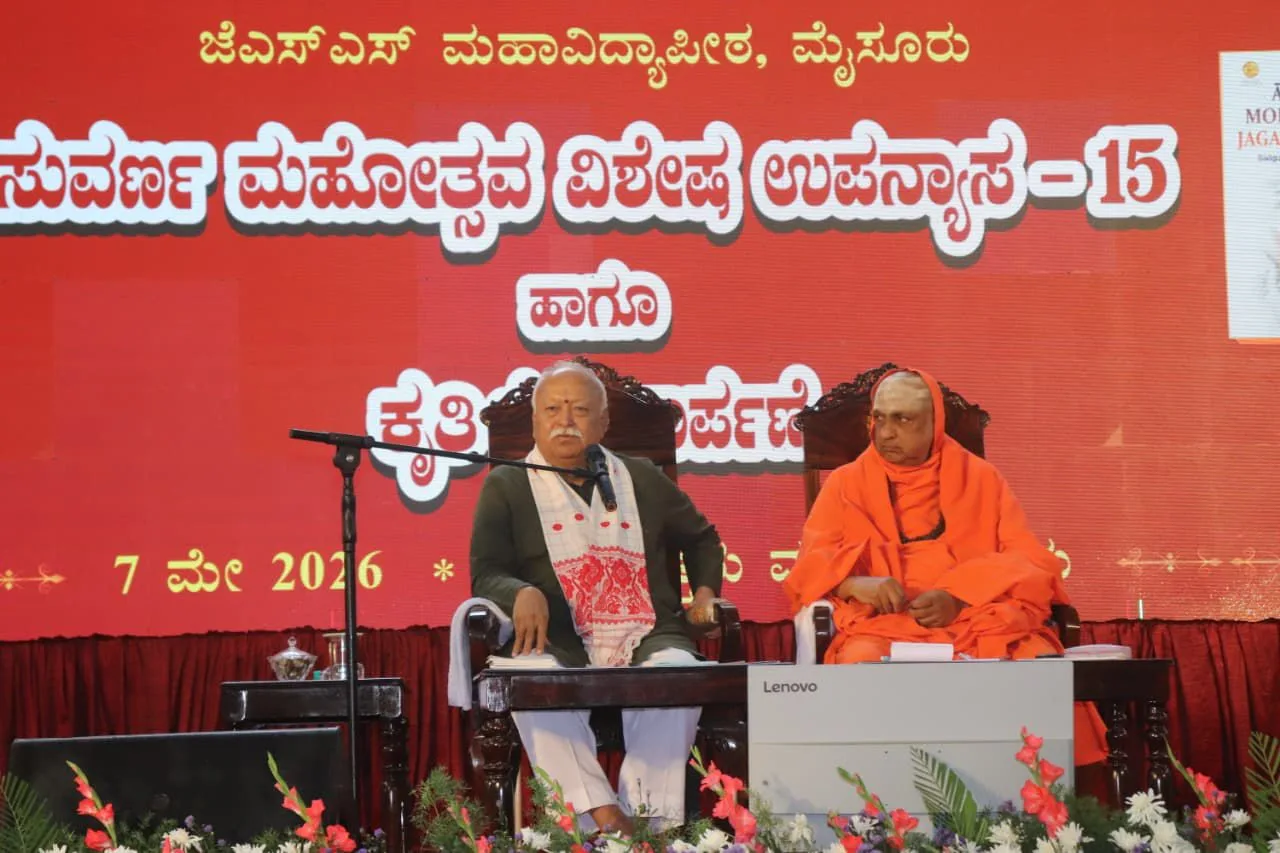
Mysuru: RSS Sarasanghachalak Dr Mohan Bhagwat delivered a Special Lecture on ‘’Social Harmony as a Catalyst for National Development’ at JSS Mahavidyapeetha, Mysuru, Karnataka on Thursday (May 7). Bhagwatji released a book ‘Atmano Mokshartham Jagat Hitayacha’ along with Pujya Jagadguru Sri Shivaratri Deshikendra Mahaswamiji of Suttur Kshetra
Addressing the gathering, Bhagwat said the Bharatiya concept of “Samaj” was fundamentally different from the Western concept of “society”. He said Bharat’s civilisational thought was based on oneness, cooperation, duty, and mutual responsibility rather than social contract theories.
He stated that Bharat viewed land, people, and civilisation collectively as the nation, and not merely the state structure. Referring to Bharat’s spiritual traditions, Bhagwat said the idea of oneness of existence formed the foundation of Bharatiya thought and social harmony.
Bhagwat stressed that social discrimination and inequality existed in the mind and called for behavioural change, social interaction, and emotional integration to remove divisions in society. He urged people to build friendships across communities, visit families from different social sections, and support measures aimed at social equality.
Referring to Dr B.R. Ambedkar’s speeches on the Constitution, Bhagwat said political and economic equality could not succeed without social equality and fraternity. He said fraternity was essential for preserving national unity and constitutional values.
Speaking on development, Bhagwat said progress should reach the last person in society and not remain limited to individual prosperity. He said Bharat’s vision was based on the principle of “Sarve Bhavantu Sukhinah” and collective welfare.
During the interaction session, Bhagwat answered questions on religion, caste, family system, marriage, constitutional values, population policy, and social harmony. He said harmony among religions and communities was essential for humanity’s survival and urged society to rise above caste divisions through conduct and example.
He also said social harmony was not merely a catalyst but a “condition precedent” for all-round national development and called upon society to begin practising these values in everyday life.