There are three well-known Californian sayings, first: “Disrupt or be disrupted” meaning, either bring change or become a victim of change, second: “The best way to predict the future is to invent it” meaning, the best way to know the future is to create it, and third: “If you’re not embarrassed by your first product, you launched too late” meaning, if you are not slightly uncomfortable with your first effort, you started too late.
These three sayings, along with three major cities, Sacramento, Los Angeles, and Stanford, help us meaningfully connect the recent visit of RSS Sarkaryavah Dattatreya Hosabale to the United States, particularly his lecture at Stanford University. The distinctive features of these cities, namely the political centrality of Sacramento, the colourful dynamism of Los Angeles, and the intellectual and innovative ethos of Stanford, are widely known, often contrasting, yet deeply influential. Within this triad, the discussion of the RSS worldview in California becomes especially relevant.
In the centenary year of the RSS, it is also appropriate to recall the Californian state seal, which features the Roman goddess Minerva and the word “Eureka” (I have found it). This symbol reflects discovery and wisdom, resonating with the broader narrative of civilisational awakening.
Dattatreya Hosabale emphasised that in Bharatiya tradition, science and spirituality are complementary. Texts like the Upanishads are not merely religious writings but profound explorations of human consciousness, nature, and the universe
As part of its global outreach during its centenary year, visits by RSS leadership to Germany, England, and California (USA) collectively build a larger narrative of civilisational engagement.
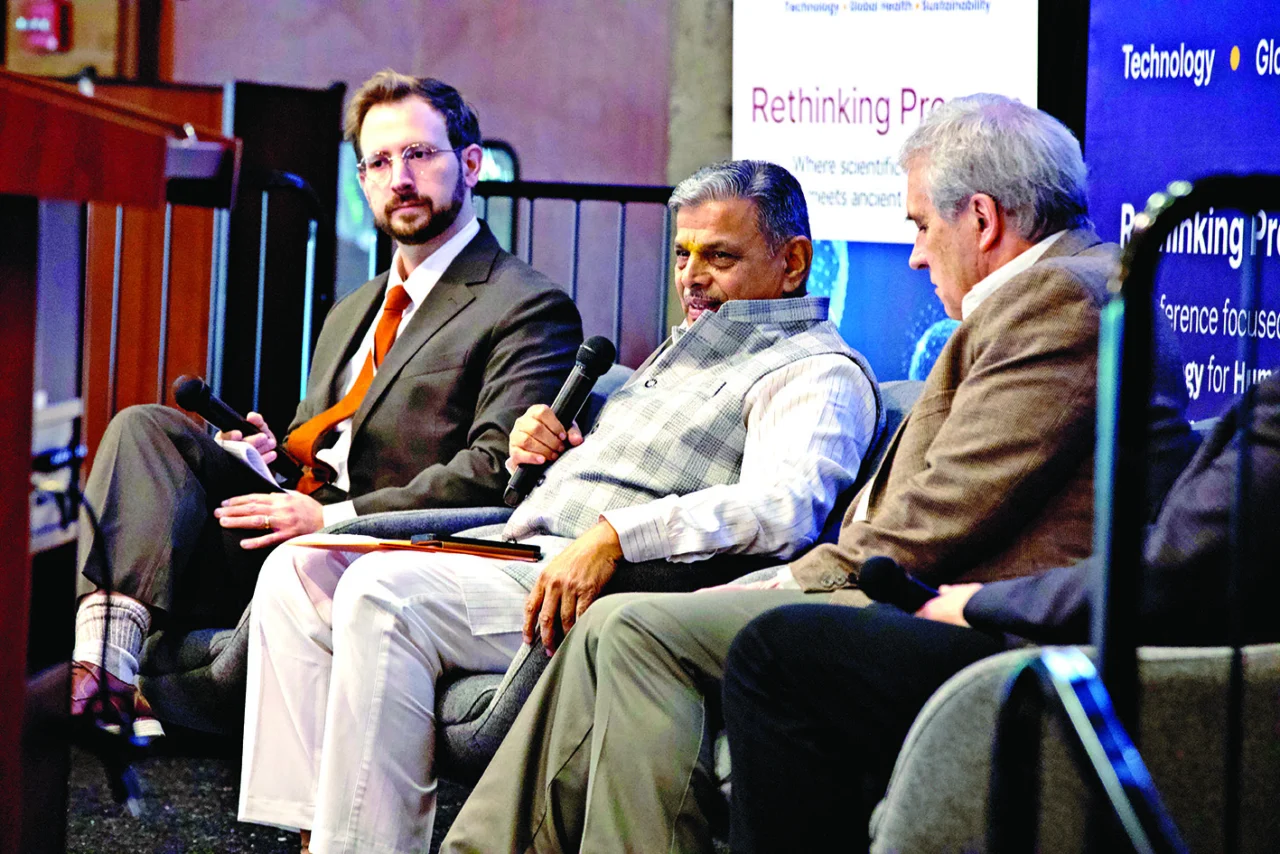
At the Thrive 2026 conference held at Stanford University, Dattatreya Hosabale delivered a lecture on “Science, Knowledge Systems, and Civilisational Leadership.” He emphasised the global relevance of Bharatiya knowledge traditions, particularly the integration of science and spirituality, ethical technology, respect for nature, and the role of wisdom in education.
He noted that science and technology policy must be grounded in civilisational values and stated that spirituality and science are not in opposition to one another. The pursuit of science and technology, he argued, should not be driven solely by profit, but also by altruistic considerations. He also conveyed to a global audience the importance of building a bridge between scientific rationalism and spiritual humanism.
Hosabale Ji explained that knowledge without wisdom leads to arrogance and imbalance, whereas wisdom-guided knowledge leads to true well-being. This insight is highly relevant in today’s data-driven era, where information is abundant but ethical direction is often lacking.
Speaking at a prestigious institution like Stanford, the Sarkaryavah strongly asserted that innovation must be accompanied by wisdom. In the age of artificial intelligence, presenting the relevance, precision, and sustainability of Bharatiya knowledge systems requires both courage and conviction. This address, in many ways, echoes Swami Vivekananda’s Chicago speech in a contemporary context. In the presence of global figures such as Nobel Laureate Prof Steven Chu, former US National Security Advisor HR McMaster, Google board member Shriram, and global investor Vinod Khosla, Hosabale’s lecture emerged as a “global charter” of Bharatiya values.
A Comprehensive Bridge
The lecture serves as a bridge between modern scientific consciousness and Bharat’s holistic civilisational outlook. Delivered at a place synonymous with innovation and global leadership, it symbolised the confluence of cutting-edge science and timeless wisdom.
The concept of Lokasamgraha (holding people together) in Bharatiya philosophy offers a guiding principle for modern global policymaking. It emphasises that every innovation, policy, and knowledge system should aim to benefit even the last person in society. Presenting this idea in California, the global hub of startups and technological innovation, is especially significant.
Hosabale Ji also indicated that Bharatiya knowledge traditions are not only a matter of past glory but also a guide for the future. If fields like artificial intelligence, data science, and biotechnology are infused with Bharatiya ethical perspectives and a sense of balance, development can become more humane and sustainable. Thus, the Stanford lecture is not merely an academic discourse but a global call, where science and spirituality, innovation and ethics, tradition and modernity converge to shape a balanced future for humanity.
In a world shaped by artificial intelligence, biotechnology, and digital economies, incorporating Bharatiya principles of ecological balance and knowledge democratisation can pave the way for sustainable global development
He emphasised that in Bharatiya tradition, science and spirituality are complementary. Texts like the Upanishads are not merely religious writings but profound explorations of human consciousness, nature, and the universe. He noted that Bharat historically demonstrated remarkable economic and intellectual vitality, but cautioned that rapid growth without ethical grounding leads to imbalance. Bharatiya thought advocates moving forward steadily, but in the right direction, ensuring harmony between progress and sustainability.
The lecture also highlighted that foreign invasions and prolonged colonial rule severely damaged Bharat’s knowledge traditions. This is not merely a reflection on the past but a warning for the present, that without preservation and reinterpretation, civilisational heritage may fade away. Today, as Bharat seeks to revive its knowledge systems through initiatives like the National Education Policy, presenting them on global platforms such as Stanford becomes essential.
Hosabale Ji introduced the idea of a “human algorithm,” emphasising that legal and scientific systems must serve human life and well-being. Humans should remain the masters of technology, not its subjects. He also stressed the democratisation of knowledge, echoing the Californian saying: “Information wants to be free.” Despite technological progress, a large section of society remains deprived of education and resources, making equitable access a key challenge. Referring to the idea “Go where the opportunities are,” he emphasised that one must carry their sense of own identity wherever they go. Abandoning one’s identity is akin to abandoning meaningful global engagement.
While explaining the global vision of Bharatiyatva and Hindutva, he stated that any technology developed for human welfare must be evaluated on three parameters — Economy, Ecology, and Ethics. Technologies that create economic inequality, exploit nature, or violate moral standards ultimately cause harm to both society and the environment. In this tradition, knowledge should be guided by wisdom (Prajna) and rational discernment, so that its responsible use can be ensured.
Significance Of Stanford Lecture
Stanford, recognised globally as a hub of innovation, artificial intelligence, and scientific research, provided an ideal platform to present Bharat’s integrated knowledge vision. It represents the convergence of rapid scientific advancement and a tradition that sees science and spirituality as two dimensions of the same truth.
The lecture reaffirmed that there is no artificial divide between scientific and spiritual knowledge. The Upanishads, he noted, engage deeply with questions of human existence, psychology, and consciousness. He further pointed out that colonial disruptions led to the neglect of the scientific dimensions of Bharatiya traditions. This serves as a warning for the future. In a world shaped by artificial intelligence, biotechnology, and digital economies, incorporating Bharatiya principles of ecological balance and knowledge democratisation can pave the way for sustainable global development. The complementarity of science and spirituality must be recognised.
Dattatreya Hosabale’s lecture comes at a time when the world is searching for new directions. The convergence of Stanford’s global platform and Bharat’s civilisational wisdom points towards a new global consciousness: balanced, inclusive, and sustainable.