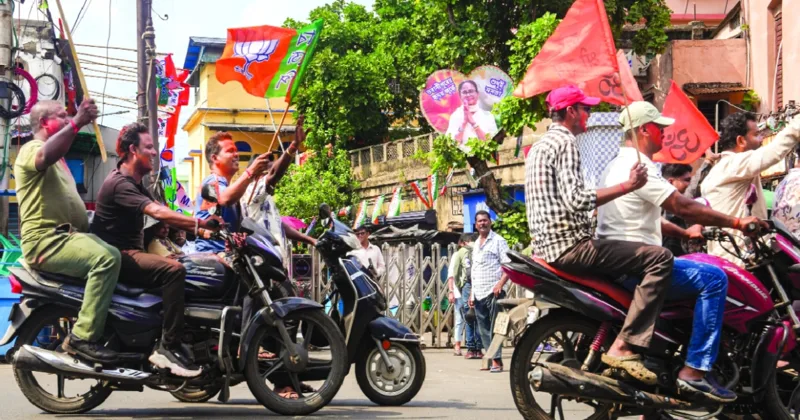
KOLKATA: In a dramatic turn of events in the West Bengal Assembly Elections 2026, the ruling Trinamool Congress (TMC) has suffered a significant blow, with a majority of its cabinet ministers failing to retain their seats.
Out of 35 ministers who contested, as many as 22 were defeated, which translates to nearly 63 per cent of the state cabinet losing their individual berths.
The most high-profile loss came from Chief Minister Mamata Banerjee, whose defeat has sent shockwaves through the party ranks and the broader political landscape of the state.
A powerful leader who had transitioned from the leader of the agitation in Nandigram and Singur to win three consecutive terms as chief minister of a crucial border state, Mamata Banerjee’s shock defeat marks one of the most serious electoral setbacks for the TMC since it came to power in 2011.
Senior Ministers Among Those Defeated
The list of losing candidates includes several senior and influential figures in the state cabinet. Among them are:
1. Mamata Banerjee (Chief Minister)
2. Aroop Biswas (Housing, Power)
3. Bratya Basu (Higher Education, School Education)
4. Chandrima Bhattacharya (Environment, Finance, Programme Monitoring)
5. Shashi Panja (Industry, Commerce & Enterprises; Women & Child Development and Social Welfare)
6. Sujit Bose (Fire and Emergency Services)
7. Indranil Sen (Technical Education, Training & Skill Development; Tourism)
8. Becharam Manna (Agricultural Marketing)
9. Swapan Debnath (Animal Resources Development)
10. Bulu Chik Baraik (Backward Classes Welfare, Tribal Development)
11. Pradip Kr. Mazumdar (Co-operation, Panchayats & Rural Development)
12. Birbaha Hansda (Forests, Self Help Group & Self Employment)
13. Manas Ranjan Bhunia (Irrigation & Waterways, Water Resources Investigation & Development)
14. Moloy Ghatak (Labour)
15. Siddiqullah Choudhury (Mass Education Extension and Library Services)
16. Udayan Guha (North Bengal Development)
17. Sandhyarani Tudu (Paschimanchal Unnayan Affairs)
18. Bankim Chandra Hazra (Sundarban Affairs)
19. Ujjal Biswas (Science & Technology and Bio-Technology)
20. Snehasis Chakraborty (Transport)
21. Srikant Mahato, MoS (Consumer Affairs)
22. Satyajit Barman, MoS (School Education)
A Political Earthquake in Bengal
The Mamata Banerjee government failed to not only address major issues such as safety of women, creation of jobs, infrastructure growth etc. it also faced the wrath of the people for not being able to rein its cadres who unleashed a reign of terror, intimidation, and exploitation amongst the citizens, especially the Hindus.
The sentiments of the citizens of the state (who felt stifled under a near-fascist avatar of the brutal regime that targeted the Hindus in a crucial border state) are evident in the massive statewide celebrations that individuals took up just outside each of their homes.
The scale of the losses suggests total disillusionment of the electorate that triggered a deep anti-incumbency wave and a clear shift in voter sentiment across regions.
Political analysts note that such a high number of ministerial defeats is rare and points to widespread dissatisfaction at multiple levels of governance.
The defeats of key administrative figures, many of whom held crucial portfolios such as finance, education, labour, and rural development, could have significant implications for the party’s organisational strength and governance continuity.
What Lies Ahead for TMC
With several top leaders unseated, the Trinamool Congress now faces the challenge of rebuilding its leadership bench and reassessing its political strategy. The loss of Mamata Banerjee, in particular, raises critical questions about the party’s immediate leadership direction and future course.
As the Election Commission of India publishes the final results of the Assembly polls of the state of West Bengal, all eyes will be on how the TMC navigates this electoral setback, and whether it can stage a political recovery in the months ahead.