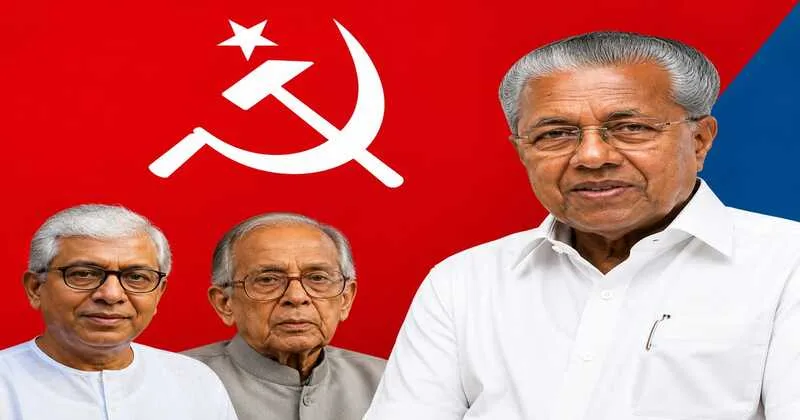
In what is being described as an unprecedented political verdict, the people of Keralam have delivered a crushing blow to the fascist approach of the ruling Communist government and Chief Minister Pinarayi Vijayan through the ballot box. The CPI(M)-led Left Democratic Front (LDF), which entered the election with the ambition of securing a historic third consecutive term, now appears to be disintegrating under a powerful anti-incumbency wave.
Even in West Bengal, where the CPI(M) and other Left parties ruled continuously for thirty-five years, they have now failed to secure even a double-digit tally. This verdict is increasingly being interpreted as not merely a routine electoral defeat, but the beginning of the end of the communist movement in Keralam, Bengal, and perhaps across India.
More than a defeat, what does Keralam verdict reveal about?
In Keralam, this moment carries deep historical symbolism that the first Communist government in India came to power in 1957 in Keralam under Chief Minister EMS. Namboodiripad. Today, with the same land that ushered in Communist rule now witnessing its possible political exit after two consecutive terms under Chief Minister Pinarayi Vijayan.
The CPI(M), which contested in 91 seats, managed to win only 26 constituencies. In Kannur’s Dharmadam constituency, although Chief Minister Pinarayi Vijayan ultimately secured victory, he trailed multiple times during the counting process, reflecting a significant erosion of support. In the 2021 election, he had secured a massive winning margin of over forty thousand votes; this time, however, his margin has fallen to below ten thousand. In addition to this, more than a dozen members of the 19th Council of Ministers have been defeated, signalling a sweeping rejection of the ruling establishment. Including this, the LDF has won a total of 35 seats. The BJP has secured 3 seats, while the UDF has won 102 seats.
This is not just a defeat; it is shaking the very foundations of the CPI(M) and other Left parties in Keralam. For example, in the Ambalapuzha constituency in Alappuzha district, long regarded as a stronghold of the CPI(M), senior leader, G Sudhakaran, contesting as a rebel, delivered a stunning blow to the party by securing victory. The impact has been profound, with the very foundation of the CPI(M) shaken in regions under Sudhakaran’s influence. Meanwhile, in Kannur district, traditionally considered the party’s bastion, CPI(M) rebels have advanced towards victory, lowering the red flag even in its strongest pockets. Emerging cracks in stronghold constituencies such as Taliparamba, Payyannur and Dharmadam point to a deeper erosion of the party’s dominance in the district. Beyond Alappuzha and Kannur, the party has suffered major setbacks in its strongholds such as Kasaragod, Palakkad, Kozhikode, and Kollam. Out of Kerala’s 14 total districts, the LDF has suffered a complete defeat in six districts. Party cadres themselves admit that the weakening of the CPI(M)’s base stems from the loss of its ideological soul, alleging that the organisation has degenerated into a structure, resembling a corporate entity rather than a mass political movement.
Arrogance and fascist tendency in governance and public backlash
At the heart of this electoral debacle lies a growing perception of arrogance and fascist tendencies in governance. The words and actions of Chief Minister Pinarayi Vijayan increasingly came under scrutiny, with critics pointing to a disconnect between the leadership and the people. His arrogant responses to public concerns, most notably remarks akin to “go home and ask” to a party worker, were seen as dismissive and disrespectful, fuelling widespread resentment. This election result is widely being viewed as a “shock treatment” administered by Keralam’s politically conscious electorate against a governance style that appeared to treat citizens as subordinates rather than stakeholders. The verdict sends a clear message that the electorate has rejected not just policies, but an entire attitude of governance perceived as fascist, authoritarian and unresponsive.
The defeat has equally exposed the consequences of an outdated ideology and a highly centralised, personality-driven style of governance and political functioning under Chief Minister Pinarayi Vijayan and the party cadre. The Chief Minister and his inner circle, emboldened by prolonged incumbency, sidelined several influential and grassroots-connected leaders within the party. This strategic miscalculation has proven disastrous. The deliberate marginalisation of strong Kannur-based leaders such as P. Jayarajan, E. P. Jayarajan, and M. V. Jayarajan resulted in a significant erosion of support even in traditional party strongholds. These leaders were effectively cut off due to the overconfidence of the leadership. The outcome has demonstrated that abandoning leaders with deep public connections in favour of a tightly controlled leadership structure has backfired severely.
Similarly, although she contested in this election, the exclusion of former Health Minister K. K. Shailaja from the 2021 elections and the government, despite having earned widespread admiration for her handling of the Covid-19 crisis, alienated a substantial section of women voters. Her absence from the electoral forefront was widely perceived as a calculated move to prevent the rise of alternative power centres within the party. Further compounding the crisis was the public humiliation and sidelining of veteran leader G. Sudhakaran, long regarded as a pillar of the party in Central Keralam. This internal discord not only weakened organisational morale but also shook the confidence of traditional supporters. The role of party state secretary M. V. Govindan has also come under severe criticism. All strategic initiatives undertaken under his leadership, including public outreach campaigns and resistance marches, failed to resonate with voters. Instead, they were widely dismissed as superficial exercises lacking substance. Govindan’s inability to address internal dissatisfaction or reflect public sentiment has been seen as a major factor in the party’s collapse. His perceived role as merely an extension of the Chief Minister’s authority further diminished his credibility.
Just as Lenin’s statues were brought down in Russia after the collapse of the Soviet Union, the political image of Pinarayi Vijayan is now being dismantled in Keralam. All the strategies of M. V. Govindan, who sought to consolidate control and suppress dissent within the party, have failed in the face of the people’s resistance. This administration, seen as having alienated both followers and ordinary citizens, now stands pushed towards the margins of history. As the decline of communism reaches its final stages, this verdict is likely to be remembered as a decisive triumph of democracy over arrogance. Keralam, it appears, is awakening to a new political dawn.
Electoral Factors: Minority consolidation, faith, and economic distress
Economic distress further intensified public dissatisfaction. The perception of a government indulging in corruption, luxury and extravagance while ordinary citizens struggled with rising prices and declining agricultural productivity created a powerful anti-incumbency sentiment. The inability to control inflation and address the agrarian crisis alienated large sections of the rural population. The anger of lakhs of unemployed youth, combined with widespread dissatisfaction across social groups, culminated in a massive wave in favour of the opposition parties. The opposition, led by the Congress, capitalised on this sentiment through the minority support. Additionally, controversies surrounding Public Service Commission (PSC) recruitment, allegations of backdoor appointments, and exam-related irregularities severely damaged the party’s credibility among the youth. The growing perception of corruption and unfair practices eroded trust in the system. Reports of hooliganism associated with the Students’ Federation of India (SFI) extended this discontent from campuses to the wider public sphere.
The Congress–Muslim League-led UDF’s victory was driven by a decisive consolidation of Muslim and Christian minority votes. Anti-BJP campaigning, along with the involvement of Islamist groups such as Jamaat-e-Islami, added momentum to this consolidation, strengthening the UDF’s position across key constituencies. However, the BJP secured victories in three seats, notably defeating LDF ministers in two of them.
At the same time, the LDF’s approach to sensitive issues such as Sabarimala created a deep divide among Hindu voters. The government’s stance on the issue, widely seen as dismissive of traditional beliefs, triggered a backlash among devotees. In contrast, the UDF positioned itself as a defender of faith, assuring voters that customs and traditions would be respected. This assurance translated into significant electoral gains, as many voters used the ballot to express their disapproval of the government’s earlier stance.
The beginning of the end of Communism in India
This electoral outcome is not merely a state-level development; it carries national implications. With the decline of communist influence already evident in states like West Bengal and Tripura, Keralam was widely seen as the last major bastion of the ideology in India. The current verdict suggests that even this stronghold is now slipping away.
This marks a significant moment in India’s political trajectory, a decisive step towards the disappearance of communism from the national landscape. The ascent of M. A. Baby to the position of general secretary comes at a time when the party faces a severe crisis of relevance, lacking both political power and public support. There is a growing perception that the Communist Party of India (Marxist) [CPI(M)] risks being reduced to a historical footnote rather than a living political force.
As Keralam prepares for a transition of power, this election marks a dramatic turning point. The dream of a third consecutive term for Pinarayi Vijayan and his team has ended in what many describe as a humiliating defeat. If the leadership fails to introspect and continues on its current path, it risks accelerating the complete collapse of the party. The fall of these “red fortresses” under the force of the UDF’s electoral wave symbolises more than a change in government but it signals the fading relevance of communism in India’s democratic framework. Whether the CPI(M) can rebuild from this setback remains uncertain. For now, the verdict stands as a decisive rejection of its current leadership and ideology, marking what could well be remembered as the beginning of the end of communism in India.