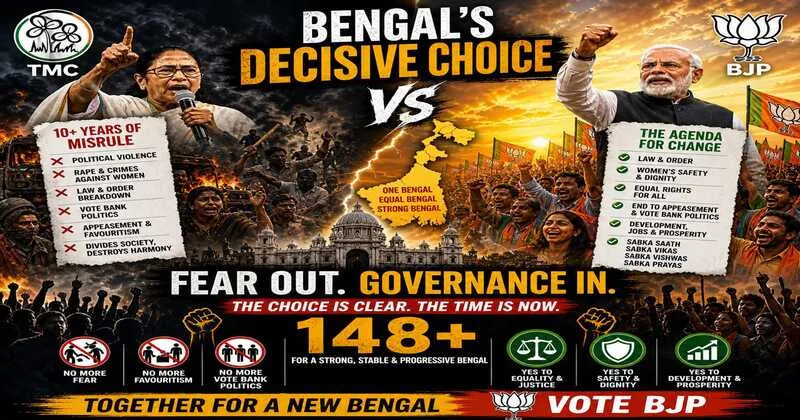
West Bengal stands at a defining crossroads. What is unfolding today is not merely an electoral contest, but a deeper shift in public consciousness, a movement away from fear, fragmentation, and selective politics towards governance rooted in law, accountability, and equal treatment. The call of the moment is clear and resonant: Fear Out. Governance In.
In a 294-member Assembly, the majority mark of 148 is not just a number; it represents the threshold of political transformation. The steady rise of the Bharatiya Janata Party from 3 seats in 2016 to 77 in 2021 reflects a growing consolidation of support across West Bengal. This is not a sudden surge, but the result of sustained organisational expansion and a narrative that aligns with the aspirations of a changing electorate.
At the core of this shift lies a fundamental concern: law and order. Over the past several years, repeated allegations of political violence, crimes against women, and localised breakdowns in enforcement have shaped public discourse. These concerns have contributed to a broader perception that governance must act with greater firmness, neutrality, and accountability. Increasingly, citizens are asserting that democracy cannot function under fear, and that governance must be anchored firmly in the rule of law.
For many voters, this is no longer about isolated incidents; it is about systemic accountability. The demand is for a state where justice is timely, enforcement is impartial, and institutions function without influence or bias. Women’s safety, protection of life and liberty, and the assurance of equal legal recourse have become central to electoral decision-making.
Alongside this, there is a visible and growing rejection of appeasement, polarisation, and vote-bank politics based on religious considerations, especially the way policies were framed, and schemes were introduced in favour of Muslims. The electorate is signalling that governance cannot be selective, nor can it be shaped by narrow electoral calculations. There is an increasing insistence on equality before the law, where the state treats every citizen fairly without discrimination, without favouritism, and without bias.
This marks a significant transformation in Bengal’s political discourse. Voters are moving beyond identity-driven alignments and are instead prioritising governance outcomes-security, development, transparency, and opportunity. The shift is from dependency to empowerment, from patronage to policy.
Regionally, this change is already evident. North Bengal and the tribal belt of Junglemahal have witnessed substantial political realignment, driven by demands for dignity, development, and inclusion. These regions have become the foundation of a broader electoral shift. The ripple effects are now visible in Central Bengal, where evolving voter preferences are making the contest increasingly competitive.
The decisive battleground, however, lies in South Bengal and the urban-industrial corridors. Here, aspirations of youth, professionals, and the middle class are redefining political priorities. Employment, infrastructure, safety, and clean governance have taken precedence over legacy loyalties. It is in these regions that incremental shifts can produce decisive electoral outcomes.
The pathway to 148 is therefore structured and achievable. Strong consolidation in North Bengal and Junglemahal provides the base. Strategic gains in Central Bengal build momentum. And even a partial breakthrough in South Bengal can tilt the balance. This is not the mathematics of a wave; it is the arithmetic of sustained political expansion.
What adds to the significance of this moment is the emergence of a clear bipolar contest. The fragmentation that once characterised opposition politics has given way to a direct choice between two distinct governance models. On one side is a system often criticised for centralised control and selective politics; on the other, a framework that emphasises institutional accountability, development, and alignment with national growth.
Within this evolving landscape, the rise of the Bharatiya Janata Party is being driven by its positioning on key issues-law and order, administrative accountability, and governance based on equality before law. This messaging is increasingly resonating with voters seeking stability, fairness, and a decisive break from past patterns.
The electorate of today is informed, aspirational, and assertive. It is no longer willing to accept fear as a political reality, nor selective governance as a norm. What it seeks is clear: security without compromise, justice without delay, and governance without bias. Thus, the narrative of West Bengal in 2026 is not merely electoral; it is transformational. It is about ending fear-driven politics, rejecting appeasement and divisive strategies, and restoring governance as a system that works equally for all.
In this context, the movement towards 148 is not just about forming a government. It is about redefining the very nature of governance, where law prevails over fear, institutions prevail over influence, and citizens are empowered by rights rather than constrained by uncertainty.
Fear Out. Governance In. is more than a slogan; it is the articulation of a जनमत that seeks stability over chaos, equality over favouritism, and development over division. If this trajectory continues, the mandate that emerges may well mark the beginning of a new political chapter in West Bengal, one defined by order, accountability, and decisive governance.