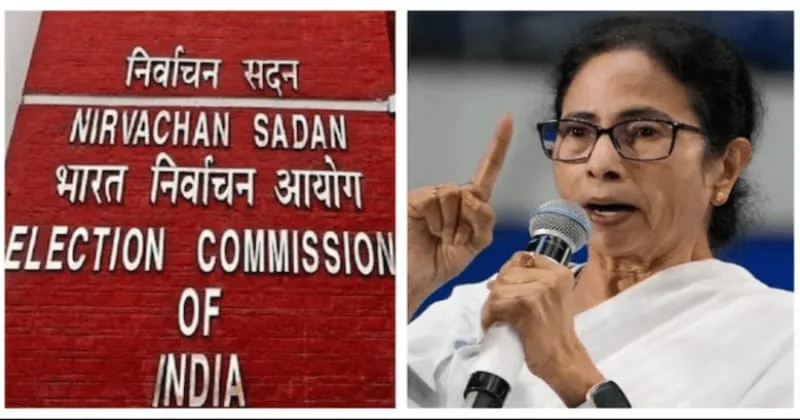
West Bengal once again witnessed high-voltage political theatre as Chief Minister Mamata Banerjee landed at a strongroom in Bhabanipur, claiming that Electronic Voting Machines were being “tampered with.” She remained inside the premises for hours, projecting the situation as a “life and death fight” to protect democracy. The optics were dramatic and carefully calibrated to send a message of suspicion.
However, beyond the rhetoric, the episode exposed a deeper and troubling pattern. Whenever electoral outcomes appear uncertain or unfavourable, institutions suddenly come under attack. In this case, Banerjee’s allegations were not backed by any technical or procedural evidence. They were based on CCTV footage that the Election Commission of India clarified showed routine segregation of postal ballots. This is a standard process that had already been communicated to all political parties in advance.
The larger concern is not just about one night of confrontation. It is about the repeated attempt to cast doubt on established democratic systems without substantiation. Such actions risk eroding public trust in institutions that rely heavily on credibility and transparency.
What really happens to EVMs after voting ends
Contrary to the alarmist narrative being pushed, the journey of an Electronic Voting Machine from the polling booth to the counting table is one of the most tightly controlled and monitored processes in India’s electoral framework. Each step is designed to ensure that there is no room for manipulation or secrecy.
Immediately after voting concludes, the Ballot Unit, Control Unit, and VVPAT are switched off and sealed at the polling station itself. This is done in the presence of polling officials as well as representatives of political parties. The seals are not merely procedural formalities. They carry the signatures of all stakeholders, including party agents.
This means that any attempt to tamper with the machines would require breaking these seals. Such an act cannot go unnoticed because the broken seals would be immediately visible during verification. The system is designed in a way that manipulation cannot happen discreetly or silently.
Secure transportation under surveillance
Once sealed, the EVMs are transported to designated storage centres under heavy security. Armed escorts accompany the movement, and in many cases, vehicles are tracked using GPS systems. Candidates and their authorised agents are allowed to follow the convoy, ensuring complete transparency during transit.
This process eliminates the possibility of the machines being taken to unknown locations or being handled without oversight. At no stage are the EVMs left unmonitored or outside the scrutiny of stakeholders.
Inside the strongroom with layered security
After transportation, EVMs are stored in strongrooms that are designed to function as high security zones. These facilities are protected by multiple layers of security that operate round the clock. The rooms are secured with double lock systems, monitored continuously through CCTV cameras, and guarded by armed personnel.
Equally important is the role of political parties in this process. Representatives of candidates are permitted to remain outside these strongrooms at all times. Many parties deploy their own workers to maintain constant vigilance. This creates a system of mutual oversight where rival parties watch each other as closely as they watch the authorities.
If there were any irregularity, it would not remain hidden for long. Political competitors have the strongest incentive to detect and expose any wrongdoing, making the system inherently self-checking.
Strict logging and controlled access
Every activity involving EVMs is documented meticulously. Logs are maintained for all movements and any interaction with the machines. Access to strongrooms is tightly regulated and allowed only under clearly defined and authorised circumstances.
In rare situations where a strongroom must be opened, such as an emergency, it can only be done in the presence of authorised officials, observers, and representatives of political parties. The entire process is recorded and documented, ensuring that there is no scope for unauthorised or hidden actions.
On the day of counting, the process does not begin with tallying votes. It begins with verification. The seals on all EVMs are inspected in front of candidates and their agents. Only when these seals are found intact does the counting process proceed.
The Control Unit is then accessed to retrieve the votes stored in the machine. This initial verification step is crucial because it ensures that any tampering attempt would be immediately detected before counting begins. A compromised machine would fail this basic integrity check.
VVPAT cross check and paper trail
To further enhance transparency, a sample of VVPAT slips is counted and matched with the electronic results. This provides a physical paper trail that can be used to verify the accuracy of the electronic count.
This mechanism was strengthened following directions from the Supreme Court of India, which has consistently upheld the reliability of EVMs while also recommending additional safeguards like expanded VVPAT verification. The presence of a paper audit system significantly reduces the scope for discrepancies.
The Election Commission has repeatedly clarified that EVMs are standalone devices that are not connected to any network. They do not use the internet, Bluetooth, or any wireless communication system. This eliminates the possibility of remote hacking entirely.
Votes are stored in non rewritable memory chips. Once a vote is cast, it cannot be altered or deleted. Unlike general purpose computers, these machines are built for a single function, which limits their vulnerability to external interference.
Before they are deployed in elections, EVMs undergo multiple rounds of testing. Mock polls are conducted in the presence of political party representatives to verify their functioning. This ensures that the machines are working correctly before they are used in actual voting.
The judiciary, including the Supreme Court, has examined these systems on multiple occasions. While acknowledging that no system is theoretically perfect, the courts have consistently found no evidence of large scale tampering in real world scenarios.
The weak link argument and its limitations
Some argue that the weakest point in the system could be physical access during storage or transportation. However, this argument fails to account for the multiple layers of safeguards that are already in place.
Continuous surveillance ensures that every movement is monitored. Political party oversight adds another layer of scrutiny. Mandatory seal verification ensures that any interference is immediately visible. Detailed logging creates a permanent record of all actions.
For tampering to succeed, all these independent safeguards would have to fail simultaneously without being detected by rival parties or officials. Such a scenario is highly improbable and lacks any documented precedent.
To further strengthen the process, the Election Commission has introduced a QR based Photo Identity Card system for counting centres. This system adds another layer of access control and ensures that only authorised individuals can enter sensitive areas.
The process involves multiple levels of verification. At the outer layers, manual ID checks are conducted. Additional screening takes place at inner perimeters. Final entry into counting halls is granted only after successful QR code scanning.
This system applies to all personnel, including candidates, counting agents, and officials. It reflects an evolving approach where the electoral system continues to adopt new measures to address concerns and improve security.
Mamata Banerjee’s allegations and political messaging
Mamata Banerjee’s visit to the strongroom appears less like an act of institutional vigilance and more like a calculated political move. By alleging manipulation without presenting evidence, she attempted to create a narrative that questions the credibility of the entire electoral process.
This approach is not new. In several elections, political leaders have resorted to blaming EVMs when faced with unfavourable projections or outcomes. Exit polls are dismissed as conspiracies, and institutions are accused of bias.
While such tactics may help mobilise political support, they carry serious consequences. Repeated allegations without proof weaken public confidence in democratic systems and institutions.
India’s electoral system is one of the most scrutinised in the world. From the sealing of machines to VVPAT verification, every step is designed to ensure transparency and accountability.
When political leaders repeatedly question this system without evidence, the impact goes beyond a single election. It creates doubt among voters and undermines faith in democratic processes.
Democracy relies on trust as much as it relies on procedures. If every unfavourable outcome is attributed to manipulation rather than public mandate, it shifts the focus away from accountability and introspection.
Facts stand taller than allegations
The facts are clear. EVMs in India are protected by a robust and multi layered security framework that combines physical safeguards, technological design, and institutional oversight.
The allegations made by Mamata Banerjee, despite their dramatic presentation, do not hold up when examined against these established processes. The system has been tested repeatedly, both in practice and in courts, and has consistently been found reliable.
In a democracy, raising questions is legitimate, but doing so without evidence can be damaging. Responsible leadership requires balancing vigilance with credibility.
Ultimately, democracy does not function on suspicion alone. It functions on systems that are transparent, processes that are accountable, and the will of the people that is expressed through the ballot.