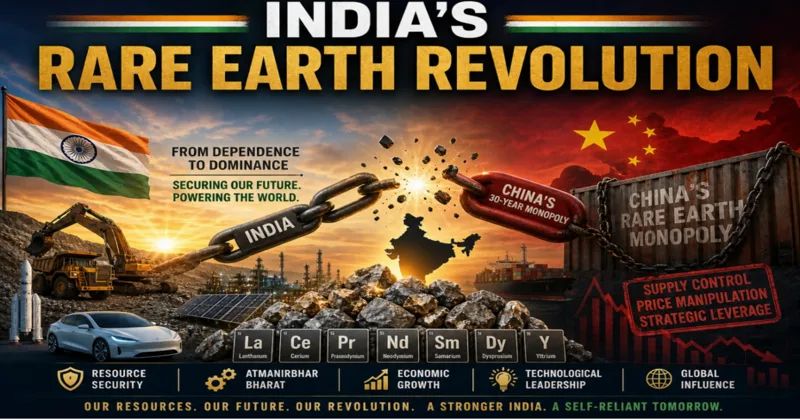
In 1992, Deng Xiaoping made a declaration dismissed by most of the world as bluff that “The Middle East has oil, China has rare earths.” Three decades later that declaration has become the defining geopolitical issue and supply chain material of the 21st century and India has spent most of those three decades financing it.
The Union Budget 2026–27 announcement of Dedicated Rare Earth Corridors across Odisha, Kerala, Andhra Pradesh, and Tamil Nadu combined with the November 2025 Rare Earth Permanent Magnet (REPM) scheme worth ₹7,280 crore and the ₹34,000 crore National Critical Minerals Mission (NCMM) which constitutes the most strategic minerals policy any Indian government has ever executed for Aatmanirbhar Bharat.
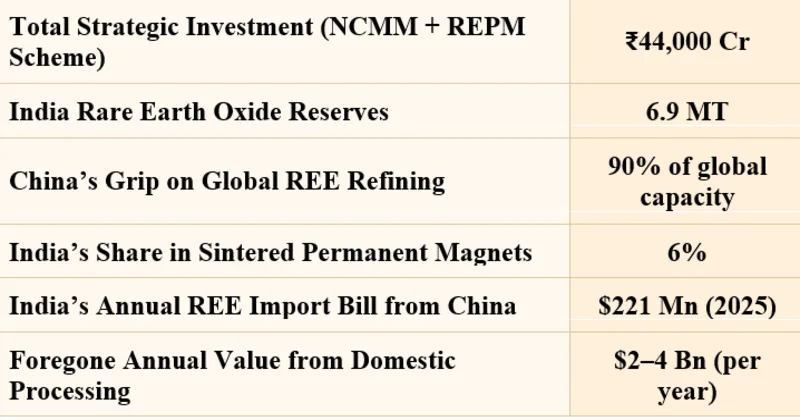
Dragon’s 30-year mineral monopoly
The numbers are staggering in their implication. China today controls approximately 70% of global rare earth mining and a 90 per cent of global refining capacity. For sintered permanent magnets the components that power India’s electric vehicles, missile guidance systems, wind turbines and fighter jet actuators. China share has climbed to 94 per cent, up from roughly 50 per cent just two decades ago. The International Energy Agency (IEA) found that China leads in processing for 19 of 20 critical strategic minerals. This is a monopoly and it will create a chokepoint.
For India this dependency carries a specific price tag. Official figures from 2025 place India’s imports of rare earth elements, magnets and related materials from China at approximately $221 million annually, with 80–90 per cent of all REE supplies sourced from a single strategic competitor with whom India shares a contested 3,488-km Himalayan border. The difference between what India pays for processed imports versus what it could earn from domestic value-addition is estimated at $2–4 billion annually.
“India holds the world’s third-largest rare earth reserves, estimated at 6.9 million tonnes, yet contributes less than 1% to global REE production. This is not a geological failure. It is a policy failure that the Modi government is now correcting with historic urgency”.— Kotak Mutual Fund Critical Minerals Research, 2025
The wake-up call India should not ignore
On April 4, 2025, Beijing fired its economic weapon. In retaliation against US tariffs, China Ministry of Commerce imposed export controls on seven heavy rare earth elements such as scandium, yttrium, samarium, gadolinium, terbium, dysprosium and lutetium. The result was immediate and China total exports of rare earth magnets fell 74 per cent year on year in May 2025, the lowest level since COVID-19 lockdowns. US-specific magnet shipments collapsed by 93.3 per cent. German, American and Indian automakers issued joint warnings about production shutdowns.
By October 2025, Beijing escalated to a level extending extraterritorial jurisdiction over any product manufactured anywhere in the world using Chinese rare earth materials or Chinese processing technologies. This was not a trade dispute. This was an assertion of sovereign control over the global technology supply chain. The IEA called it a marked escalation. Chatham House called it a “stark warning to the West”. For India, it was a declaration of the precise vulnerability that 75 years of IREL monopoly and policy inertia had created.
China’s strategy was called as calibrated concession by analysts, which involves toggling access rather than granting permanent stability. When border tensions escalated in 2024, China imposed rare earth curbs that crippled Indian electronics and automotive sectors. They were partially lifted only after high-level talks between External Affairs Minister S. Jaishankar and Chinese Foreign Minister Wang Yi in September 2025, timed to PM Modi expected Shanghai Cooperation Organisation visit. China treats rare earth access as a diplomatic lever, not a commercial arrangement.
Modi Government Response: The architecture of atmanirbharta
Prime Minister Modi government has responded with a compressed, multi-layered policy offensive that dismantles 75 years of regulatory inertia in 24 months.
Policy Timeline
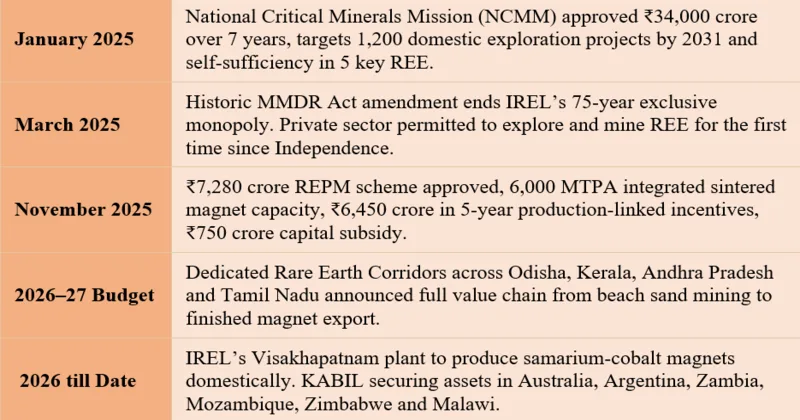 The REPM scheme is sophisticated and deliberately PLI-modelled with global competitiveness bidding for up to five beneficiaries, a 2-year facility setup gestation, followed by 5 years of sales-linked incentives. The ₹750 crore capital subsidy makes India separation and refining economics viable against Chinese incumbents who have had three decades of subsidised head start. This is the Strategic Leap Model in action exactly what Indian defence and industrial base demanded, and exactly what Viksit Bharat @2047 requires.
The Four Corridors: Mapping India’s mineral backbone
The Rare Earth Corridors are geographically mapped directly onto India’s proven coastal placer and interior Teri Sand deposits, all operated bby existing IREL infrastructure.
Rare Earth Corridor Map
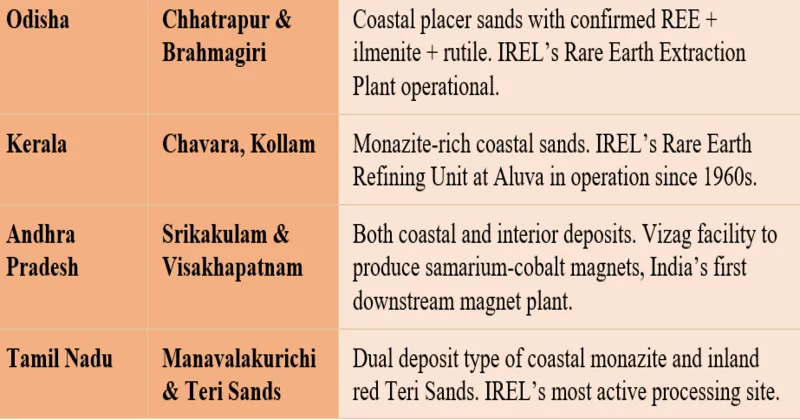 These four corridors cover India’s estimated 6.9 million tonne rare earth oxide reserves the world’s third largest pile locked in beach sand mineral complexes containing ilmenite, rutile, zircon, monazite, sillimanite and garnet alongside REEs. The corridor model integrates mining, processing, research and manufacturing in geographic clusters which replicates the precise formula that made China’s Jiangxi rare earth complex globally dominant in the 1990.
Beyond China: India alliance strategy for mineral security
The PM Modi government understands that domestic corridors alone are insufficient. India’s mineral security doctrine is now explicitly multi-vectored. Through KABIL (Khanij Bidesh India Limited), New Delhi is acquiring overseas mineral assets in Australia, the world’s third-largest REE producer as well as Argentina, Zambia, Mozambique, Peru, Zimbabwe, Malawi, and Côte d’Ivoire. India is a member of the 15-nation Minerals Security Partnership (MSP), alongside the EU, Japan, South Korea and Canada for a direct counter-coalition to Chinese mineral dominance.
The removal of IREL from the US export control list is a pivotal strategic realignment, unlocking American technology transfer for REE separation and magnet manufacturing. The IREL-Japan joint venture for samarium-cobalt magnets at Visakhapatnam represents India’s first serious downstream manufacturing entry. In July 2025, BatX Energies partnered with Germany’s Rocklink GmbH to establish India’s first fully integrated rare earth magnet recycling facility with a zero-liquid-discharge. Circular economy play aligned with the EU-India Trade and Technology Council vision that simultaneously reduces Indian demand for Chinese inputs.
Challenges India must confront and can overcome
India’s R&D investment in rare earth separation and materials science remains a fraction of China. The nation faces a severe shortage of rare earth metallurgists, a specialised workforce China cultivated through decades of state-directed investment. Environmental challenges are real for coastal REE mining intersects with Coastal Regulation Zone (CRZ) policy and threatens fragile beach sand ecosystems that India cannot afford to sacrifice for short-term extraction gains. Separation infrastructure, solvent extraction systems alone cost $300–800 million per facility which demands payback periods of 8–15 years, making private capital cautious without credible government off-take commitments.
The PLI framework has already demonstrated that India can build globally competitive semiconductor packaging, mobile phone manufacturing and pharmaceutical bulk drug industries in compressed timeframes. The REPM scheme applies the same model production-linked incentives providing the demand certainty that turns 15-year payback periods into viable investment cases. The National Critical Minerals Mission target of 1,200 domestic exploration projects by 2031 will systematically map and de-risk the geological base that private operators need.
“India’s journey towards rare earth self-sufficiency is a race against time and international competition, a pathway to industrial resilience, technological advancement, and strategic autonomy. The road is clear. The will is present. The investment is committed.” — National Critical Minerals Mission, Government of India, 2025
The Civilisational Stakes: Why this goes beyond economics
The ₹44,000 crore committed across NCMM and the REPM scheme is not an industrial investment. It is India formal declaration that the era of mineral vassalage is over. Rare earth permanent magnets are the enabling technology of the 21st century economy for every electric vehicle motor, wind turbine generator, precision missile seeker, MRI machine, smartphone, vibration motor runs on neodymium-iron-boron or samarium-cobalt magnets. A nation that cannot make its own magnets cannot claim genuine sovereignty in defence, energy or electronics.
Four coastal corridors stretching from Chavara’s monazite beaches to Brahmagiri’s placer sands are not lines on a budget document. They are the sinews of a sovereign high-technology manufacturing civilisation. When the first samarium-cobalt magnet rolls out of IREL’s Visakhapatnam facility made from Indian ore, refined in Indian facilities, wound into Indian motors. It will represent the moment when India finally treated its geological inheritance as the strategic weapon it always was. Deng Xiaoping said China had rare earths. He was right. But India has them too and a government that has finally decided to use them.