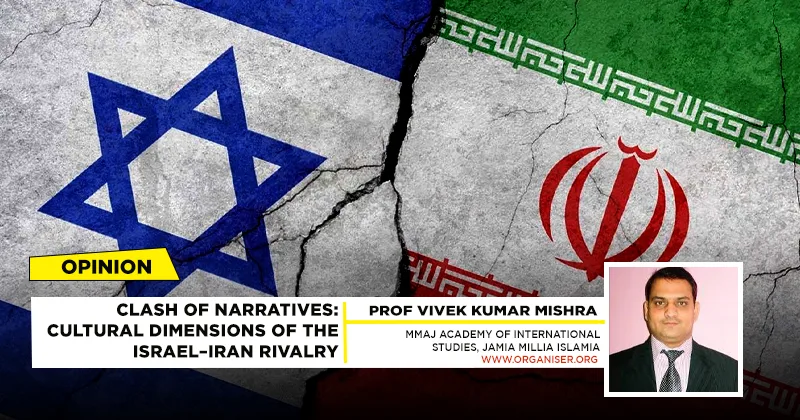
The State of Israel was founded on May 14, 1948 and Iran was the second Muslim-majority nation—after Turkey—to acknowledge its sovereignty, thereby opening the door to friendly bilateral relations. The Suez War in 1956 was a turning point between the two countries in the direction of cordial relations. Israel has maintained good relations beyond the Arab countries at its borders and established relations with the non-Arab countries also. More than a strategic partnership, Israel’s identification with the Mohammad Reza Shah Pahlavi of Iran anchored both states within the modern Western camp during the Cold War.
The 1979 Iranian Revolution overthrew Shah Pahlavi’s pro-Western regime and established the Islamic Republic of Iran, led by Ayatollah Khomeini. After that, anti-Zionism became a key ideological component of Iranian foreign policy, and all ties were cut with the State of Israel. Since then, the Iranian government has systematically referred to “the Jewish State by demeaning terms, such as the “Zionist regime” and “Occupied Palestine”, and has called for its destruction.
Elements of cultural identity in Iranian foreign policy
Iran is a theocratic state distinguished by its unique institutional structure. It operates as a hybrid political system, combining elements of theocracy, democracy and aspects of military authoritarianism. The theocratic character of governance is reflected in four principal institutions: “the Supreme Leader, the Guardian Council, the Assembly of Experts, and the Expediency Council.” At the top of this hierarchy is the Supreme Leader, who acts as both the highest religious and political authority, exercising extensive powers, including serving as commander-in-chief of the armed forces and holding the authority to declare war. The theocratic system gives significant power to the Supreme Leader. The Supreme Leader sets foreign policy priorities through institutions like the Islamic Revolutionary Guard Corps (IRGC), which align with revolutionary ideology.
It is widely observed that post-Shah regime Iranian foreign policy blends Shia Islamism, Persian nationalism, and a strong anti-Western orientation. The Iranian national identity projects a sense of superiority towards its Arab neighbours. Iran’s identity combines Shiism, anti-imperialism, and Persian heritage. It frames Iran as a defender of oppressed Muslims, especially Palestinians, and as an opponent of Western, particularly American, influence in West Asia. Iran’s incorporation of Shiite symbolism into its foreign policy serves to promote anti-Israel sentiments and demonstrate support for Shiite groups, reflecting a broader sense of Islamic solidarity. This revolutionary identity influences Iran’s foreign policy, framing it as a moral obligation grounded in Islamic principles. Hard-line factions within the clerical establishment use anti-Israel rhetoric to bolster their legitimacy.
These approaches show how Iran’s foreign policy serves as a tool to reinforce its revolutionary identity and consolidate domestic power. Iran’s hostility toward Israel became a central pillar of the Islamic Republic’s ideological framework after the 1979 Revolution. Following Khomeini’s death, his successor, Ali Khamenei, largely continued this ideological trajectory. Closely aligned with conservative factions within Iran’s political system, Khamenei upheld the revolutionary principles established by Khomeini and maintained a similarly hardline stance in both domestic and foreign policy. Khamenei believed that the state should be designed according to the word of god, not people.
Elements of cultural identity in Israel’s foreign policy
Israel functions as a typical liberal democracy in terms of the separation of powers; however, it is also often characterised as an ethnic democracy, shaped by an ideology rooted in ethnic nationalism. Zionism as an ideology has a special place in the state of Israel. Zionism is a form of Jewish nationalism which believes that “Jews as a religious entity are a nation”. The Declaration of the State of Israel advances Zionist principles by asserting that the Jewish people possess a “national and historical right” to establish a Jewish state, and Israel’s identity is deeply rooted in this self-conception as a Jewish homeland. Zionism, which sees Israel as the homeland of the Jewish people with a right to self-determination based on religious and historical claims to the land, formed Israel’s founding philosophy as it emerged from the trauma of diaspora and anti-Semitic persecution.
Israel perceives itself as under constant threat, particularly from regional adversaries, especially from Iran. Iran is considered an existential threat due to its support for Hezbollah, Hamas and its anti-Israel militant groups. This perception underpins a foreign policy strongly oriented toward defence. Furthermore, Israeli society’s siege mentality perpetuates an “us versus them” narrative, supported by cultural and religious rationales in political policy and public debate. Israel’s Basic Law upholds the notion that it is a “Jewish state,” placing Jewish identity at the centre of its security and national policies. This mindset supports a foreign policy that prioritises security and self-preservation, especially when combined with religious narratives of biblical land claims. Israeli foreign policy is based on the constant panic of Israel being destroyed by Iran. This includes pre-emptive actions against Iran’s nuclear program and its proxies.
The ideology and cultural narratives not only define each nation’s self-image but also shape a foreign policy in which both Iran and Israel view each other as ideological and existential adversaries. Israel and Iran’s constructed threat perceptions motivate both countries to form and maintain strategic alliances in order to mitigate perceived existential threats. Iran’s backing of Hezbollah and other militant groups and its advancing nuclear program are viewed by Israel as significant threats to its national security and survival. Because of this viewpoint, Israel has strengthened its ties with nations that share its apprehension about Iranian influence, including the United States, which offers significant military assistance, and some Gulf States that also see Iran as a regional force that threatens stability.
For Israel, national security is closely tied to countering Iran’s influence. Iran’s nuclear ambitions and its support for groups like Hezbollah, Houthis and Hamas heighten this concern. Israel maintains its security through robust military deterrence and close strategic partnerships—especially with the United States—aimed at preserving regional stability and preventing Iran from acquiring nuclear capabilities that could alter the balance of power. Iran, on the other hand, views Israel as both an ideological and strategic adversary. The conflict’s intensity is fuelled by mutual perceptions of existential threats. Both nations’ strategies, rooted in ideology and security concerns, have shaped the conflict defined by hybrid warfare and ongoing competition for regional dominance.
Ongoing Conflict
The ongoing conflict developed through a rapid cycle of escalation, beginning with the Hamas attacks of October 7, 2023 in Israel, and culminating in the launch of Operation Epic Fury on February 28, 2026—a joint U.S.–Israeli military campaign against Iran. In the aftermath of the Hamas assault, Iran’s regional proxy network—including Hezbollah, the Houthis, and Iraqi Shi’a militias—activated multiple fronts, targeting both Israeli territory and U.S. forces across the region. Israel’s assassination of Hezbollah leader Hassan Nasrallah in September 2024 was followed by a ground incursion into southern Lebanon. The June 2025 Twelve-Day War represented the first prolonged aerial confrontation between Israel and Iran. On June 13, Israel launched Operation Rising Lion, deploying more than 200 fighter jets to strike approximately 100 targets, including Iran’s nuclear facilities at Natanz, Fordow and Isfahan.
The strikes resulted in roughly fifty per cent of Iran’s missile stockpile being destroyed and the killing of about 30 senior IRGC commanders along with 11 nuclear scientists. On June 22nd, the United States joined the hostilities by sending B-2 stealth bombers to launch 14 Massive Ordnance Penetrators against Iran’s subterranean nuclear sites. A ceasefire mediated by Qatar on June 24th 2025, ended the conflict, which had caused approximately 1,062 Iranian and 29 Israeli fatalities.
The International Atomic Energy Agency reported that Iran had significantly expanded its stockpile of uranium enriched to 60 percent, exceeding 408 kilograms. Prior to a second wave of strikes, Badr Bin Hamad Al Busaidi—serving as the chief mediator in indirect U.S.–Iran negotiations in Vienna—announced that Tehran had agreed not to accumulate enriched uranium, to downgrade existing reserves to fuel-grade levels, and to permit IAEA inspections. However, “on February 27, 2026, the IAEA revealed that Iran had hidden highly enriched uranium in an underground facility, with the remaining stockpile theoretically sufficient to produce approximately nine nuclear weapons if further enriched to the 90 percent threshold required for weaponization”.
By mid-February 2026, the US–Iran nuclear negotiations in Oman had not achieved any progress, as the United States insisted on zero enrichment, while Iran rejected this demand. Iran sought to retain the capability to enrich uranium to levels suitable for nuclear power plants. On February 28th, 2026, the United States and Israel launched their coordinated strike and killed many IRGC officers, including Iranian supreme leader Ayatollah Khamenei. On March 1–2, Hezbollah carried out a large-scale assault on northern Israel, extending its reach to the Haifa region and striking key military targets. The operation was framed as retaliation for the killing of Ayatollah Khamenei and represented the first major barrage from Lebanon since the November 2024 ceasefire. In response, the Israel Defence Forces (IDF) targeted more than 70 weapons depots, launch positions, and logistical hubs in southern Lebanon, while also conducting widespread airstrikes across Beirut’s southern suburbs.
The Operation Epic Fury launched by the US and Israel to counter Iran’s nuclear program and ballistic missile threats marked a transition from “shadow war” to direct conflict. Despite two rounds of strikes against Iran’s nuclear infrastructure, Iran retains both its enriched uranium stockpile and its centrifuge manufacturing knowledge, leaving its reconstitution potential intact. Ongoing peace talks between the United States and Iran, as well as Israel and Lebanon, offer cautious grounds for optimism toward achieving a sustainable peace.
Cultural and material dynamics operate in tandem to perpetuate the rivalry between Israel and Iran. The deep-seated ideological and cultural differences shape how each state perceives the other as a threat, reinforcing mutual suspicion. Their distinct identities contribute to viewing one another as existential adversaries: Iran’s revolutionary Islamic orientation drives its opposition to Israel, while Israel’s identity as a Jewish state underpins its security-centric policies, particularly in response to Iran’s proxy networks and nuclear aspirations. Therefore, it can be argued that the primary factors contributing to the development of a protracted war are the stark ideological and cultural identity disparities between the two nations. The conflict between Iran and Israel is rooted in fundamental differences in their national identities and conflicting ideological views, which have hindered both sides from coming to a peaceful resolution.