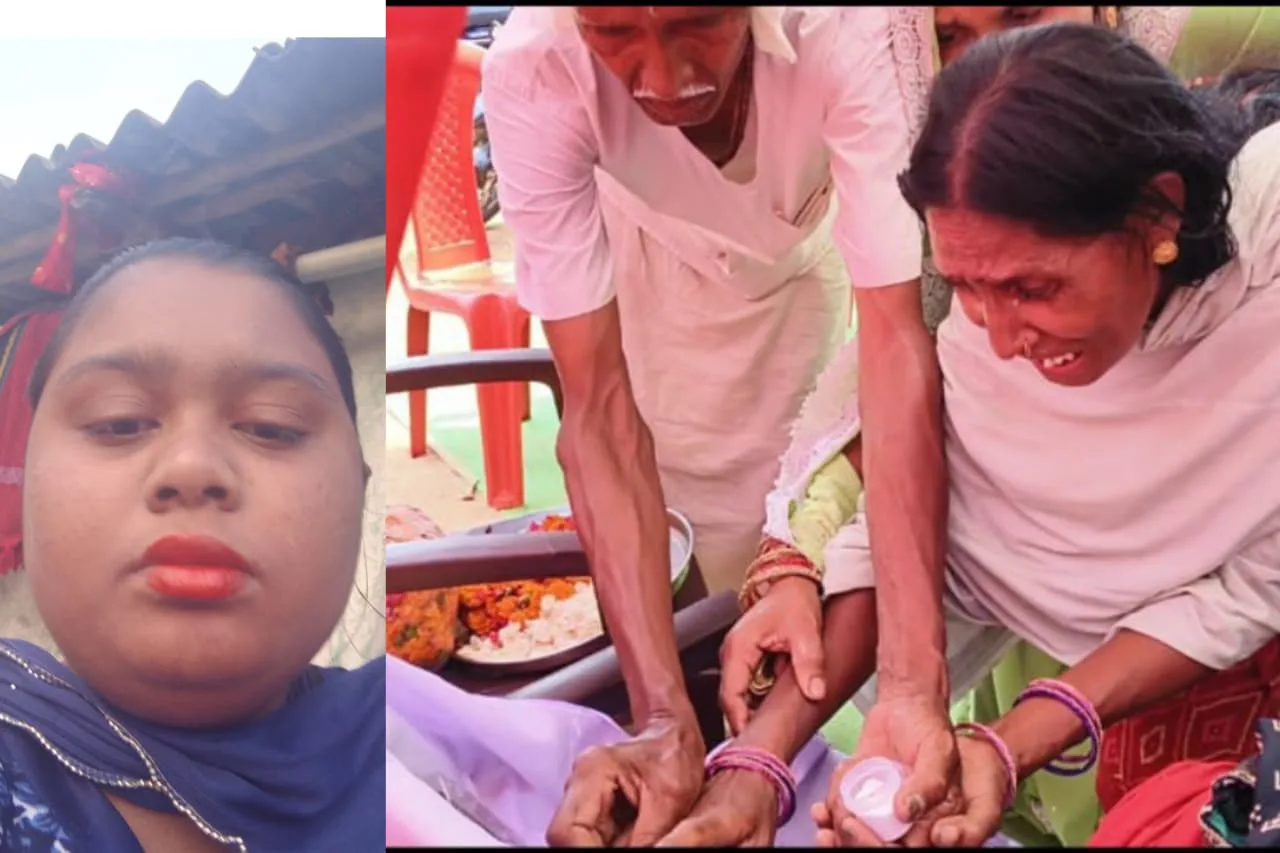
In a landmark judgment that lays bare the fatal consequences of unregulated “miracle healing” practices by missionaries, a special court in Raipur has sentenced Ishwari Sahu to life imprisonment for the death of 18-year-old Yogita Sonwani in Chhattisgarh’s Gariaband district. Yogita belongs to the Satnami caste, which falls in the Scheduled Caste category.
The case, registered as FIR No. 157/2025 at Rajim Police Station and tried as Special Criminal Case No. 30/2025, marks what is being seen as the first conviction under the Chhattisgarh Dharma Swatantrya Adhiniyam (anti-conversion law) in a case leading to life imprisonment.
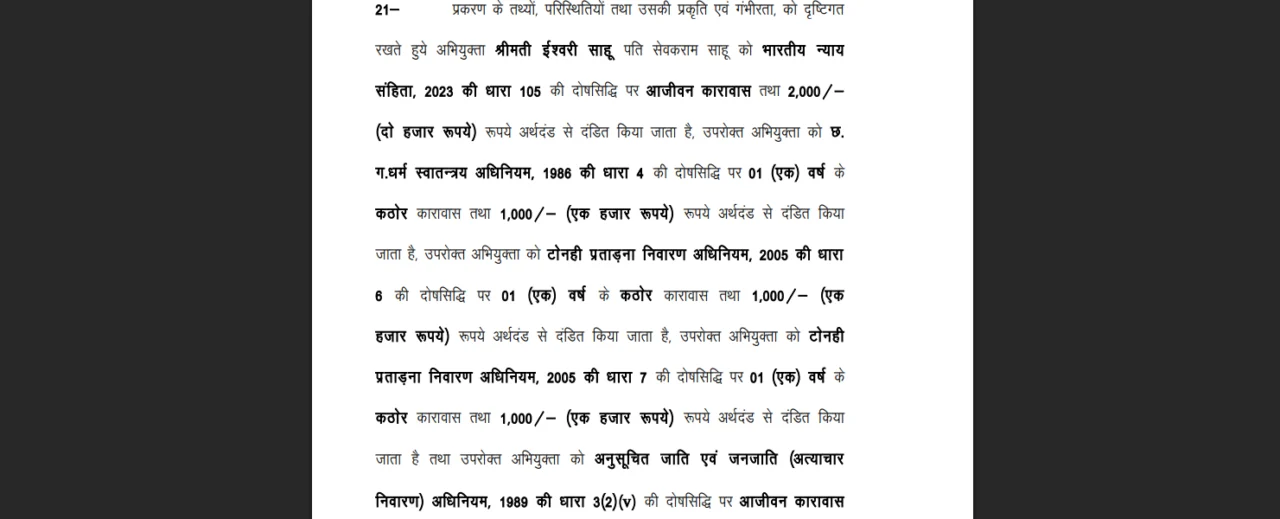
Delivering the verdict on May 1, 2026, Special Judge Pankaj Kumar Sinha convicted the accused under Section 105 of the Bharatiya Nyaya Sanhita, Section 4 of the Chhattisgarh Dharma Swatantrya Adhiniyam, Sections 6 and 7 of the Chhattisgarh Tonhi Pratadna Nivaran Act, and Section 3(2)(v) of the SC/ST (Prevention of Atrocities) Act, sentencing her to life imprisonment along with a fine of Rs 2,000. The court rejected the defence’s plea for leniency and underscored the gravity of the offence.
In a detailed and strongly worded order, the court recorded the sequence of events in a single, unambiguous finding: “From 01.01.2025 to 22.05.2025, at village Sursabandha, Police Station Rajim, District Gariaband, the accused, under the pretext of treating Yogita Sonwani, without any medical qualification or degree, administered so-called miraculous oil and hot water to her. By deceit and by showing complete confidence, she controlled the victim and her mother and claimed that treatment would only be possible if performed by her. In the guise of treatment, she touched, harassed and exercised control over the victim, applying oil and hot water and massaging her body. Due to these acts, the victim suffered internal injuries and fractures, resulting in her death. The nature of the death is homicidal.”
This judicial conclusion effectively stitched together months of testimony, medical evidence, and witness accounts into a single narrative: what was presented as “healing” was, in fact, sustained physical abuse leading to death.
A desperate mother, a fatal turn
The case began not as a criminal conspiracy but as the grooming of a mother who was desperate to cure her ailing daughter. Sunita Sonwani, a 52-year-old daily wage labourer, had been struggling to treat her daughter Yogita’s alleged mental illness for nearly two years. With limited financial resources, she had already exhausted formal medical avenues.
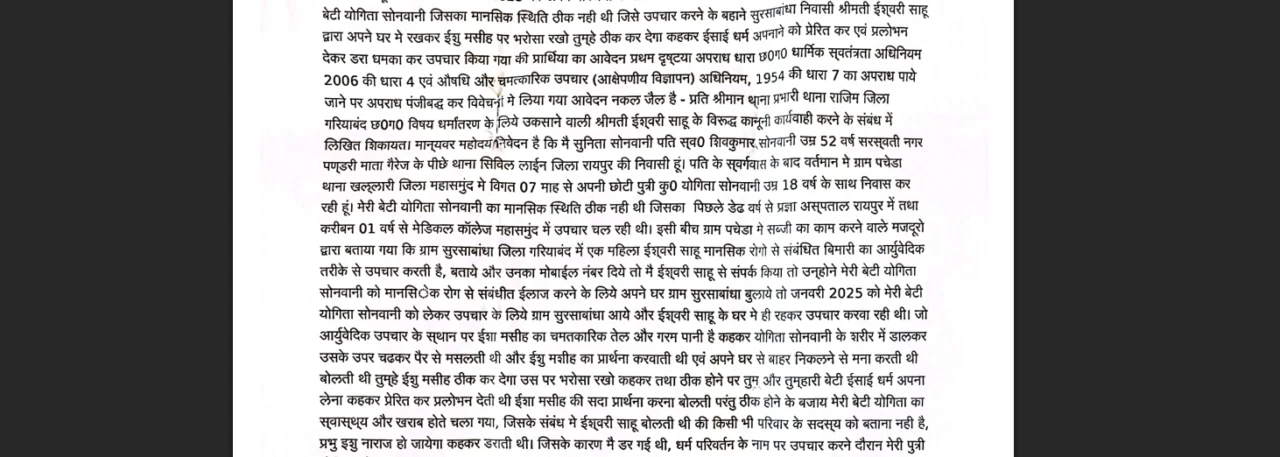
In her testimony, Sunita narrated her situation in detail: “I studied up to 8th class and I do daily wage labour work. After my husband’s death, I was living with my daughter Yogita in village Pacheda. My daughter was mentally ill and I had been getting her treatment for one and a half years at Pragya Hospital, Raipur, and for about one year at Medical College, Mahasamund. During this time, people working in the vegetable market told me that there is a woman in village Sursabandha who treats mental illness. They gave me her mobile number. I contacted her and she called my daughter for treatment, so in January 2025, I took my daughter there and kept her at the accused’s house for treatment.”
That decision, taken in hope, marked the beginning of a four-month ordeal.
‘Miracle Healing’: Inside the house
What unfolded inside Ishwari Sahu’s residence was detailed extensively in court, with Sunita’s testimony forming the backbone of the prosecution’s case. Her statement, recorded in court and reflected in the judgment, presents a continuous account of what she witnessed:
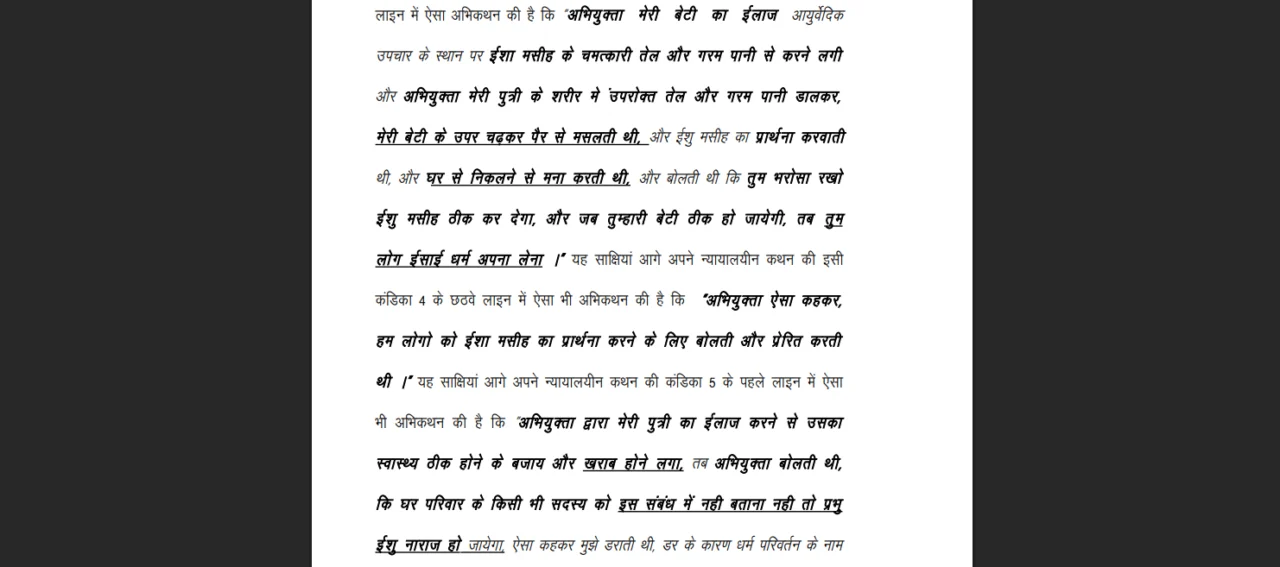
“The accused started treating my daughter not with proper medicine but by using what she called the miraculous oil and hot water of Jesus Christ. She used to apply that oil and hot water on my daughter’s body and because of this blisters and pain started appearing. She would make her pray to Jesus Christ and would stop her from coming out of the house,” she added.
She used to say, “‘Keep faith in Jesus Christ, He will cure you,’ and she would also say that after my daughter gets cured we should adopt Christianity. Whenever I questioned her about this treatment, she would threaten me and say that if I tell anyone about this, Lord Jesus would get angry. Due to fear I remained quiet, but instead of getting better my daughter’s condition became worse.”
The testimony also described the physical nature of the “treatment,” which the court later linked directly to the cause of death.
In another part of her statement, Sunita said: “The accused used to massage my daughter and apply hot water and oil repeatedly. Because of this, blisters and wounds developed on her body. On the day my daughter died, she had fever and was in pain. The accused kept saying that this is part of the treatment and that she would get cured.”
Her voice, as recorded during proceedings, reportedly broke at one point when she added: “Due to the treatment given by the accused, my daughter Yogita Sonwani died on 22.05.2025.”
A pattern of pressure and fear
The prosecution’s case was strengthened by the testimony of Rekha Bhel, the victim’s maternal aunt, who confirmed that Sunita had shared details of the treatment during those months.
Her statement presented a consolidated account of what she was told: “My sister told me that the accused was not giving proper medical treatment but was using hot water and oil in the name of Jesus Christ. She said the accused would massage Yogita and make her pray, and would say, ‘Keep faith in Lord Jesus Christ, He will cure everything.’”
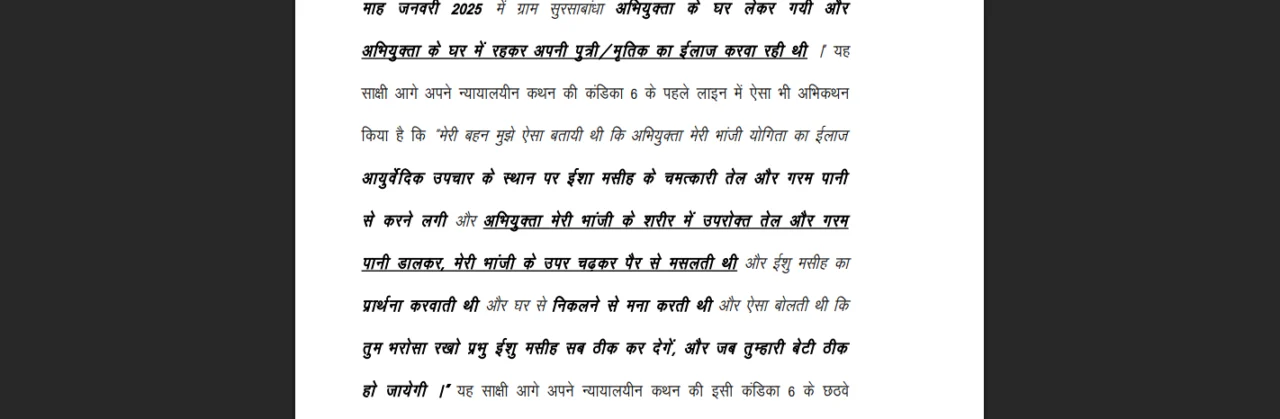
“My sister also told me that the accused used to say that after the girl gets cured, they should adopt the Christian faith. She would also warn that no one should tell anyone about this matter, otherwise Lord Jesus Christ would get angry. Instead of improving, Yogita’s condition was worsening during this period, and under this fear and pressure, she remained there until her death on 22.05.2025.”
This testimony reinforced the prosecution’s argument that the victim was not only physically harmed but also kept under psychological control.
Injuries that told the truth
The turning point in the case came with the medical evidence. The postmortem, conducted at District Hospital Gariaband, revealed findings that aligned with the prosecution’s claims and contradicted any suggestion of natural death.
The combined medical opinion of three doctors was presented in court as follows: “On examination of the body, it was found that there were internal injuries, particularly in the neck region. There was fracture of the thyroid cartilage on both sides, and due to the impact of a hard object, the breathing of the deceased stopped. The death occurred within 12 to 24 hours of these injuries. In our opinion, the nature of the death is homicidal.”
When the defence attempted to suggest that such injuries could be self-inflicted, Dr. Nidhi Jaysawal categorically rejected the claim: “The nature of the injuries and death as described cannot be caused by pressing one’s own throat. Such injuries indicate external force.”
These findings were directly incorporated into the court’s reasoning, forming the basis for the conviction under culpable homicide.
Court rejects leniency: ‘Not a case for probation’
During the sentencing phase, the defence sought leniency, arguing that the accused was a woman and had no prior criminal record. The court, however, dismissed this argument in a consolidated observation:
“The argument of the learned counsel that the accused is a woman and this is her first offence has been considered. However, in this case, the accused treated an 18-year-old young woman belonging to a Scheduled Caste by applying miraculous oil and hot water, touching and massaging her in the guise of treatment, due to which she suffered internal injuries and fractures leading to death. Considering the seriousness and nature of the offence, this is not a case where the benefit of the Probation of Offenders Act should be given, and it is appropriate to award proper punishment.”
The final sentencing order read: “The accused Ishwari Sahu is hereby convicted under Section 105 of the Bharatiya Nyaya Sanhita, 2023 and sentenced to life imprisonment along with a fine of Rs 2,000.”
Family after verdict: ‘All done in the name of Jesus’
After the judgment, Yogita’s maternal uncle Rekhraj spoke about the events leading up to the tragedy, describing how the family had been drawn into the situation.
His account presents a continuous narrative of what the family experienced: “Despite taking treatment from government medical colleges, my sister was trapped. She took Yogita to Sursabandha where Ishwari Sahu, in the name of treatment, poured hot oil and water on her body and massaged her saying this will cure her. All of this was done in the name of Jesus.”
He added, “She kept telling my sister not to inform anyone, saying that if she did, it would invite Shaitan and her daughter would never get cured. Whenever my sister questioned the treatment, she was silenced and told that these thoughts were being put in her mind by Shaitan.
He said, “Even after the girl died, Ishwari said that she should be buried because she had reached Jesus, that Jesus loved her and had called her.”
Case sets a legal marker
With FIR No. 157/2025 culminating in a conviction under Special Criminal Case No. 30/2025, the case establishes a critical legal precedent in Chhattisgarh. It is among the first cases where the anti-conversion law has been invoked in conjunction with a homicide case, leading to life imprisonment.
The court’s findings leave little room for ambiguity: the accused had no medical qualification, yet claimed exclusive ability to cure, used physical force disguised as treatment, and operated in an environment of fear and control.
The death of Yogita Sonwani is not just a case of individual crime but a stark example of how unverified “miracle healing” practices, when combined with coercion and physical harm, can turn deadly. What began as a search for treatment ended in a courtroom where the law had to step in to establish accountability.
The Raipur court’s verdict draws a clear line: when claims of healing lead to injury, coercion, and death, they are not acts of faith, they are offences under the law.
And in this case, that line has been enforced with the harshest possible consequence: life imprisonment.