Guwahati: The EVMs, lying in the strong rooms with tight security, know the results, but it has to be opened on May 4 for us to know who forms the next government in Assam. In 35 fortified strong rooms across Assam, thousands of Electronic Voting Machines sit in silence — each one carrying within it the collective verdict of a state that voted in record numbers on April 9 is ready to be open for counting sharp at 8am on May 4.
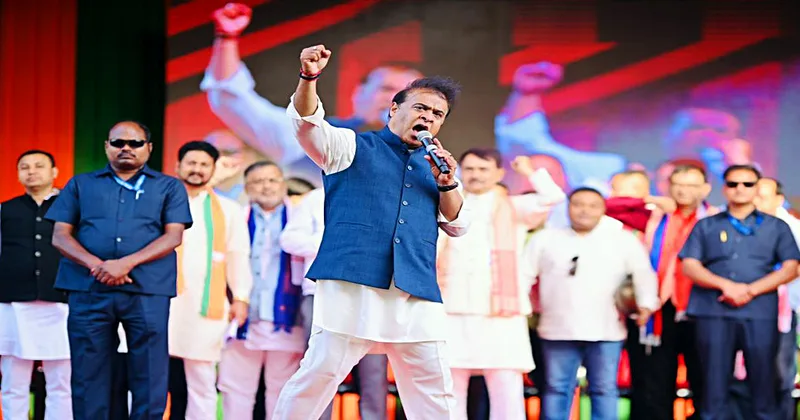
As the countdown enters its final hours, the mood across political camps could not be more different. The Bharatiya Janata Party, riding on the incumbency of two consecutive terms and the towering political stature of Chief Minister Himanta Biswa Sarma, is projecting quiet confidence — the kind that comes from an organisation that believes it has read the ground correctly. The opposition, by all visible indicators, is going into Monday looking considerably more uncertain, its arithmetic fragile and its messaging yet to find the kind of traction that translates into seats.
“People of Assam accepted the development model of BJP, that’s what the exit poll says and the result will be even better”, says Dilip Saikia, state president BJP.
Dispur — Assam’s seat of power — is waiting. And the machinery of India’s Election Commission is ready for the big day.
Chief Electoral Officer Anurag Goel on Saturday laid out the scale of the security blanket that has been wrapped around the state’s EVMs since polling day itself. Twenty-five companies of Central Armed Police Forces have been guarding the strong rooms continuously since April 9 — not deployed after the fact, but present from the moment voting ended. They will not leave until every machine has been counted, verified, and shifted back to warehouses.
Round-the-clock CCTV surveillance covers every strong room. State police personnel provide an additional layer of security alongside the CAPF deployment. And for candidates or election agents who want the reassurance of seeing the strong room doors with their own eyes, that provision exists too — because in an election this consequential, transparency is not optional.
“We have been strictly monitoring the strong rooms with proper CCTV coverage,” Goel said. “There is a provision to take candidates or election agents, if they wish to check the strong room doors.”
On counting day itself, 800 unarmed police personnel will be additionally deployed across strong room locations. Two companies of CRPF have been positioned in Guwahati Metro for static duty. The message from the Election Commission is unambiguous — the integrity of this count will be protected at every step.
The counting operation on May 4 is, in sheer logistical terms, a massive exercise.
CEO Goel confirmed that 40 counting centres have been set up across all 35 district headquarters in the state, with approximately 5,981 officials engaged in the counting process. To ensure that human error — intentional or otherwise — has nowhere to hide, around 2,348 micro-observers have been appointed specifically to watch the counting officials. These micro-observers report directly to the counting observers, creating a layered accountability structure that leaves little room for slippage.
The Election Commission has deployed 126 counting observers drawn from different states — one for each Assembly constituency. These are not local officials with local loyalties. They are external eyes, placed deliberately to ensure the process remains above reproach.
The VVPAT factor
CEO Goel flagged clearly that results may be delayed well into the late evening — and the reason is a significant procedural change. The Election Commission has made it mandatory this cycle to count all VVPAT slips, irrespective of the margin between candidates. Unlike previous elections where VVPAT verification was done on a sample basis, every slip now gets counted. Every constituency. No exceptions.
What that means practically is that the counting process will take considerably longer than in previous years.
Assam recorded nearly 86 per cent voter turnout in the April 9 polling — the highest the state has seen in recent years, surpassing the 84.64 per cent of 2016 and significantly above the 82.02 per cent recorded in 2021. What drove that surge — enthusiasm for the incumbent, desire for change, or simply a more motivated electorate — is precisely the question that May 4 will answer.
Additionally, 1,19,463 postal ballots had already been cast across the state ahead of counting day. Service voters’ ballots were set to continue arriving through the postal department right up until 7:59 am on May 4, the last permissible moment before counting begins.
The Election Commission directed the district administrations across the state to issue advisories restricting victory processions and public gatherings after results are declared. The instruction is firm — regularise and restrict celebrations to prevent unnecessary confrontations between political factions.
“It’s a matter of time, we will surely form the next government with more than 90 seats”, says BJP leader Dilip Sharma.
The BJP goes in believing the people of Assam have given them a mandate to continue. The opposition goes in hoping the record turnout carries within it the winds of change. The EVMs know the answer already.