

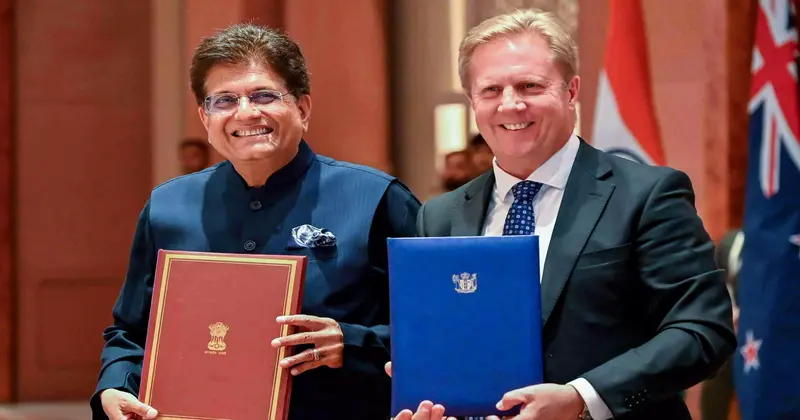
The recently signed Free-Trade Agreement(FTA) between India and New Zealand is not merely another addition to New Delhi’s expanding portfolio of economic partnerships it is a calculated geopolitical and economic maneuver shaped by an increasingly volatile global order. Coming after 15 years of intermittent negotiations, the agreement reflects a broader strategic shift: a conscious movement away from overdependence on dominant global powers and toward a diversified, multi-aligned trade architecture.
At a time when global supply chains are under unprecedented stress from the closure of the Strait of Hormuz due to the ongoing US-Iran war to shifting tariff regimes under Donald Trump India’s trade diplomacy is beginning to mirror its long-standing geopolitical doctrine of strategic autonomy. The New Zealand deal must be viewed in this context: not as an isolated economic pact, but as part of a layered response to an unstable international system.
A timely economic realignment
The urgency behind the agreement cannot be overstated. Indian exporters have been grappling with disruptions caused by maritime chokepoints and fluctuating Western trade policies. The closure of the Strait of Hormuz one of the world’s most critical oil and trade arteries has reverberated across industries, raising logistics costs and forcing exporters to rethink traditional routes.
Simultaneously, steep tariffs imposed by the United States have introduced uncertainty into one of India’s most significant export markets. The recent legal confusion triggered by a US Supreme Court ruling invalidating several tariff measures has only added to the unpredictability. In this climate, India’s decision to secure duty-free access for 100 percent of its exports to New Zealand is both pragmatic and forward-looking.
The benefits are immediate and tangible. Small and medium enterprises in sectors such as textiles, leather, and gems and jewellery stand to gain significantly. These industries, often vulnerable to external shocks, now have a relatively stable and open market to tap into. The agreement’s provision for 5,000 Temporary Employment Entry Visas further strengthens people-to-people ties and opens pathways for Indian professionals in a developed economy.
New Zealand’s strategic calculus
For New Zealand, the agreement is equally strategic. Wellington has long grappled with its economic dependence on China, its largest trading partner. As Beijing’s growth slows and geopolitical tensions mount, diversification has become an economic necessity rather than a policy choice.
India, with its expanding middle class and robust growth trajectory, presents an attractive alternative. The EY projection that India could become the world’s second-largest economy in purchasing power parity terms by 2038 adds weight to this calculus. By securing early access to Indian markets particularly in sectors like wool, aluminium, and horticulture New Zealand positions itself advantageously for the long term.
However, the deal is not without its critics within New Zealand. Concerns over inadequate access for dairy exports a cornerstone of the Kiwi economy highlight the inherent asymmetries in the agreement. While tariffs on products like wine are set to reduce significantly, the limited concessions on dairy underscore India’s cautious approach to protecting its domestic agricultural sector.
India’s domestic balancing act
This caution is not without reason. India’s dairy sector, dominated by small farmers and cooperative structures, is both economically vital and politically sensitive. The decision to allow duty-free import of dairy ingredients for processing and re-export reflects a nuanced compromise one that seeks to facilitate trade without undermining domestic producers.
Yet, concerns remain. Experts like Biswajit Dhar have rightly pointed out the risks of circumvention, where imported intermediate goods could potentially seep into the domestic market. Ensuring robust compliance mechanisms will be critical to maintaining the delicate balance between openness and protection.
This balancing act is emblematic of India’s broader trade strategy under Commerce Minister Piyush Goyal. Unlike the sweeping liberalization seen in some Western economies, India’s approach is calibrated opening up selectively while safeguarding key sectors. It is a model that reflects both economic pragmatism and political realism.
Strengthening India’s negotiating hand
One of the most significant implications of the New Zealand deal lies in its impact on India’s ongoing negotiations with the United States. Trade talks with Washington have often been fraught, particularly over issues like agricultural imports and market access.
By successfully concluding agreements with partners such as the European Union, the United Kingdom, and now New Zealand, India sends a clear message: it has alternatives. This diversification strengthens New Delhi’s bargaining position, allowing it to negotiate from a position of confidence rather than compulsion.
As Vivek Mishra of the Observer Research Foundation notes, the deal signals India’s willingness to move forward with other partners even as discussions with the US remain complex. In essence, it reduces the asymmetry in negotiations, making it clear that India is not solely dependent on any single market.
The Road Ahead: Australia and beyond
The logical next step, as several analysts have pointed out, is a comprehensive trade agreement with Australia. Both Australia and New Zealand share similar export profiles, particularly in agriculture and dairy. India’s existing early harvest agreement with Canberra provides a foundation upon which a broader pact can be built.
Such agreements would further consolidate India’s presence in the Indo-Pacific economic architecture, aligning with its geopolitical vision of a free, open, and inclusive region. They would also complement initiatives like the Quad, where economic cooperation is increasingly seen as a pillar of strategic alignment.
A broader ideological shift
From a broader ideological perspective, the New Zealand agreement reflects a shift in India’s economic thinking—one that resonates with the evolving narrative within policymaking circles influenced by institutions like the RSS and the BJP. The emphasis is no longer on isolationism or protectionism, but on self-reliance through global integration.
This is not a contradiction, but a synthesis. The idea of Atmanirbhar Bharat is often misunderstood as inward-looking. In reality, it seeks to build domestic strength while engaging confidently with the world. The New Zealand deal exemplifies this approach: opening markets where beneficial, protecting sectors where necessary, and always keeping national interest at the forefront.
A calculated step in an uncertain world
In an era marked by geopolitical turbulence and economic fragmentation, India’s trade strategy is evolving into one of calculated diversification. The free-trade agreement with New Zealand is a testament to this shift a blend of opportunity, caution, and strategic foresight.
It is not a perfect deal. No trade agreement ever is. But it is a timely one, reflecting both the constraints and possibilities of the current global landscape. As India continues to navigate the complexities of international trade, such agreements will play a crucial role in shaping its economic destiny one partnership at a time.