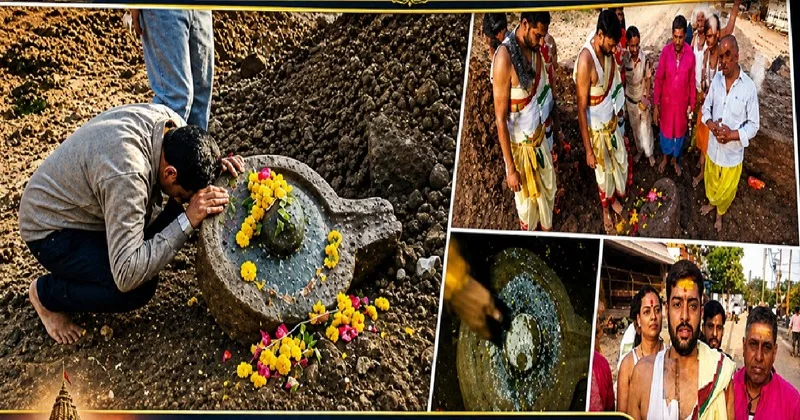
UJJAIN: It was that sacred moment at dawn, when the divine resonance of the ‘Bhasma Aarti’ was echoing through the precincts of the Shri Mahakaleshwar Temple, that another wondrous sign emerged from the very womb of the earth; an ancient Shivaling. It was as if the holy soil of Ujjain itself was proclaiming that Shiva resides in every single particle of this land. Discovered on Friday morning during tunnel excavation work near Gate No. 4, this Shivaling has become a living confluence of faith, history, and the ‘Sanatan’ tradition. This event further reinforces the belief that Ujjain is a pilgrimage site where, from time to time, Lord Mahadev Himself manifests signs of His divine presence.
The Emergence of the Shivalinga During Excavation and the Immediate Response
Construction work for a tunnel and a waiting hall, intended to enhance facilities for devotees, was underway in front of the Shri Mahakaleshwar Temple. On morning of April 1, sometime between 4:00 AM and 5:00 AM, a Poclain machine operator spotted a Shivalinga buried within the soil. Upon receiving this information, Site Engineer Satish Rajput and other officials immediately alerted the temple administration. As a precautionary measure, all excavation work was halted immediately.
Temple priest Akash Sharma arrived at the site and performed rituals and worship according to scriptural rites. He noted that the discovery of the Shivaling precisely during the ‘Bhasma Aarti’ is considered an extremely auspicious sign; subsequently, devotees offered water and performed worship. Confirming the incident, Ashish Falwadia, Assistant Administrator of the temple, stated that the Shivaling was indeed found during excavation near the prepaid booth, and that work is now proceeding with extreme caution to ensure the preservation of any other potential ancient artifacts that may be discovered.
Devotees’ Faith and the Growing Crowd at the Site
As news of the discovery spread, a large number of devotees began converging on the site. People regarded this as a divine sign of Lord Shiva’s grace. The discovery of a Shivaling in such a manner coinciding with the auspicious occasion of ‘Buddha Purnima’, held special significance for the devotees. The continuous stream of visitors seeking ‘darshan’ and performing worship continued unabated and the entire area appeared to be completely immersed in an atmosphere of deep devotion.
In this regard, according to Site Engineers Satish Rajput and Deepak Patel, there remains a possibility that other ancient artifacts or relics may also be discovered alongside the Shivalinga during the ongoing excavation process. Indications, such as the discovery of a Nandi idol, have also been found and are currently under investigation. The Department of Archaeology has been apprised of the entire matter. Just five years ago, Dr. Ramesh Yadav an official from the Department of Archaeology stationed here had remarked, in the context of previously discovered structures, that a temple dating back to the 11th or 12th century might lie buried beneath this site. He had also suggested that a wall discovered in the southern direction could be approximately 2,100 years old. Regarding the recently discovered Shivling, Dr. Raman Solanki has preliminarily suggested that it likely belongs to the Parmar era and dates back to the time of King Bhoj. He clarified, however, that its precise chronological dating can only be determined following proper cleaning and scientific analysis.
Layers of History Uncovered in the Past
This is not the first such occurrence within the Mahakal Temple complex. In 2020, during expansion work, excavations conducted at a depth of 25 to 30 feet yielded several idols, including those of a Shivling, Nandi, Lord Ganesha and Goddess Chamunda. Experts identified these artifacts as belonging to the Parmar era and estimated them to be approximately one thousand years old. Prior to that, during an earlier phase of the temple’s expansion, the structural remains of an 11th-century temple had surfaced; its architectural style was recognized for its exquisite beauty and immense historical significance. At that time, the Department of Culture promptly dispatched a team from the Department of Archaeology to conduct an inspection of the site.
The Spiritual Grandeur of Ujjain- The City of Mahakal
Ujjain is revered as the City of Bhagwan Shiv. The Mahakaleshwar Temple, situated here, is one of the twelve ‘Jyotirlingas’ and holds a position of paramount importance within the entire ‘Sanatan Dharma’ tradition. Here, Lord Shiva resides in the form of “Mahakal” the Great Lord of Time, who is regarded as the master of both time and death. The tradition of the ‘Bhasma Aarti’, the sacred banks of the River Shipra and the array of ancient temples collectively render Ujjain a unique spiritual hub. The atmosphere here is imbued with ‘sadhana’, ‘tapasya’ and ‘bhakti’, offering every devotee a truly distinct and profound spiritual experience.
Ujjain’s Central Place in the Sanatan Tradition
Ujjain known in ancient times as ‘Avantika’- is counted among the ‘Saptapuris’ (the seven holy cities). It is widely believed that a pilgrimage to this sacred city leads to the attainment of ‘Moksha’. This city has long served as a prominent hub for astronomy, astrology and religion. In every lane and along every ‘ghat’ here, one can sense the vibrant pulse of religious consciousness.
Ujjain’s Simhastha Kumbh is counted among the largest religious gatherings in the world. Held every twelve years, this festival draws tens of millions of devotees who take holy dips in the sacred waters of the River Shipra. The presence of saints, sages and various ‘Akhadas’ transforms this event into a truly global spiritual confluence. During Simhastha, Ujjain’s spiritual energy reaches its zenith and the city radiates the message of Indian culture and the ‘Sanatan’ tradition to the entire world.