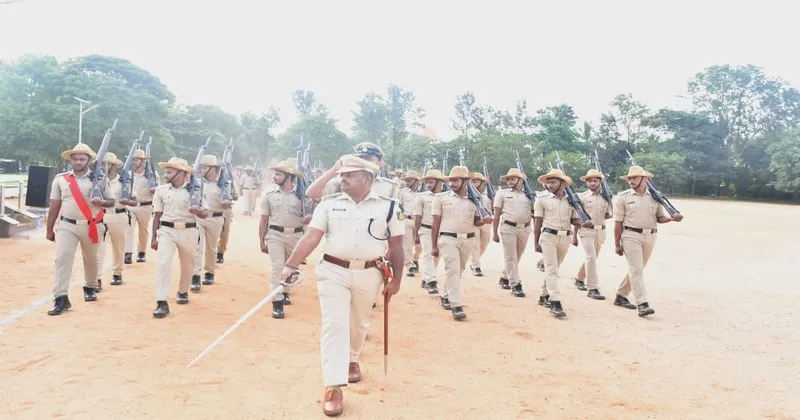
Bengaluru: Even as the Karnataka government claims to have abolished the controversial ‘orderly system’ within the police force, fresh allegations suggest that the practice continues unabated in several units of the Karnataka State Reserve Police (KSRP) and India Reserve Battalions (IRB). The matter has now reached the office of the Governor of Karnataka, bringing the issue back into sharp focus.
According to a written complaint submitted by Tejas Kumar Gowda, said to be associated with a Congress unit in Bengaluru, and others, the banned orderly system is allegedly still functioning across multiple police units. The Governor’s office has officially acknowledged receipt of the complaint, which contains serious allegations of misuse of manpower and corruption.
The orderly system, a legacy of the British era, involved deploying police constables for personal and domestic work at the residences of senior officers. This included tasks such as cooking, cleaning, and running errands—activities far removed from policing duties. The Karnataka government had scrapped this system, terming it a significant reform to improve efficiency, dignity, and professionalism in the police department.
However, the complaint claims that despite the official ban, the system is still operational in all 12 KSRP battalions, two training institutions, and IRB units across the state. It alleges that commanding officers, with the support of subordinate officials, continue to assign personnel as orderlies based on rank hierarchy.
Several officers across key locations including Bengaluru, Belagavi, Mysuru, Kalaburagi, Mangaluru, Shivamogga, Hassan, Vijayapura and Munirabad have been named in the complaint. It further claims that inspectors, assistant commandants, deputy commandants and commandants are each being allotted multiple personnel for personal assistance, in violation of government directives.
One of the most serious allegations is that some personnel are being allowed to stay away from duty after paying a sum of Rs 28,000 in cash. These individuals are reportedly permitted to remain in their hometowns and engage in private occupations or businesses, while their attendance is falsely recorded under designations such as assistants or aides. This practice, the complaint states, not only violates rules but also places an unfair burden on remaining staff.
The issue is compounded by an existing shortage of personnel in the police force. Many reports in recent years have highlighted the stress faced by police staff due to heavy workloads, long hours and lack of adequate manpower. In such a scenario, diversion of personnel for non-official duties could further weaken the system and impact law enforcement efficiency.
The complainants have also urged authorities to verify the claims by examining mobile location data of personnel allegedly assigned as orderlies. They argue that such an investigation would reveal whether those marked present are actually performing duties in their respective units.
It is noteworthy that after abolishing the orderly system, the government introduced a special allowance structure for officers. Senior officials were to receive monthly allowances based on rank in lieu of orderlies. Despite this, the continuation of the alleged practice raises questions about enforcement of reforms.
The complaint has demanded a comprehensive probe led by a retired High Court judge to ensure impartiality. It has also called for strict disciplinary action against officers found guilty of violating government orders. Additionally, there is a demand to immediately recall all personnel engaged as orderlies and redeploy them to regular policing duties.
Experts note that the abolition of the orderly system was expected to free up more than 3,000 personnel for active field duties, thereby strengthening policing and improving public safety. The move was also seen as a step towards restoring dignity to police personnel who were previously engaged in domestic work.