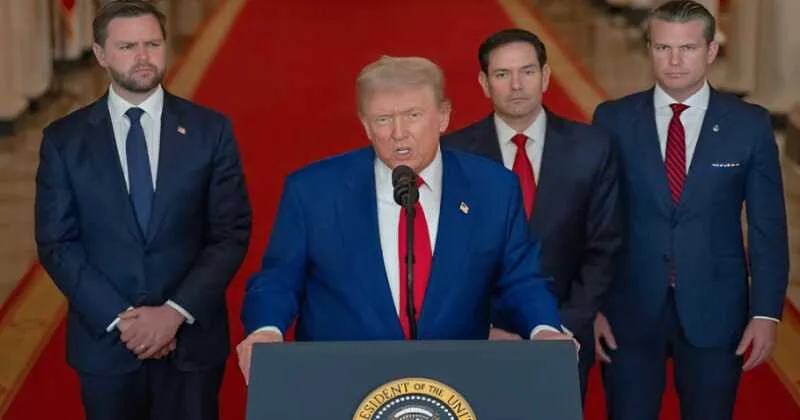
Washington DC: J. D. Vance is reportedly concerned that reports from Defence Secretary Pete Hegseth and top military officials about the progress of the Iran war are inaccurate. Vance fears that the Pentagon’s exaggerated portrayal of America’s achievements in the war will mislead President Donald Trump. The rift within the administration was revealed by The Atlantic. Defence Secretary Pete Hegseth and Joint Chiefs of Staff Chairman General Dan Caine have claimed that Iran’s air force, navy and defences have been destroyed in the eight-week war and that the US arsenal is secure. But Vance has reportedly repeatedly questioned these claims in closed-door discussions.
Doubts over military claims and missile stockpile
Vance suspects the Pentagon is hiding the fact that the US has a huge deficit in its missile stockpile. He has already informed President Trump that the current shortage of weapons will affect future relations with countries such as China, Russia and North Korea. The US has already used up more than half of its missiles, according to the Center for Strategic and International Studies.
The Pentagon claims that Iran’s military power has been completely destroyed. The US has full control over Iran’s airspace and its arsenal has not been reduced at all. However, Vance suspects that the real situation is different. According to intelligence reports, Iran still maintains two-thirds of its air force and missile launch systems. Iranian boats capable of disrupting traffic in the Strait of Hormuz still pose a threat. The criticism is that Pentagon chief Pete Hegseth only tells Trump what he wants to hear instead of telling him the facts on the ground. The report also says that Hegseth is able to read Trump’s mind using his previous experience at Fox News.
War scepticism and Operation Epic Fury
Even before the launch of ‘Operation Epic Fury’ on February 28, Vance had opposed war with Iran, saying that it would cause great casualties and destabilise the region. But Vance is now moving with extreme caution, keeping in mind his good relationship with the president and his political future in 2028.
Meanwhile, US intelligence reports have indicated that Iran’s air force and missile launch systems are largely still secure. Iran also currently has the capability to conduct naval operations in the Strait of Hormuz.
Meanwhile, US Defence Secretary Pete Hegseth sparred with Democratic lawmakers during a nearly six-hour-long hearing, in his first time facing questions under oath since the start of the Iran war.
Hegseth appeared before the House Armed Services Committee on Wednesday alongside Chairman of the Joint Chiefs of Staff Gen Dan Caine and the defence department’s chief financial officer Jules Hurst.
Cost of war and political backlash
In his opening remarks, Hegseth said the “biggest adversary we face” is the “defeatist words” of Democrats and some Republicans. Democratic lawmakers on the committee criticised how federal money is being used in the conflict. Hurst revealed in the hearing that the war had cost the US $25bn (£18.5bn) so far. Hurst said most of the expenses had been for munitions and to replace equipment. He told lawmakers that a full assessment of the cost will be provided at a later time. The US and Iran have agreed on a ceasefire to allow for peace talks, but the conflict has not officially ended.
Money was a major talking point during the hearing. The White House has asked Congress to boost the US defence budget to $1.5tn , a sweeping rise that would mark the largest expansion in military spending since World War Two. Hegseth told the committee the budget request “reflects the urgency of the moment”. Gen Caine said the $1.5tn “represents a historic down payment for future security” that would allow the US to get ahead of fast-evolving technology. Democrats on the committee often characterised the US military action in Iran as an expensive “war of choice” waged without the approval of Congress.
“You have been lying to the American public about this war from day one, and so has the president,” California Democrat John Garamendi said. He told Hegseth that Trump was “stuck in a quagmire” of another war in the West Asia.