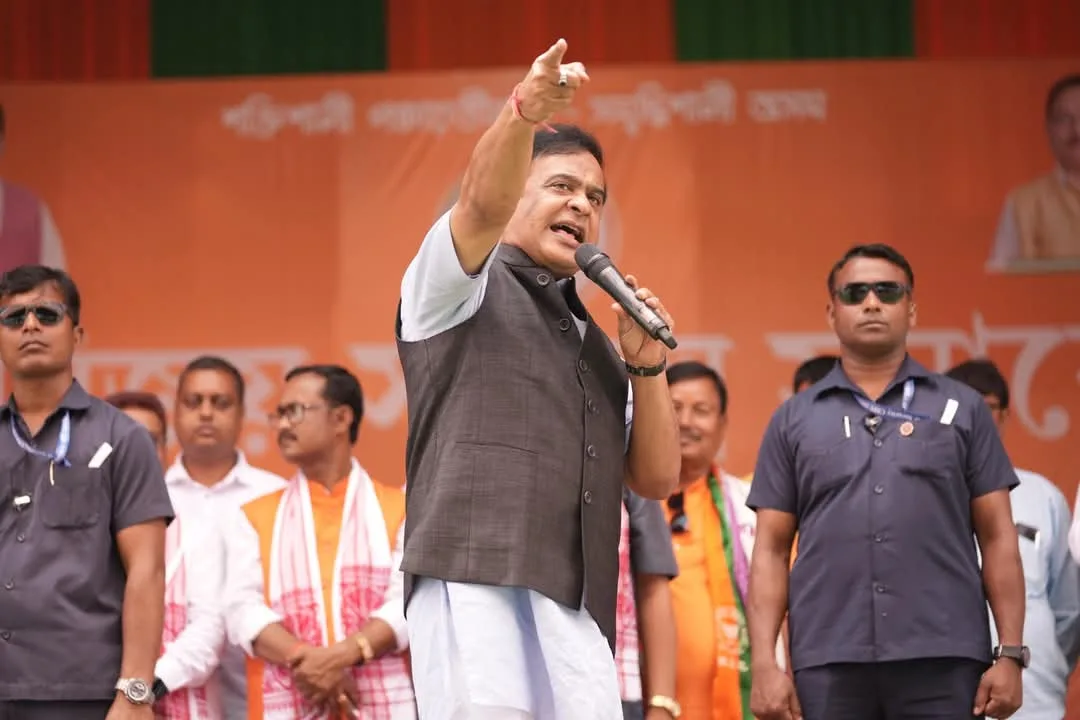
The latest exit poll released by Axis My India after the completion of voting in Assam has projected a clear victory for the Bharatiya Janata Party led National Democratic Alliance. According to the survey, the NDA is expected to win between 88 and 100 seats in the 126 member Assembly, well above the majority mark of 64 seats. The projections reinforce the possibility of the ruling alliance returning to power with a strong mandate and potentially improving upon its previous performance.
The Congress led alliance, which contested the elections under a broader opposition front, is projected to secure between 24 and 36 seats. These numbers indicate a significant gap between the ruling alliance and the opposition, suggesting that the Congress and its allies may fall short of mounting a serious electoral challenge. The “Others” category has been projected to win negligible or no seats, pointing towards a largely bipolar contest in the state with limited space for smaller parties and independents.
The elections in Assam were conducted in a single phase on April 9 as part of the larger Assembly election cycle that also included West Bengal, Tamil Nadu, Kerala and Puducherry. The counting of votes for all these regions is scheduled for May 4, when the final results will determine whether the exit poll projections hold true.
A key highlight of the Assam elections was the high voter turnout, with approximately 85.38 percent of eligible voters participating in the democratic process. This strong turnout reflects high political engagement across regions and communities. Analysts often view such high participation as a crucial factor that can influence electoral outcomes, and in this case, the Axis My India projections suggest that the ruling NDA may have benefited significantly from this voter enthusiasm.
Multiple other exit polls have also echoed similar trends, indicating a near consensus on the NDA’s advantage in the state. Surveys conducted by agencies such as VoteVibe for CNN News18, JVC and Chanakya Strategies have all projected the NDA crossing the majority mark comfortably, with estimates ranging between 88 and 101 seats. These projections collectively strengthen the narrative of a decisive victory for the BJP led alliance.
Interestingly, some projections suggest that the BJP alone could secure a majority on its own. According to VoteVibe estimates, the BJP is projected to win between 72 and 78 seats independently, raising the possibility that Chief Minister Himanta Biswa Sarma may not require support from alliance partners to form the government. If this scenario materialises, it would mark a significant political milestone for the party in the state.
The electoral battle in Assam was primarily fought between the BJP led NDA and the Congress led opposition alliance, which attempted to consolidate anti incumbent sentiment. The Congress campaign was led by Gaurav Gogoi, positioning itself as an alternative to the BJP’s governance model. However, the exit poll projections suggest that the opposition’s strategy may not have translated into sufficient electoral gains.
Region wise trends further underline the NDA’s dominance across the state. In Upper Assam, traditionally considered a BJP stronghold, the alliance is projected to secure a large majority of seats. Similar trends are visible in North and Central Assam, where the NDA is expected to maintain a clear lead. Even in Lower Assam, which has a more complex social composition and has historically been competitive, the BJP led alliance appears to have performed strongly. In the Barak Valley region as well, the NDA is projected to maintain an advantage over the opposition.
Several factors appear to have contributed to the BJP’s strong performance in the state. The leadership of Himanta Biswa Sarma, combined with a focus on infrastructure development, welfare schemes and identity politics, has played a key role in shaping voter perception. The government’s emphasis on road construction, connectivity projects and welfare delivery has been highlighted as a major achievement during the campaign.
Another important factor in this election has been the voting pattern of minority communities, particularly Muslims, who constitute a significant portion of Assam’s population. Historically divided between different parties, the opposition’s inability to consolidate this vote effectively may have worked in favour of the BJP. The absence of a unified opposition strategy appears to have fragmented the anti BJP vote, further strengthening the NDA’s position.
Comparisons with the 2021 Assembly elections also provide important context. In 2021, the NDA secured a comfortable victory with 75 seats, including 60 won by the BJP. The current exit poll projections suggest that the alliance could not only retain power but also expand its seat tally, indicating sustained voter support over the past five years.
While exit polls offer an early indication of voter sentiment, they are not always accurate predictors of final results. Variations in sampling, voter behaviour and last minute shifts can influence the outcome. The final verdict will be known on May 4, when votes are counted and the actual results are declared.
For now, the Axis My India exit poll and similar projections point towards a strong and decisive mandate for the BJP led NDA in Assam, setting the stage for what could be another term of political continuity in the state.