

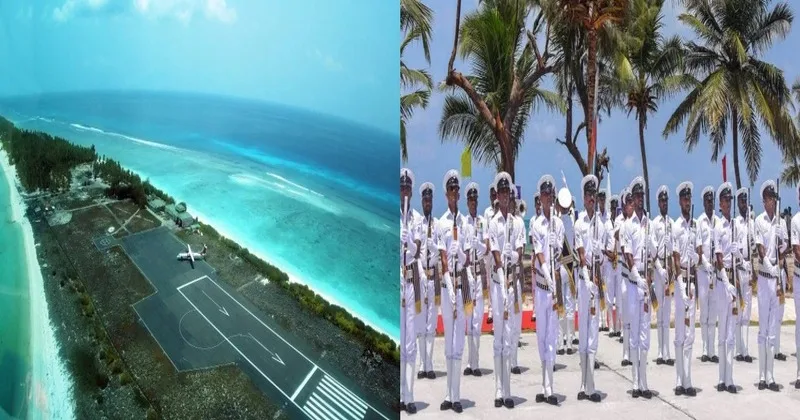
Whether it is through politics, diplomacy or elections, PM Modi has his own strategy for handling his opponents. In addition to sharing his films and images on social media, he went to Lakshadweep and spent some time snorkeling in the beautiful waters. He continued by sharing his story and urging Bharatiyas to seek out adventure on the island. However, the opposition leaders oppose the strategic initiatives and operations in the region. Let’s understand why civil and military development is significant in the Lakshdweep region.
China has exacerbated Bharat’s strategic vulnerabilities by constructing infrastructure projects and ports in numerous nations bordering the Bharatiya Ocean and Arabian Seas. Over the last few decades, China has quickly improved its naval capabilities. China is creating the port city of Hambantota in Sri Lanka, which is around 300 kilometers from Bharat. Similarly, it controls many Maldivian islands and is building an airport on them. The distance between Hambantota and the ports of Chennai, Kochi and Visakhapatnam is around 900 to 1500 kilometers. The Satish Dhawan Space Centre in Sriharikota, which is critical to Bharat’s space effort, is also approximately eleven hundred kilometers away.
Lakshadweep, thus has become increasingly important to Bharat in dealing with the Chinese Navy’s rising presence and activity in the Bharatiya Ocean region, as well as establishing a new monitoring system. Bharat’s strategy for the development of Lakshadweep is taking a critical step forward with the establishment of a dual-purpose airfield on Minicoy Island. This huge project, which can accommodate military aircraft such as fighter jets as well as commercial planes, is getting new momentum as it moves forward. According to government sources, the major goal is to build a joint-use defense airfield, a strategic move that will improve both military and civilian operations in the region.
After years of neglect, Bharatiya military planners are beginning to consider that the Lakshadweep islands can be used to oppose China’s expanding influence in neighboring countries such as the Maldives, Mauritius, Seychelles, Sri Lanka, Pakistan and Myanmar. Bharat must refocus its thinking on these islands. These islands must not only be secured, but also developed as a ‘strategic strongpoint.’ The geographical placement of these islands gives Bharat a tactical edge during hostilities. If necessary, Lakshadweep can serve as a ‘unsinkable aircraft carrier’ away from Bharat’s shoreline.
From a military standpoint, the proposed airstrip on Minicoy Island gives Bharat a powerful potential to monitor the Arabian Sea and the larger Indian Ocean region. The aim goes beyond construction, highlighting the synergy of military and civilian endeavors. Notably, collaboration between the Bharatiya Coast Guard and the Bharatiya Air Force is a key component of this project. The Bharatiya Coast Guard, which initially recommended the installation of an airfield in the Minicoy Islands, emphasizes the strategic benefits of this site. Furthermore, the construction of a dual-purpose airstrip on Minicoy Island is strategically significant in light of China’s expanding presence in the Bharatiya Ocean.
As China’s influence in the region grows, the expanded monitoring capabilities provided by this airfield allow Bharat to take a proactive position, ensuring a strong defense. The strategic importance of these island groupings, which are located on the most heavily sailed international maritime commerce routes in the Bharatiya Ocean Region, cannot be overstated. Lakshadweep has gained strategic relevance in recent years as China has increased its foothold in the Bharatiya Ocean Region.
On April 7, 2021, the guided-missile destroyer USS John Paul Jones passed just off the coast of Lakshadweep. The proximity to Lakshadweep demonstrated the archipelago’s strategic importance. It is concerning that all major world powers are trying to establish a military, diplomatic, and political presence in the Bharatiya Ocean Region. Lakshadweep can assist Bharat as a strategic sentinel, maritime guardian, and most importantly, diplomatic asset in the Bharatiya Ocean.
- Naval Outpost: The Lakshadweep islands can function as a naval outpost for Bharatiya navy assets stationed in Arabian Sea.
- Monitor Smuggling: Lakshadweep might be utilized as a base for smuggling guns and narcotics across the country. As a result, the area requires internal security measures.
- Combat Piracy: Lakshadweep can be used as a vantage point to observe any movement of pirate vessels in the Arabian Sea.
- Shipping Lines: The Nine-Degree Channel in Lakshadweep is the quickest route for ships between West and East Asia. This can be effectively tracked from the Lakshadweep Islands.
- Strategic Tool: Bharat can utilize Lakshadweep’s growth as a bargaining chip when negotiating with China, which favours the Maldives.
Joint domination of the Bharatiya Ocean Region
As Bharat has risen as a strong power in global geopolitics, and other key regional powers are collaborating with Bharat, Lakshadweep can be used as a training and coordinating hub for naval forces in the Bharatiya Ocean Region. The Arabian Sea borders Yemen, Oman, Pakistan, Iran and Maldives, making it a strategic location for joint exercises with allied forces. It is a marine area that connects numerous major shipping channels and ports, making it an important hub for worldwide trade.
The Arabian Sea contains substantial quantities of oil and natural gas and is a major source of energy in the region. The Lakshadweep Islands can be utilized as a vantage point to monitor the movement of ships in the Arabian Sea. The Exclusive Economic Zone of Bharat is very extensive and includes Lakshadweep. The Exclusive Economic Zone stretches up to 200 nautical miles (370 kilometers) from any country’s coastline. Because of Lakshadweep, Bharat now controls a big portion of the sea, allowing it to monitor the movements of ships sailing far and wide.
Lakshadweep’s Kavaratti island hosts a Bharatiya naval facility. Along with this, Bharat is currently developing a strong base on Lakshadweep, which is predicted to be extremely beneficial in fighting with China.
Lessons from history
The Mumbai terror attacks on November 26, 2008, exposed Lakshadweep’s strategic vulnerability. According to Kerala-based historian K.M.Seethi, B.K. Loshali, an Bharatiya Coast Guard (ICG) official, stated in 2010 that the islands and sandbars of the Lakshadweep provide “perfect hideaways for infiltrators and contraband”. The 25 deserted islands of Lakshadweep would “pose a real danger to the coast of Kerala”, according to Loshali.
According to historian K.M.Seethi, the challenge to Bharat’s hold on the Lakshadweep existed in the past as well. When Pakistan gained independence in August 1947, there were reports of an attempt to annex the Lakshadweep. On August 9, 2019, Fateh-ul-Mulk Ali Nasir said in the Friday Times, a Lahore-based daily, that “Pakistan missed an opportunity in the Laccadives in 1947.” Nasir stated that if Pakistan had seized the island, it would have had an oceanic outpost near the equator. The geostrategic and defense benefits would have been enormous, and Pakistan would have a tropical island getaway to rival the Maldives as a tourist hotspot.”
However, he stated that then-Pakistan Prime Minister Liaquat Ali Khan aimed “to make this remote and tropical archipelago a southern extension of Pakistan in the Bharatiya Ocean” and thus attempted “to take control of the islands in August 1947.” The Pakistan Navy had reportedly dispatched a frigate from Karachi. However, by that time, Bharat’s Deputy Prime Minister, Sardar Patel, had acted promptly and dispatched a team of top Bharatiya officials to raise the Indian flag.
On April 7, the US Navy’s 7th Fleet reported that the guided missile destroyer “USS John Paul Jones” passed 130 nautical miles off Lakshadweep without telling Bharat. The United States stated that it did so solely to “uphold the rights, freedoms, and lawful uses” of the sea as recognized in international law. The US Navy also stated that it was “challenging Bharat’s excessive maritime claims”. New Delhi was irritated by the audacious US assertion, but responded calmly because the US is an ally. However, the US intrusion proved that Chinese or Pakistani navy vessels might replicate the US drill.
Geography of Lakshdweep
Lakshadweep is an archipelago of 36 islands in the Arabian Sea, approximately 440 kilometers from the coast of Kerala. With a total land area of only 32 square kilometers, the Lakshadweep Islands off Bharat’s west coast are the smallest of the Union Territories (UT) administered by the Government of Bharat. Nonetheless, they provide around 20,000 square kilometers to Bharat’s territorial sea and 400,000 square kilometers to the country’s Exclusive Economic Zone. Central government, which aspires to be the “net-security provider” in the Bharatiya Ocean Region (IOR), sees the Lakshadweep Islands as a critical maritime bastion from which to advance its naval imperatives while also countering the escalating asymmetric threats emanating from its western seaboard. Despite this, most Bharatiya researchers have tended to emphasize the geopolitical significance of Bharat’s eastern coast’s Andaman and Nicobar Islands (A&N).
The recent crisis in the Strait of Hormuz, with its catastrophic impact on the global economy and security, makes it evident that we must strengthen footprint in the Lakshdweep region to ensure strategic edge and economic and national security.