When Prime Minister Narendra Modi addressed the first meeting of the National Ganga Council in Kanpur on 14 December 2019 and articulated the vision of Arth Ganga linking economic life to the ecological restoration of the river it was not a promise. It was a progress of restoration. By then, five years of concentrated investment, institutional restructuring and physical construction had already begun reversing what 130 years of urban neglect had inflicted on India most sacred river.
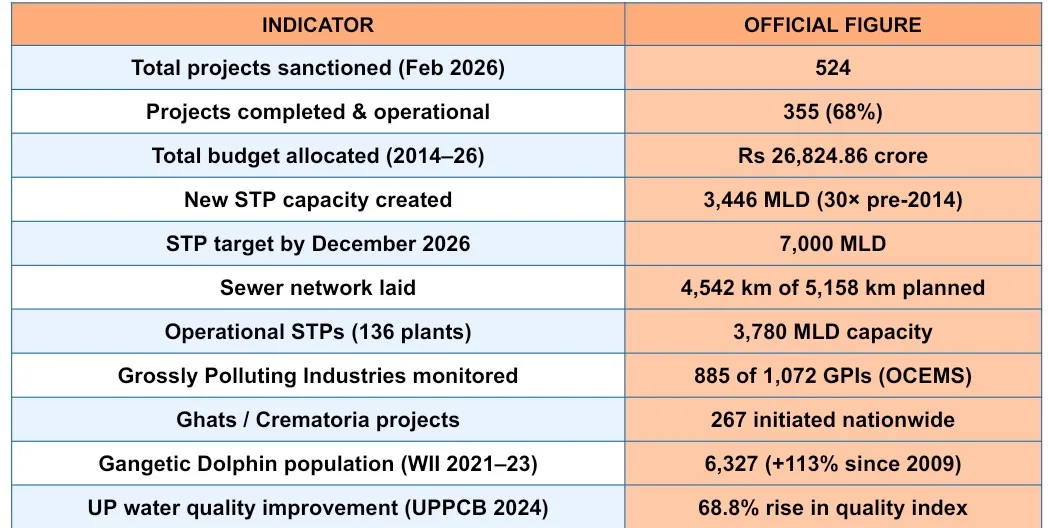
Launched in June 2014 with an initial budget of Rs 20,000 crore, extended to 2026 with an additional Rs 22,500 crore and allocated Rs 3,400 crore for FY 2025–26, the Namami Gange Programme carries a total of Rs 26,824.86 crore since initial phase. Against the available resources of Rs 20,424.82 crore for 2014–15 to 2023–24, the National Mission for Clean Ganga (NMCG) has disbursed Rs 16,648.49 crore, an 82 per cent utilisation rate. Till February 2026, 524 projects have been sanctioned under the programme, of which 355 approximately 68 per cent are complete and operational. It is a programme of disbursements, contracts, pipes, pumping stations and treatment plants.
The problem of previous government
In 2013 the year before Namami Gange, the Ganga basin generated approximately 12,000 MLD of sewage against installed treatment capacity that barely reached 100–115 MLD in the main Ganga cities. Roughly 3,000 MLD discharged directly into the main river channel every day. In Kanpur, India leather capital has only 170 MLD of the city 340 MLD sewage was being treated. 1.76 lakh of 5.54 lakh properties, only 32 per cent were sewer-connected. The Sisamau Nala, an open sewer since the 1890, poured 140 MLD of raw sewage into the Ganga daily and was known as the largest drain in Asia. In Varanasi, treatment capacity stood at just 100 MLD. In Prayagraj, 60 drains were completely untapped. In West Bengal, the river stretch from Triveni to Diamond Harbour was classified as PRS Priority III BOD between 10 and 20 mg/L unsafe for bathing.
Two previous programmes Ganga Action Plan I (1985) and GAP II (1993) had failed because of poor maintenance, absent accountability, inconsistent electricity to plants and no obligation on operators to keep assets running. Namami Gange studied those failures and built their remedies into its very contract structure.
How the PM Modi government restructured delivery
Ministry of Jal Shakti (2019): The Modi government created a unified Ministry of Jal Shakti in 2019, consolidating all water-related departments including River Development and Ganga Rejuvenation under one roof. This ended the fragmented inter-ministerial dysfunction that had paralysed previous Ganga programmes.
Hybrid Annuity Model (HAM): Private operators are contracted not just to build STP but to operate them for 15 years, with payments structured as annuities over the contract lifecycle. Financial incentives are thus aligned with long-term performance. By early 2026 HAM projects had crossed 150 operational STPs nationwide.
Seven-IIT consortium: A comprehensive Ganga River Basin Management Plan was developed by a consortium of seven IITs, by bringing scientific rigour to a problem previously managed through piecemeal political decisions.
Real-tume industrial monitoring: Online Continuous Effluent Monitoring Stations (OCEMS) have been installed at 885 of 1,072 Grossly Polluting Industries, feeding data directly to CPCB servers. Real-Time Water Quality Monitoring Stations at 36 locations on the river measure 17 parameters continuously since 2017.
NMCG Legal Status: In April 2025, the Finance Ministry granted income tax exemption to NMCG from AY 2024–25, recognising it as an authority under the Environment (Protection) Act 1986 a legal consolidation that strengthens the mission’s institutional permanence.
Transformation of UP cities in last decade
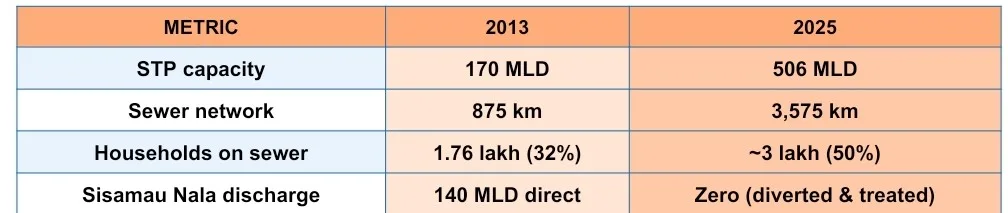 The Sisamau Nala an open sewer for 130 years was tapped in 2018, its flow diverted to the Jajmau (205 MLD) and Bingawan (210 MLD) STPs. On 30 December 2023, Prime Minister Modi inaugurated the Jajmau Common Effluent Treatment Plant (CETP), a dedicated 20 MLD facility to treat industrial discharge from Kanpur tannery cluster. Total treatment capacity in Kanpur now stands at 487 MLD. 11 of 21 drains are fully tapped by diverting approximately 175 MLD away from the river. Of the remaining 10, nine are inside approved and funded projects.
In Varanasi, treatment capacity has quadrupled from 100 MLD to 420 MLD. Untapped drains have fallen from 8 to just one partially tapped. The city Polluted River Stretch (PRS) classification has improved from Priority IV (BOD 6–10 mg/L) to Priority V (BOD 3–6 mg/L) on the CPCB own scale. In Prayagraj, of 60 untapped drains in 2017 not one remains untapped today. Treatment capacity grew from 268 MLD (2017) to 348 MLD (2024) and PRS likewise improved from Priority IV to Priority V.
During Mahakumbh 2025, the CPCB monitored water quality at eight stations across the Prayagraj stretch throughout the bathing season. Its comprehensive report confirmed that median values of pH, Dissolved Oxygen (DO), Biochemical Oxygen Demand (BOD) and Faecal Coliform (FC) at all monitored locations were within the permissible limits for Primary Bathing Water Quality Criteria. Bathing-quality water at the world’s largest religious gathering, certified by India own pollution control authority.
Prime Minister Modi direct engagement: Projects inaugurated
What marks this government’s approach is the level of Prime Ministerial engagement a sustained political signal that Ganga restoration is a governance priority.
January 25, 2024: PM Modi inaugurated projects worth Rs 790.5 crore from Bulandshahr, UP including the 30 MLD STP at Masani, Mathura, rehabilitation of 36.8 MLD existing capacity, a 20 MLD TTRO (Tertiary Treatment and Reverse Osmosis) plant and a 58 MLD STP with 264 km of sewerage network at Moradabad.
October 2024 (Gandhi Jayanti): PM Modi inaugurated and laid foundation stones for 10 STP projects across Uttar Pradesh, Bihar and Jharkhand, totalling Rs 1,555 crore five inaugurations worth Rs 534.25 crore and five foundation stones worth Rs 1,021 crore.
December 30, 2023: PM Modi inaugurated the Jajmau CETP in Kanpur, treating 20 MLD of leather industry effluent that would otherwise reach the Ganga India’s largest common effluent treatment plant for tannery discharges.
January 2023: During the MV Ganga Vilas cruise launch, PM Modi inaugurated and laid foundation stones for inland waterways projects worth over Rs 1,000 crore, advancing the Arth Ganga vision of river-linked economic development.
Ecological Signal: What nature is confirming
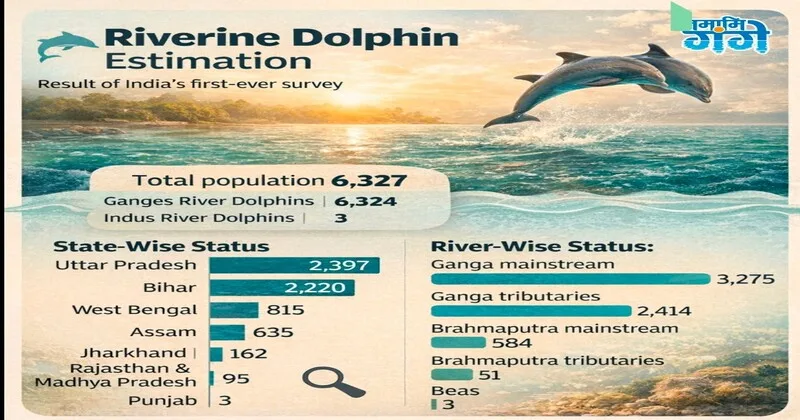
The most positive affirmation of the Ganga restoration comes from the wildlife returning to the river. The Gangetic River Dolphin, an Indian National Aquatic Animal, a carrier of river health has numbered from 2,500 to 3,000 after 2009. By the nationwide Wildlife Institute of India (WII) survey of 2021–23, that figure had risen to 6,327, a more than twofold increase. Dolphins were confirmed in multiple tributaries where they had previously been unrecorded such as the Rupnarayan, Girwa, Kauriyala, Babai, Rapti, Bagmati, Mahananda, Ken, Betwa and Sind.
NMCG in partnership with CIFRI released 49.25 lakh Indian Major Carps, 42,117 Hilsa and 7,370 Mahseer into Ganga basin rivers in 2024 alone. The river supports over 140 fish species including critically endangered ones like the Ganges Shark.
Conducted at 50 locations along the Ganga and its tributaries, CPCB biomonitoring found Biological Water Quality (BWQ) predominantly ranging from Good to Moderate. The presence of diverse benthic macro-invertebrate species the insects and organisms at the base of the aquatic food chain confirms the river ecological recovery is structural not superficial.
CPCB water quality assessment (January–September 2023) found Dissolved Oxygen the single most critical parameter for aquatic life is within acceptable bathing quality limits across almost the entire stretch of the Ganga. BOD exceedances above 3 mg/L were recorded only in specific urban UP stretches. The UPPCB 2024 annual report documented a 68.8% improvement in water quality across UP rivers and reservoirs. As of April 2025 UP has 152 STPs, 141 operational, 126 already meeting environmental discharge norms an 89 per cent compliance rate among functional plants.
Beyond Sewage: A holistic programme
Namami Gange operates on four pillars. Nirmal Ganga addresses sewage and industrial pollution with 212 sewerage projects worth Rs 34,526 crore are sanctioned, with real-time effluent monitoring at 885 of 1,072 Grossly Polluting Industries. Aviral Ganga enforces ecological flows, e-flow norms for the upper Ganga were notified in 2018 and tightened in 2024, with penalties for non-compliant hydro projects. Jan Ganga ensures community ownership, 1,674 Gram Panchayats on the Ganga banks have been brought under Ganga Gram, and 267 ghats and crematoria have been developed or renovated nationally 24 in Kanpur and Bithoor alone. Gyan Ganga drives knowledge with two Centres of Excellence and a seven-IIT-designed Digital Twin for the river have been established. In 2024, the Bhartiya Prakritik Krishi Paddhati was launched nationally, with the Ganga basin designated priority zone for chemical-free natural farming by addressing agricultural runoff as a source of river pollution. Internationally the UN Decade on Ecosystem Restoration (December 2022) recognised Namami Gange as one of the Top 10 World Restoration Flagship Initiatives. At COP29 in Baku (2024), India formally positioned it as a climate-resilient restoration model.
Engineering over promises
There is a precise test for any government that pledges to restore a civilisational river, the test of infrastructure. The Modi government has passed that test against a record verifiable in official data. Sewage treatment capacity multiplied 30 times over the pre-2014 baseline. Kanpur sewer network expanded from 875 km to 3,575 km. Varanasi treatment capacity quadrupled from 100 to 420 MLD. Prayagraj eliminated all 60 of its untapped drains. The Gangetic Dolphin population more than doubled. Bathing-quality water was confirmed at India most sacred ghats during Mahakumbh 2025 by the CPCB itself. 355 of 524 sanctioned projects are complete. Rs 16,648 crore has been disbursed. Work is ongoing the 7,000 MLD target by December 2026 means the next phase of construction is already under contract.
The Ganga has a long memory. It has absorbed more than a century of abuse. But since June 2014, a government has been working drain by drain, plant by plant, pump station by pump station to give the river the governance it has always deserved. The data and dolphins confirm it. The pilgrims at Prayagraj, bathing in certified clean water during Mahakumbh 2025, confirm the effort7s of Namami Ganga.