Kolkata: Since assuming office in 2011, Mamata Banerjee has led a governance model that has consistently raised questions about administrative neutrality in a demographically complex state. West Bengal, where Hindus form the majority and Muslims a significant minority as per the Census of India, has seen a decade-long political pattern in which state policy and public messaging have been perceived as disproportionately focused on minority consolidation. Budgetary allocations toward minority affairs, stipends for religious functionaries, and targeted welfare structures indicate a governance framework that differentiates between communities, shaping a political environment where electoral arithmetic appears closely tied to administrative decisions.
🚨 Mamata Banerjee Foundational Betrayal: A Majority Made Into a Minority in Its Own State
A Deep Dive – 15 Years of Documented Failure Based on Court Records, Budget Data, NCRB Figures, and Documented Incidents.
Seventy percent of West Bengal's population is Hindu. Seventy… pic.twitter.com/DTzC1RWtNB
— Axis & Power (@ThePowerAxis) April 27, 2026
2017: Baduria–Basirhat Violence
The violence in Baduria and Basirhat in 2017 marked a major communal flashpoint under the TMC government. What began with a controversial social media post escalated into widespread unrest, including arson, destruction of property, and loss of life. Ground reports and subsequent documentation pointed to selective targeting in several affected areas, raising serious concerns about the nature of the violence. The administrative response, focused on internet shutdowns and delayed containment, highlighted gaps in early intervention and preparedness, allowing the situation to spiral before effective control was established.
2018: Asansol–Raniganj Ram Navami Clashes
The 2018 Ram Navami clashes in Asansol and Raniganj exposed deeper structural issues in law-and-order management during religious events. Evidence from the aftermath suggested that the violence involved elements of prior preparation, including the stocking of projectiles and crude weapons in certain locations. This indicated a breakdown in intelligence and preventive policing. Statements from Mamata Banerjee attributing part of the tension to the conduct of processions intensified concerns about administrative positioning, as they appeared to shift focus away from those carrying out the violence and onto those participating in religious observances.
2021: Post-Poll Violence
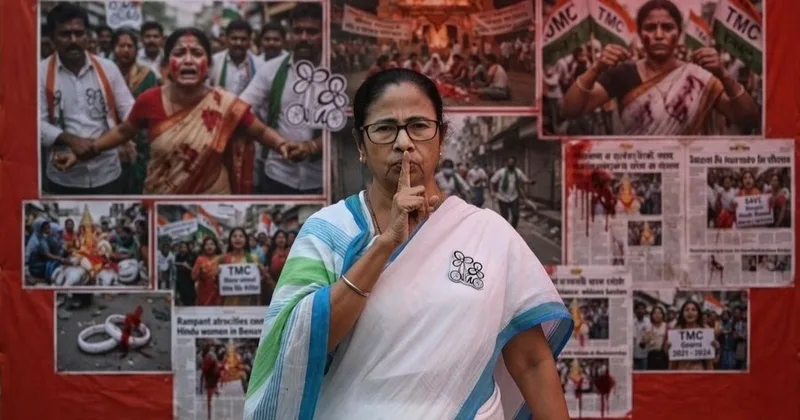
The post-election period in 2021 remains one of the most controversial phases in West Bengal’s recent history. Following the TMC’s electoral victory, widespread violence was reported across districts, including killings, arson, displacement, and allegations of sexual assault. The scale and seriousness of the incidents led to intervention by the Calcutta High Court, which ordered investigations into multiple cases. The sequence of events raised fundamental concerns about the ability and willingness of the state machinery to ensure impartial protection of citizens in a politically charged environment.
2023: Ram Navami Procession Clashes Across Districts
In 2023, communal clashes during Ram Navami processions across districts such as Howrah, Hooghly, and North Dinajpur reinforced an emerging pattern of tension around religious events. Reports documented stone-pelting, vandalism, and disruptions along procession routes. Statements suggesting that processions passing through certain areas contributed to tensions introduced a contentious dimension to the issue, effectively raising questions about the extent to which religious expression in public spaces was being constrained under administrative reasoning tied to law and order.
2024: Dhuliyan Violence in Murshidabad
The violence in Dhuliyan, Murshidabad, represented a serious breakdown of local governance, with reports of homes being looted, properties destroyed, and lives lost. Eyewitness accounts described widespread fear and displacement, with families fleeing affected areas in search of safety. The subsequent deployment of central forces underscored the severity of the situation and pointed to limitations in the initial response by state authorities. The delay in effective containment allowed the violence to escalate before control measures took full effect.
March 2025: Multiple Incidents in a Single Month
March 2025 saw multiple incidents across districts, including temple vandalism, attacks on homes, and localised communal disturbances. A notable pattern during this period was the rapid dismissal of communal angles in certain cases at very early stages of investigation. Such responses raised concerns about the depth and transparency of inquiry processes, particularly in sensitive situations where public trust depends heavily on thorough and impartial investigation.
April 2025: Surge in Reported Incidents
April 2025 witnessed a sharp rise in reported incidents across several districts, making it one of the most volatile periods in recent years. The frequency and geographic spread of disturbances suggested a pattern rather than isolated occurrences. The clustering of incidents within a short timeframe intensified concerns regarding preventive policing and long-term administrative strategy, contributing to a broader perception of instability in parts of the state.
Welfare Policies and Political Debate
State welfare policies under Mamata Banerjee have consistently prioritised schemes directed toward minority communities, including significant budgetary allocations and institutional support structures. At the same time, there is no comparable statewide framework for Hindu religious workers, such as pandits and Mandir functionaries. This asymmetry in policy design reflects a governance approach where welfare distribution appears aligned with specific demographic segments, raising persistent questions about balance, equity, and the role of electoral considerations in shaping public expenditure.
Fifteen years of governance under Mamata Banerjee have produced a deeply polarised political and social landscape in West Bengal. Recurrent communal incidents, administrative responses that have often been questioned, and policy decisions that reflect uneven prioritisation have collectively shaped the current discourse. The interplay between governance, law enforcement, and electoral strategy continues to define the state’s trajectory, ensuring that debates around neutrality, fairness, and institutional accountability remain central to any assessment of this period.