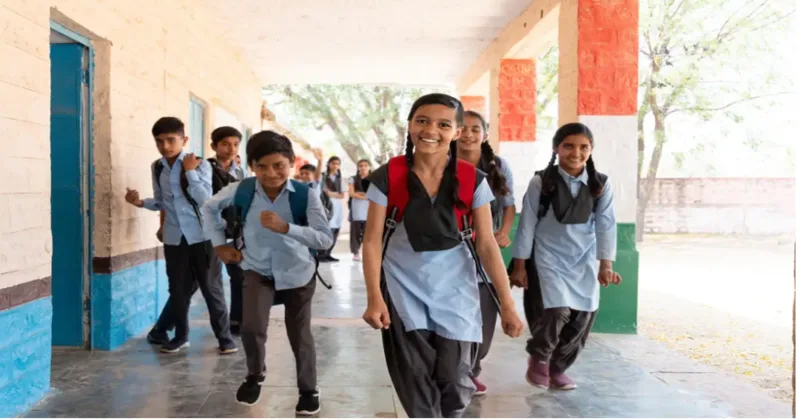
LUCKNOW: The Government of Uttar Pradesh has intensified its flagship ‘School Chalo Abhiyan’, in which it aims to ensure that every child in the 6 to 14 age group is enrolled in school and goes to classes regularly. The campaign, which began on April 1, is being implemented on a large scale under the leadership of UP Chief Minister Yogi Adityanath. The renewed focus is on bringing out-of-school children back into the education system.
Officials from the Basic Education Department have announced that the next phase of the campaign will begin from May 1, with special enrolment drives planned in labour colonies, brick kilns, and slum areas. These locations have been identified as key zones where children are more likely to remain outside formal schooling due to economic and social challenges. The aim of this initiative is to directly reach such children, including those who have never attended school or dropped out midway due to some reasons.
The campaign places strong emphasis on integrating marginalised and vulnerable groups into mainstream education. Authorities have been directed to identify children with special needs and ensure their admission into suitable institutions equipped to support them.
Particular attention is also being given to girls who have discontinued their education. Such students will be prioritised for admission in Kasturba Gandhi Balika Vidyalaya (KGBVs), which are residential schools designed to promote education among girls from disadvantaged backgrounds. This step is expected to improve female enrolment and reduce dropout rates, especially in rural and underprivileged areas.
To ensure effective implementation, Additional Chief Secretary (Basic and Secondary Education) Parth Sarathi Sen Sharma has issued strict instructions to divisional commissioners and district magistrates to achieve full enrolment of eligible children. During the first phase of the campaign (April 1 to April 15), children aged three were enrolled in Anganwadi centres and Bal Vatikas, while six-year-olds were admitted to Class 1. Simultaneously, surveys were conducted to identify children between the ages of 7 and 14 who had dropped out of school.
In the ongoing second phase, officials have been directed to accelerate efforts and personally reach out to children who were previously missed. The government has also set clear transition targets to prevent dropouts at crucial stages to ensure that the students move seamlessly from Class 5 to 6, Class 8 to 9, and Class 10 to 11.
Additionally, there is a strong push to implement provisions under the Right to Education Act (RTE). Authorities have been instructed to ensure that children selected through the RTE lottery system are admitted to private schools without delay.
Alongside enrolment drives, the state government is also focusing on strengthening school infrastructure. Initiatives such as Operation Kayakalp and Project Alankar are being implemented to upgrade facilities in government schools. Officials have been asked to conduct surveys to identify gaps in infrastructure, including classrooms, sanitation, drinking water, and other basic amenities. These gaps will be addressed using Corporate Social Responsibility (CSR) funds and other available resources.
Schools are also being onboarded onto the Vidyanjali Portal, which enables community participation and records infrastructure gaps. The government is encouraging volunteers, NGOs, and social organisations to contribute towards improving school facilities and creating a more welcoming learning environment.
The expansion of ‘School Chalo Abhiyan’ shows the state government’s broader goal of achieving universal elementary education. By combining enrolment drives with infrastructure development and community participation, the initiative is addressing both access and quality issues in the education system. With a strong push on inclusion, monitoring, and infrastructure, Uttar Pradesh is taking a comprehensive approach to ensure that no child is left behind in the journey towards education.