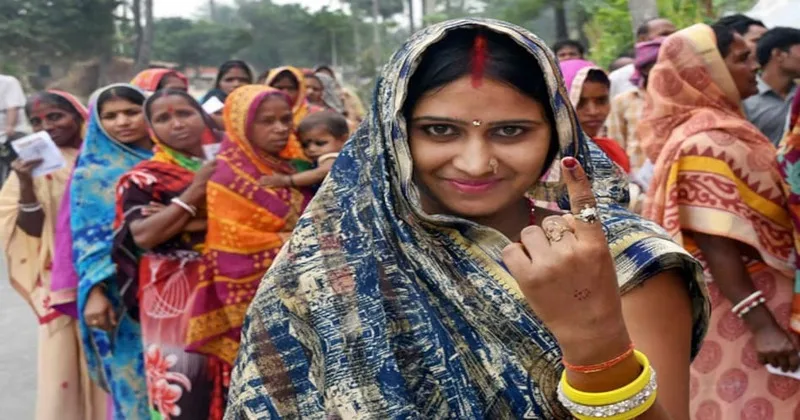
Massive, unprecedented and record-breaking 93 per cent turnout in the Phase 1 of the West Bengal elections is a welcome sign for the national security. There are very clear indications that the people of West Bengal have voted for a change in the government. 93 per cent turnout means that virtually all the eligible voters have exercised their franchise. Such a large turnout also conveys that all the sections of society have voted. It is noteworthy that such a large turnout was possible because the security forces provided a safe and enabling environment to the voters. ECI and West Bengal State Election Commission also deserve to be complimented.
In India, the local issues dominate the electoral discourse in the assembly elections. But sometimes the local issues acquire security considerations. For example, the people residing in the border states are more aware of wars and conflicts. Some states which have come out of serious insurgency and terrorism in the past are conscious that their government should check secessionist forces. This is true in the case of states like Mizoram and Tripura. The case of West Bengal is slightly different. West Bengal was under the rule of Left Front government led by CPI(Marxist) from 1977 to 2011. Since 2011, the state of West Bengal has been ruled by TMC. So, the state of West Bengal has been ruled by the parties for the last 49 years which did not place the national security as the primary concern.
West Bengal shares a 2217 km border with Bangladesh, the longest amongst the Indian states. To get a sense of the magnitude, Rajasthan shares 1075 km border with Pakistan which is completely fenced. West Bengal border with Bangladesh is a complex terrain consisting of plains, riverine areas, marshy land and ravines. About 569 km of the border is still unfenced in West Bengal because the ruling TMC government has not made the land available for fencing. Obviously, the aim of such a large stretch of unfenced border is to facilitate vote bank politics of the ruling dispensation in West Bengal through illegal immigration from Bangladesh. Among the Indian states, West Bengal has largest number of illegal migrants from Bangladesh. This fact was further substantiated by the hurdles posed by the state during the conduct of Special Intensive Revision(SIR) by the ECI.
West Bengal had its share of organised violence in the past. Naxalism originated in West Bengal from Naxalbari in the year 1967. It began as a violent response to the exploitation of tribals in North Bengal. Thereafter, Naxalism continued in various parts of the state. In the beginning of the year 2000, there was a fresh revival of Naxalite violence in districts like West Medinipur, Bankura and Purulia. By the end of the year 2011, the active Maoist threat had significantly reduced in West Bengal. But the last 15 years of TMC rule in West Bengal has witnessed political patronage to the illegal migrants from Bangladesh. With increased economic distress on the limited state resources, the state of West Bengal is an easy breeding ground for an organised unrest, armed resistance and terrorism.
Unfortunately, none of the political parties in West Bengal except the BJP have raised the issue of illegal immigration during the election campaign. That makes it easy for the ruling TMC to claim that the issue is being raised to harass the minority community. But this time around, the voters of West Bengal have realised the seriousness of the threat of illegal immigration. The limited economic resources of the state have already been stretched. In addition, the state has adopted a negative approach to Centre sponsored welfare schemes like Ayushman Bharat Scheme. With few job opportunities available in West Bengal, a large strength of the working class has migrated to various parts of the country. Their place has been occupied by the illegal migrants.
The large turnout in the Phase 1 is thus not just because of the anti-incumbency. It is a reflection of all the issues including the serious threat of illegal immigration into West Bengal. The voters of West Bengal are aware of so many new pockets of unauthorised habitat that have emerged in all the constituencies. As of now, the security threat from the illegal immigration may be benign but it has the potential to be the next major internal security threat in India after Naxalism. In the Phase 2 of the assembly elections on April 29, the voters must again vote in record numbers. This time around, it is not just a question of better governance but a mandate to strengthen the national security.