Representative Image
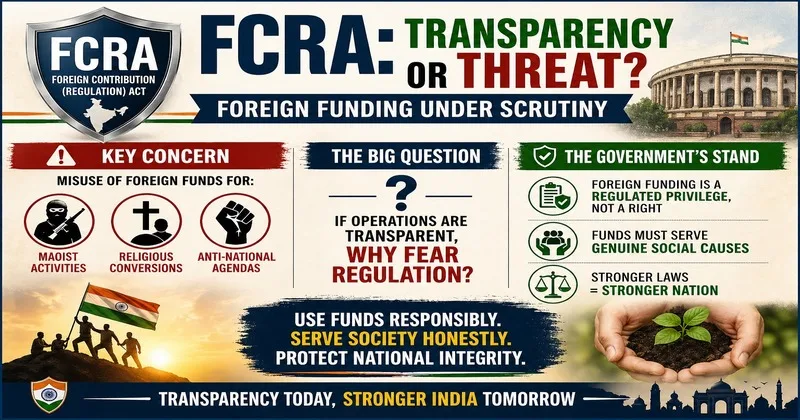
The FCRA framework emphasises transparency, accountability, and national security by regulating foreign funding in India. Proposed amendments have sparked opposition from certain political groups and minority institutions, who view them as restrictive. However, stricter oversight is justified due to past instances where foreign funds were allegedly diverted toward unlawful activities such as Maoism, religious conversions, and anti-government agendas. Investigations and government data highlight misuse by some organizations, reinforcing the need for regulation. Foreign funding is not an inherent right but a controlled privilege requiring compliance. Organizations operating lawfully have little reason for concern, as the primary objective remains ensuring proper utilization of funds.
The Foreign Contribution (Regulation) Act (FCRA) is once again at the center of a national debate. The government describes it as an essential instrument for transparency, accountability and national security; conversely, Church-backed institutions, certain minority organizations and the opposition, including the Congress party have termed it an assault on institutional autonomy. But is this truly the case, as alleged by the so-called minority institutions, the Congress and other opposition parties, who are cornering the Modi-led central government over these FCRA regulations and portraying them as being directed against minorities?
It is noteworthy that the government has not yet completely withdrawn the Foreign Contribution (Regulation) Amendment Bill, 2026 (FCRA Amendment Bill 2026), which was introduced in the Lok Sabha on March 25, 2026. However, following massive protests by opposition parties and disruptions within Parliament, the process for its enactment has been put on hold. The Bill failed to pass during the conclusion of Parliament’s Budget Session on April 2, 2026 and has been deferred. While opposition leaders are demanding its complete withdrawal, the government has not yet made an official announcement regarding its permanent revocation. For the time being, it has not been enacted into law.
In reality based on a thorough and in-depth analysis, it can be asserted that the Foreign Contribution (Regulation) Act is entirely in the national interest. The central government’s objective is to ensure that the FCRA (foreign funding), which has historically been utilized as a catalyst for anti-national forces, subversive movements, Maoism and religious conversions is henceforth channeled exclusively into genuine social service activities.
In this context, Vinod Bansal, National Spokesperson for the Vishva Hindu Parishad (VHP), states, “Amidst this entire controversy, a fundamental question arises in my mind: when thousands of other social, religious and educational institutions are operating under this very law and harbor no fear regarding the amendments, what, then, does this intensity of opposition truly signify? Is this genuinely a battle for rights, or are there deeper ideological, political, and financial interests intertwined with it?”
Bansal further asks: “Hindus constitute the majority in this country; naturally, they possess the largest number of educational institutions, social service NGOs, religious trusts, and other organizations. Yet, they have raised no objection to the Central Government’s amendments to the FCRA rules. Similarly, there are numerous organisations belonging to the Jain, Buddhist, Sikh communities and they, too, have voiced no objections. Why, then, are the Christian missionary institutions, particularly those affiliated with the Church leading this opposition? Furthermore, why are certain Islamic institutions also standing in opposition to these new regulations? What is the underlying reason? Could it be that they have been engaging in some wrongdoing all this while and are now haunted by the fear that such activities will be brought to a halt?”
It is noteworthy that, at present, the Catholic Bishops’ Conference of India (CBCI) one of the country’s largest organizations of Christian bishops is characterizing this bill as an “existential threat to minority institutions and NGOs.” The All India Catholic Union (AICU) holds a similar stance; it is a major civil representative body of the Christian community. Its argument is that, under the provisions of this bill, the government could potentially interfere with the assets of Church-run institutions an act that, it contends, violates both religious freedom and constitutional rights.
Some Members of Parliament (MPs) and leaders of the Indian Union Muslim League (IUML) have raised objections to the bill, characterizing it as a measure intended to exert pressure on minority institutions. Leaders such as E.T. Mohammed Basheer (an IUML-affiliated MP) have issued public statements warning of the negative impact this bill could have on Muslim-based NGOs and socio-educational institutions. In states like Kerala, Karnataka and Tamil Nadu, several Muslim community-based socio-educational institutions and NGOs have labeled the bill a “threat to minority institutions.” However, a pertinent question arises: if all your operations are being conducted in strict accordance with the rules and regulations, why does this fear persist? The only logical inference is that foreign funding is, in fact, being diverted toward illicit or unconstitutional activities, the exposure of which is precisely what is being feared!
Instances involving the use of such foreign funding to fuel religious conversions, support Maoist-Naxalite activities and foster an environment hostile to democratically elected governments have surfaced repeatedly across the country. Consider a recent example; the Government of India has informed the Supreme Court that funds received from abroad, ostensibly intended for developmental projects are frequently diverted to train Maoists (Naxalites) and to finance their operational activities.
The investigation into “The Timothy Initiative” (TTI) (2026) came to light this very month- April 2026 wherein the Enforcement Directorate (ED) investigated a global Christian mission named ‘The Timothy Initiative.’ This investigation centered on the suspicious withdrawal of crores of rupees via foreign debit cards in regions historically affected by Naxalism (such as Bastar and Dhamtari in Chhattisgarh). The organization was not registered under the FCRA and allegedly received foreign funds amounting to ₹95 crore illegally, which were subsequently utilized in areas affected by Maoist violence.
The case involving the Environics Trust (2024) had also recently surfaced; in this instance, the CBI has accused the Environics Trust of receiving foreign donations in Odisha under the guise of relief funds for Cyclone ‘Amphan,’ only to utilize those funds to fuel protests against the JSW Steel project. It has further been alleged that the Trust maintained links with elements espousing Naxalite ideology.
Investigative agencies (such as the NIA and ED) have discovered that, in certain instances, leaders of the banned CPI (Maoist) organisation received funds- both through extortion from businesses and contractors and via NGOs which were subsequently diverted toward the procurement of weaponry and the financing of terrorist activities. The Ministry of Home Affairs has suspended the FCRA registrations of several NGOs including the Tuticorin Diocesan Association and the Centre for Promotion and Social Concern, after their activities were found to be allegedly linked to anti-national agendas and efforts to disrupt social harmony. Numerous other cases of this nature have emerged to date, all involving allegations of religious conversions and anti-national activities, wherein the perpetrators were found to be funding their entire spectrum of illicit operations using foreign donations. When asked about this matter, Priyank Kanoongo, a member of the National Human Rights Commission (NHRC), stated that the FCRA law exists to ensure transparency regarding foreign funding entering India, specifically the processes involved and the manner in which such funds are utilized. He argued that if the government is introducing amendments to this legislation, no one should have any objection.
Kanoongo asserts, “Those who are opposing this measure seek to alter India’s demographic composition; they aim to undermine India’s sovereignty through the medium of foreign funding. Everyone ought to commend this initiative by the government. From the perspective of human rights protection, this constitutes a highly significant step. Engaging in, or facilitating, religious conversions through the power of money constitutes a violation of fundamental human rights. We fully support this move by the government.”
He further added, “Following the introduction of transparency within the FCRA framework, we discovered how the Rajiv Gandhi Foundation, an NGO associated with Sonia Gandhi and Rahul Gandhi was utilizing Chinese funds brought into India to engage in divisive activities. In a nation of 1.4 billion people, if you are undertaking social service work, you must possess credibility. India faces no dearth of donors. If you work for the betterment of the nation, there will be no need to depend on foreign funding; conversely, if you do require foreign funding, you must clearly articulate the specific work you intend to undertake.”
The government’s stance mirrors this sentiment; if an organization is operating with complete transparency, why should it fear strict scrutiny? The government has also explicitly clarified before the Supreme Court that unregulated foreign funding poses a potential threat to national sovereignty.
A glance at the statistics renders the picture even clearer. According to the Ministry of Home Affairs, approximately 15,000 organizations currently hold valid FCRA registrations. Conversely, the registrations of nearly 22,000 organizations have been revoked, while the registrations of approximately 15,000 others have lapsed due to a failure to renew them. These figures demonstrate that the government has undertaken large-scale action, and that such measures are not confined to any single specific group. It is also worth noting that, under the law, receiving foreign funding is not a fundamental right. It is a regulated privilege, granted subject to government permission and oversight. If they so choose, organizations can continue their operations using local resources. All in all, if you require foreign funding, by all means, accept it; however, utilize it with transparency, that is all the government asks of you.
