When we wish to dig into the vast storehouse of knowledge, it is not to our own languages that we turn. Anyone who is seeking knowledge turns to the West where, by now, an enormous amount of knowledge has been generated and more is being generated every day. We import knowledge, and frequently contribute to this Bharatiya tradition of knowledge, whether in the form of science or practical in the form of technology. The status of Samskrit in this knowledge syndrome and its role in the growth of Bharatiya knowledge system is vast and exemplary.
Bharatiya civilisation, cradled in the lap of Samskrit formed its spirit, binding different peoples projecting national solidarity. It is the voice of Bharat’s spirit and her wisdom. There was a time when Asian scholars with a deep understanding of Samskrit would come to famed Bharatiya institutions to soak and absorb the fabulous thought processes in beautiful expressions from Upanishads, Ramayan, Mahabharat and other epics and texts that have exercised fascination for centuries. Pythagoras, the Greek mathematician and philosopher of 6th century BC learnt his geometry basics from the Shulba Sutras. Arthashastra, the treatise or polity, was discovered as late as 1909 due to the efforts of Samskrit scholars. There are any number of documents and texts that are waiting to be discovered and understood that will have a bearing on our lives. We lose the ideas if Samskrit goes out of usage.
Samskrit is all the more needed today, both with short and long-term perspectives. Down the ages, it gradually went out of practice and today we ask – what is its relevance in today’s wealth creating patterns, introduced by the swirling winds of open market economy resulting in globalisation?
Tapping Into The Vast Knowledge
In our sacred texts, we find that our ancestors have welcomed the questions. The Upanishads and Bhagavadgita answer many questions of life. In Prashnopanishad, the six disciples discuss some of the toughest ideas about nature, God and the universes with their teacher. If we take up topics of public administration, science, management, mathematics or astronomy, we may be in a position to argue in a very similar fashion.
There is ample material available to indicate that impressive advances were made in the past in chemistry, mathematics, astronomy, botany and several other fields. Books already exist which give us what is called a history of Hindu chemistry. The relevance of the study of Samskrit should be evident in the case of humanities also.
From time immemorial, this land is called ‘Bharat’, a Samskrit word meaning (a nation) immersed in the light of knowledge. But since colonisation, it became more known as India. We were forced to forget Samskrit language and hence, today, we have to retrieve the real ‘Bharat’ ie the knowledge treasure of this land. Samskita is the key to that treasure house.
Self-esteem is one of the most important factors in the development of an individual, community and nation. Enhancement of self-esteem of a nation happens by acknowledging its past achievements and strengths and transmitting these experiences down the generations.
Knowledge is now being acknowledged as the key factor for societies to progress and for economies to grow. Since scientists and ‘thought leaders’ do not know Samskrit, they are not in a position either to decode and unearth the knowledge hidden in Vedas, Shastras and other Samskrit works or even to estimate and appreciate it. That is the biggest handicap in the much-required Knowledge Explosion. Bharat can prosper and enlighten the world only by overcoming the mighty challenge of language handicap. We need Samskrit more than ever to lead the ‘Knowledge Globe’.
Past Relic Or Treasure House?
The issue is pretty basic: Should we look upon Samskrit as a relic of the past or as a treasure house of traditional Bharatiya knowledge?
There are five million manuscripts in Bharat. Even after leaving apart the duplications, 96 per cent of them are unedited and unpublished. Even catalogues are not prepared. They are written in 14 ancient scripts which are known by very few people. That is the state of affairs of the knowledge heritage of Bharat at present! While some of them are copies of manuscripts available elsewhere, there is reason to believe that more than a quarter is important enough to deserve to be published and made available to the community of scholars.
Undoubtedly our repository of knowledge is all preserved and buried in the medium called Samskrit. More than 60 per cent of the vocabulary of most of the Bharatiya languages is derived from Samskrit. Hence, it is complementary to all Bharatiya languages. Samskrit can help in preserving regional languages of Bharat undiluted.
Samskrit is an effective instrument of social harmony. It can eradicate differences of caste, sect, gender and region. On the other hand, the existing infrastructure for imparting Samskrit education is abysmal. It is not the Government, but each one of us, who must realise the benefits that can accrue from our ancient wisdom and to bring interesting ideas from the Samskrit texts into the mainstream. It we make a conscious effort to take forward this movement, the relevance of the language and its utility in these trying times will be as attractive as English.
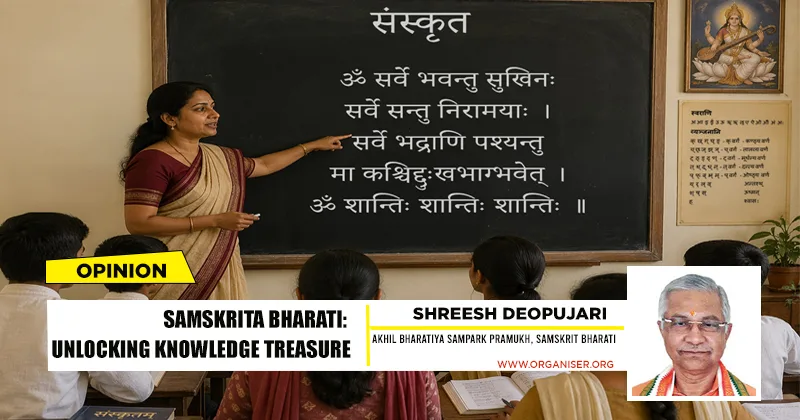
Towards this end, Samskrita Bharati is doing yeoman service in promoting Samskrit as spoken language. Their classes are participative through oral drills and situational conversations with a unique methodology of teaching, making it easy for the learners. Software professionals from Oracle, Intel and Mphasis etc have appreciated these courses conducted in their premises. So, it is an appeal to all professionals to share their precious time to learn the very invaluable Samskrit. The enfoldment of our ancestral knowledge will influence the present world and make it a better place to live. One may be a doctor, an engineer, a manager, an advocate, a CEO, that does not matter, one must enrich their knowledge from Samskrit. Start learning Samskrit from today itself.