When Prime Minister Narendra Modi moved the Constitution (One Hundred and Twenty-Eighth Amendment) Bill in a Special Session of Parliament on September 19, 2023 closed an ignorant chapter of Congress party. The Nari Shakti Vandan Adhiniyam (106th Constitutional Amendment Act, 2023), reserving one-third of all seats in the Lok Sabha, State Assemblies and the Delhi Assembly for women, ended thirty years of broken promises of opposition parties. The BJP led NDA brought the Constitution (131st Amendment) Bill, forward in letter on 16th April, 2026 and in spirit of voting on 17th April,2026 it was rejected and obstructed the role reservation of women’s in legislature. The opposition which buried it session after session, will now have to face the anger of women not just in the 2029 Lok Sabha elections but at every level, in every election and at every place.
Three Decades of Betrayal
The Women’s Reservation Bill was first placed before Parliament in 1996. For twenty-seven years, Congress-led governments introduced it, debated it and abandoned it, a hostage to coalition arithmetic and political cowardice. Prime Minister Narendra Modi convened a Special Session in the newly inaugurated Parliament, adorned with the Sengol and steered the Bill to near-unanimous passage with 329 votes in the Lok Sabha, 214 in the Rajya Sabha. He said “his government commitment is iron-clad, no matter what opposition we may face, we will continue to strive to empower women and ensure their representation in legislative institutions”. That promise is now written into the Constitution itself as Articles 330A and 332A.
Ardhanarishvara: Nari is Half of Existence
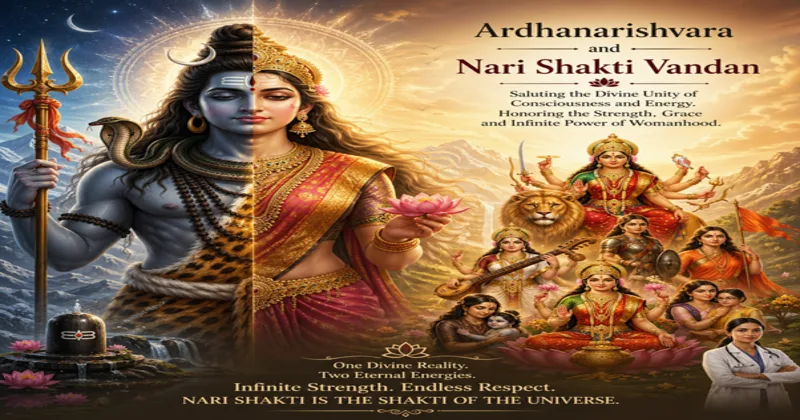
Today global civilisation prides itself on progress, yet it struggles toward a completeness, that Shiva Darshan established in timeless antiquity. We limit ourselves to Bills and political discourse, while real progressivism lives in the Ardhanarishvara form we have confined to rituals. The Shaivite concept of Ardhanarishvara, where Shiva and Shakti as one indivisible being is not a religious image but also a profound political statement, Shakti requires no privilege because she is already the inseparable half of Shiva’s existence. Where Shiva and Shakti’s participation is natural and inevitable. Governance without women is as incomplete as Shiva without Shakti. The word ‘Vandan’ means reverence in the Act’s, title makes this explicit, this is not empowerment granted from above, it is the State acknowledging what Bharatiya civilisation always knew. As long as we speak the language of giving women rights, equality will remain on paper. Real justice begins when we accept Nari with the consciousness of Ardhanarishvara.
Ending Dynasty: The Lesson of Ganesha and Kartikeya
The deepest fault of modern Indian politics is vanshawaad and the desire to build empires of comfort for one’s own children. Every political family wants to secure wealth and palaces for its progeny. But Shiva who is Sarvashaktimaan neither lived in a mahal himself nor built one for Ganesha or Kartikeya. This is Shiva’s most imporatnt message that merit is not born in luxury but in responsibility and struggle. Ganesha became master of Riddhi-Siddhi and Kartikeya the Devasenaapati not through palace-protection but through proof of their own buddhi and parakrama. Shiva Darshan says the true ‘varis’ earns his place through guna, not through the mahals a father has built. The delimitation and Nari Shakti Vandan will have structurally dismantles this dynastic model through women’s representation via reserved seats, it will have compelled parties to field women on the strength of their own connect and competence not as surrogates for male patrons.
Kailash over Kothi: Transparent Governance and Nature Wisdom
Modern politics turned satta into a synonym for Lutyens walls, creating an opaque chasm between the ruler and the ruled. Against this, Shiva’s culture is to dwell in nature and open among his gana. The lutyens is the symbol of Elitism, the open mountain is the symbol of transparency and simplicity. Shiva teaches that only one who lives with prakriti can truly feel the real suffering of the people. Today environmentalists speak of sustainable living whereas Shiva was its aadi-praneta. His residence on Kailash is the message that development does not mean concrete jungles but coexistence with nature. The rotation has reserved constituencies after each delimitation, reaching women’s representation into the most remote corners of Bharat, from Lutyens walls to the village square. The Modi government rule for a decade already mirrors this philosophy through 1.4 crore Lakhpati Didis, 10 crore Ujjwala households, 29 crore women with Jan Dhan accounts.
Sabke Beech Sabke Jaise: The Gana Principle and Real Democracy
The most revolutionary aspect of Shiva Darshan is where Shiva resides, there to reside his gana, bhoot, pret, pishach and the most ordinary jiva. Shiva built no VIP Zone, no special protocol. In his courtyard the tiger and the bull are both safe, the peacock and the serpent coexist without enmity. This is sadhana where the powerful is not the predator of the weak but the sahchar the companion. When the ruler lives ‘among the people and as the people’ the roots of untouchability are removed at the source. If today jan-pratinidhis could summon the courage to stand on the same dharataal (ground) as their gana (citizen) are, half the problems of Indian democracy would dissolve. Article 332A of the Adhiniyam embodies this principle, simultaneous reservation for women from SC and ST communities ensures that Dalit and Adivasi women the most marginalised among the marginalised to receive their guaranteed share of political power.
Ganesha Mooshak: Technology Must Serve the Last Woman
Where today we celebrate Artificial Intelligence as our greatest achievement, the form of Ganesha with his transplanted head and his vahana the mooshak teaches a timeless lesson of the greatest intellect (High Tech) must remain in taalmail with the most micro unit of society, the Last Man. The mighty Ganesha, master of Riddhi-Siddhi, rides the smallest creature. This meeting of technology and ground-level reality is what keeps society in balance. The Modi government’s Drone Didi scheme training rural women farmers to operate agricultural drones is this lesson made policy, the highest technology in the hands of the woman tilling the last acre of the last village. The Bill would have ensures that woman will also sit in the Parliament that funds the drone.
The Opposition: Women’s Anger Has a Long Memory
The same political formations that today stand on women’s rights are those whose obstruction buried the Bill across six parliamentary sessions. They disrupted, delayed and weaponised sub-quota demands as poison pills to kill it. The BJP government brought it forward in letter and spirit delivering what those parties never could or would. The opposition will have to face the anger of women not just in 2029, but at every level, in every election and at every place. The women of Bharat have long memories. They remember who fought and who stalled for thirty years. The BJP’s commitment remains unshakeable, no matter what opposition party has faced, it will continue its support to empower women and ensure their representation in every legislative institution.
Shiva as the Adi-Samvidhan
We have long been entangled in the so-called progressivism of bringing Bills and staging opposition. Even those who invoke Shiva’s legacy often abandon his democratic and humane Darshan, losing themselves in karmakand. Shiva’s path teaches that progress is not tall buildings or personal luxury or empires for one child. It is building a society where the ruler and his gana stand on the same dharataal (ground). Shiva is the Adi-Samvidhan the primordial Constitution. In enshrining Nari Shakti in India’s actual Constitution through the 106th Amendment, Prime Minister Modi government has done what no Congress ministry dared in seven decades, it has brought that ancient truth from the mandir into the parliament house, from ritual into rights. To adopt Shiva’s harmonious form in life and in governance is the real progress of modern Bharat and that journey is now written permanently into the Constitution.